Companies Mentioned
Why It Matters
Marketers must reassess budgets and compliance strategies as AI reshapes risk‑reward dynamics, and the emerging MyTerms framework could redefine data consent and the balance of power in digital advertising.
Key Takeaways
- •AI now ranks above regulation as top marketer risk
- •WFA study covers $61 B spend across 39 firms
- •IEEE SA's P7012 “MyTerms” enables machine‑readable consumer consent
- •Symmetric data flow could reshape “surveillance capitalism” in advertising
- •New “Agent/c” model proposes consumer‑first digital agents
Pulse Analysis
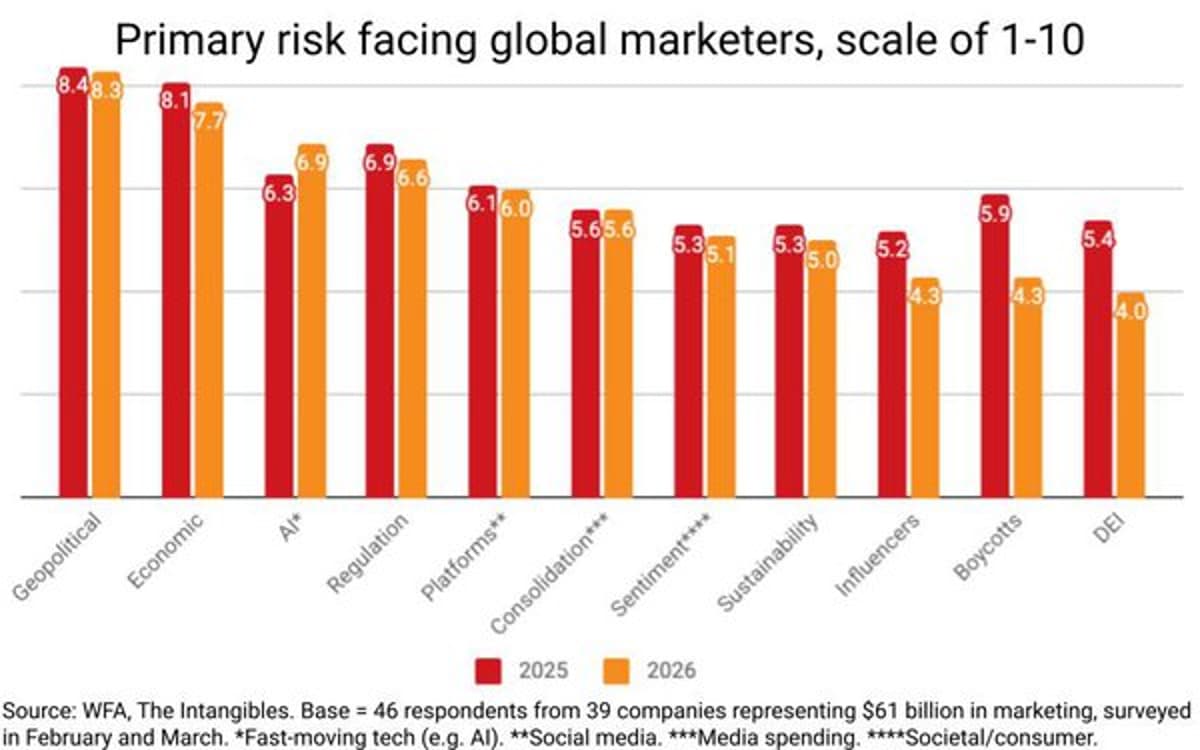
The World Federation of Advertisers (WFA) released its latest Global Risk Barometer, revealing that fast‑moving technology—chiefly artificial intelligence—has surged to the top of marketers’ risk charts. The survey, conducted with 46 respondents from 39 companies responsible for roughly $61 billion in annual ad spend, shows AI now eclipses regulatory tightening as the most pressing concern. This shift reflects the rapid integration of generative AI tools into campaign creation, media buying, and consumer targeting, forcing brands to grapple with algorithmic bias, data privacy, and the volatility of emerging platforms.
Parallel to the WFA findings, the Institute for Advertising Ethics (IAE) partnered with the IEEE Standards Association (IEEE SA) for a summit focused on the ethical dimensions of AI‑driven advertising. Attendees highlighted the newly minted IEEE SA P7012 standard, branded “MyTerms,” which creates a machine‑readable consent layer between consumers and brands. By standardizing how user preferences are communicated, MyTerms promises a more symmetrical information flow, countering the asymmetry that underpins today’s surveillance‑capitalism model. The standard’s collaboration with Project VRM and the broader “agentic era” narrative signals a move toward consumer‑first data governance.
For marketers, the convergence of heightened AI risk and emerging consent infrastructure presents both a challenge and an opportunity. Companies that embed MyTerms and similar protocols into their tech stack can differentiate themselves as trustworthy, potentially unlocking new audience segments. At the same time, the industry is experimenting with novel agency structures—dubbed “Agent/c”—that act as consumer‑centric digital representatives. Embracing these models could mitigate AI‑related uncertainties while capitalizing on the efficiency gains AI offers, positioning firms to thrive in an increasingly volatile advertising landscape.
It's Fast-Moving Tech, Stupid
Comments
Want to join the conversation?
Loading comments...