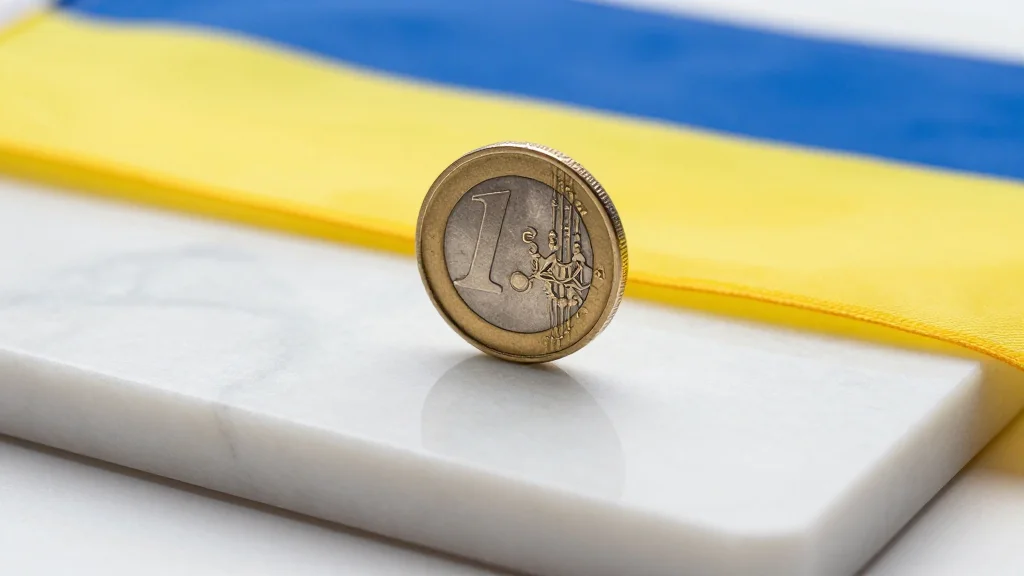
EU Approves $105 Billion Loan to Ukraine, Deepening Financial Commitment

Companies Mentioned
Why It Matters
The €90 billion loan represents a watershed moment for European fiscal policy, demonstrating the EU’s willingness to mobilise massive capital in response to geopolitical crises. By tying the aid to specific defence and energy projects, the package not only bolsters Ukraine’s resilience but also creates a pipeline of contracts for European firms, potentially reshaping sectoral dynamics within the Euro‑stock universe. Moreover, the financing structure—EU‑wide borrowing backed by member‑state guarantees—raises questions about debt sustainability and the balance of fiscal responsibility across the bloc. Investors will be parsing how the loan impacts sovereign‑bond spreads, especially in peripheral economies, and whether the increased fiscal outlay will spur a broader shift toward risk‑on sentiment in European equities.
Key Takeaways
- •EU formally approved a €90 billion ($105 billion) loan for Ukraine, the largest single‑year aid package to date.
- •Hungary lifted its veto, enabling the 20th round of EU sanctions against Russia to pass alongside the loan.
- •President Zelenskyy described the aid as a "strategic security arrangement" covering air defence, energy and food security.
- •The loan is expected to tighten Euro‑zone sovereign‑bond yields while boosting defence and energy sector stocks.
- •Disbursement will be linked to specific reconstruction projects, with the European Commission reporting progress in June.
Pulse Analysis
The EU’s decision to unlock €90 billion for Ukraine signals a decisive pivot from ad‑hoc aid to a structured, multi‑year financing strategy. Historically, European financial support for Kyiv has been fragmented, often hampered by divergent national interests. By securing a unified loan, the bloc not only strengthens its geopolitical clout but also creates a fiscal instrument that can be leveraged to influence market dynamics. The immediate effect is likely a modest uptick in Euro‑Stoxx 50 components tied to defence and infrastructure, as procurement pipelines open and investors price in new revenue streams for firms like Airbus and Siemens Energy.
However, the financing model carries hidden costs. The loan will be serviced through EU borrowing, which could modestly raise yields on benchmark German Bunds and peripheral sovereigns, especially if markets perceive an increased debt burden on fiscally constrained members. This tension between strategic solidarity and fiscal prudence may surface in upcoming budget debates in countries such as Italy and Spain, where debt sustainability remains a political flashpoint.
In the longer view, the loan could act as a catalyst for a broader re‑allocation of capital toward resilience‑building assets across Europe. As Ukraine rebuilds its grid and modernises its defence capabilities, European suppliers stand to gain, potentially reshaping the competitive landscape in sectors that have been under pressure from slower growth cycles. Investors who can identify the firms best positioned to capture these contracts may benefit from a sustained rally, provided the EU manages the fiscal side‑effects without triggering a market backlash.
EU Approves $105 Billion Loan to Ukraine, Deepening Financial Commitment
Comments
Want to join the conversation?
Loading comments...