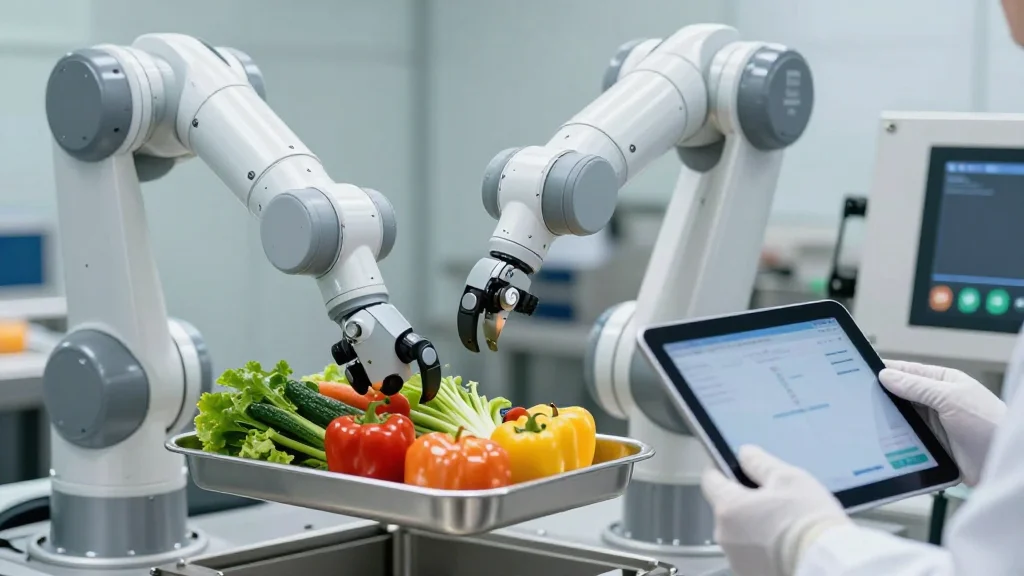
Modernization Investments Improve Operator Safety

Why It Matters
Enhanced safety lowers injury costs, improves labor retention, and enables faster, more reliable production in a competitive food market.
Key Takeaways
- •Digital HMIs reduce visual clutter, improve situational awareness
- •Training modules on iPads accelerate onboarding and skill retention
- •Automation investments cut manual lifting, lower ergonomic injuries
- •New ISO 10218‑2025 standards simplify robot safety integration
- •Line redesigns increase spacing, supporting higher speeds safely
Pulse Analysis
The food sector’s safety agenda is now driven by digital transformation. High‑performance HMIs built to ISA‑101 standards use grayscale baselines and color only for alarms, cutting visual noise and sharpening operator focus. Platforms like QAD Redzone bundle learning modules, video work instructions, and tablet‑based SOPs, creating a centralized knowledge hub that shortens onboarding cycles and supports continuous upskilling. This convergence of intuitive interfaces and accessible training reduces human error and aligns with stricter OSHA compliance expectations.
Automation is the next pillar of risk mitigation. Tyson Foods’ multi‑billion‑dollar automation rollout and the rapid adoption of collaborative robots from Universal Robots illustrate how manufacturers replace repetitive, injury‑prone tasks with flexible, software‑driven solutions. The 2025 revision of ISO 10218 provides clearer safety requirements for robot manufacturers and end‑users, easing integration and fostering confidence in robotic cells. Vendors are bundling risk‑assessment services, enabling plants with limited engineering resources to deploy cobots safely and quickly, thereby cutting labor costs and ergonomic incidents.
Physical plant design remains essential as line speeds climb. Post‑COVID spacing guidelines have become permanent, with firms like the Stellar Group redesigning layouts to lengthen lines or create parallel stations, ensuring operators retain safe clearances even at higher throughput. These design choices, coupled with barrier installations and ergonomic workstations, balance the push for productivity with a genuine commitment to workforce wellbeing. By integrating digital training, advanced robotics, and thoughtful line architecture, food processors can achieve a resilient, safe, and efficient manufacturing environment.
Modernization Investments Improve Operator Safety
Comments
Want to join the conversation?
Loading comments...