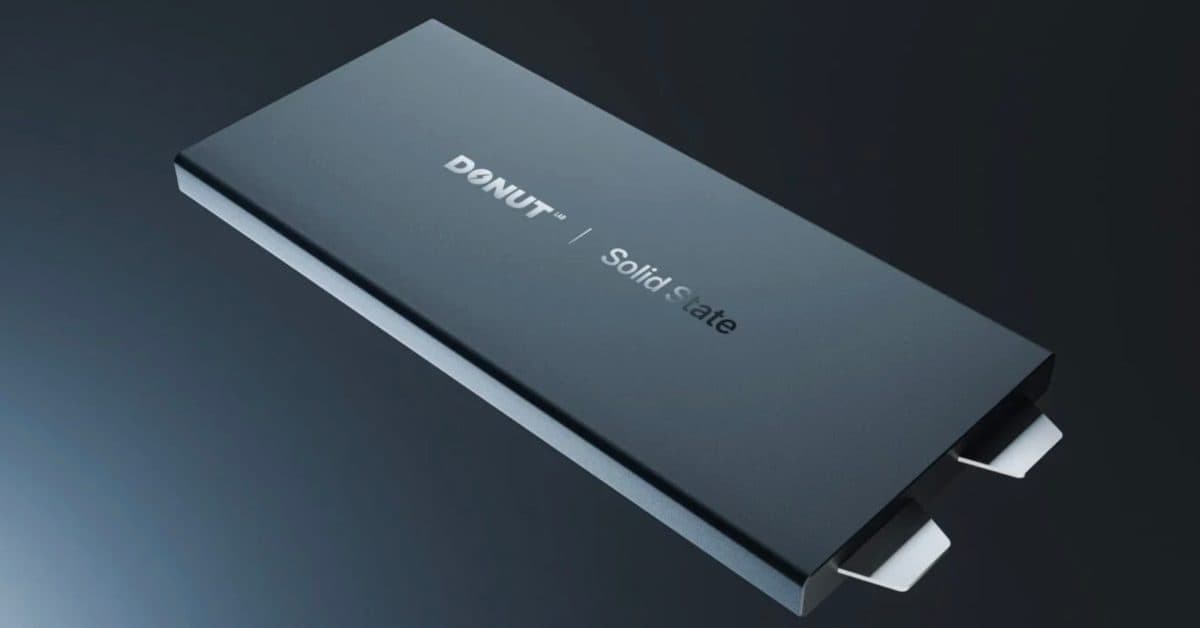
Donut Lab Solid-State Battery Retains 97.7% Charge After 10 Days in Third Test
•March 9, 2026
0
Companies Mentioned
Why It Matters
Demonstrating low self‑discharge builds confidence for commercial rollout, yet without verified energy density and longevity the battery’s market disruption remains uncertain.
Key Takeaways
- •VTT test shows 97.7% capacity after 10 days.
- •Initial voltage drop due to relaxation, not self‑discharge.
- •Self‑discharge extrapolates to 5‑7% per month.
- •Independent reports confirm fast charging and high‑temp tolerance.
- •Energy density and cycle‑life claims remain unverified.
Pulse Analysis
Solid‑state batteries promise higher safety and lower self‑discharge than liquid‑electrolyte lithium‑ion cells, but real‑world data is scarce. VTT’s latest experiment on Donut Lab’s DL1 cell provides a concrete data point: after charging to roughly half capacity, the cell lost only 0.3 Ah over ten days, with a rapid initial voltage dip that stabilised after the first hour. This behaviour aligns with the expected relaxation effect rather than continuous parasitic loss, suggesting the solid electrolyte does indeed curb long‑term self‑discharge.
When benchmarked against conventional Li‑ion chemistry, the 97.7% retention translates to an estimated 5‑7% loss per month—slightly higher than the best‑in‑class lithium‑ion modules that hover around 1‑2% after the initial 24‑hour drop. The discrepancy stems from the short test window; a longer idle period would better isolate true steady‑state loss. Nevertheless, the flat voltage curve after the first ten hours indicates the cell’s self‑discharge rate could be competitive, making it suitable for applications where standby power matters, such as electric motorcycles or grid‑storage modules.
The broader significance lies in the pattern of independent validation. VTT has already confirmed Donut Lab’s fast‑charging (11C) and high‑temperature tolerance (up to 100 °C), yet the most contentious claims—400 Wh/kg energy density and 100,000‑cycle life—remain unverified. As the company races to ship Verge Motorcycles in Q1 2026, investors and OEMs will watch for weight‑based energy metrics and long‑term cycling data. Until those benchmarks are independently proven, the battery is positioned as a promising solid‑state prototype rather than a market‑changing product.
Donut Lab solid-state battery retains 97.7% charge after 10 days in third test
0
Comments
Want to join the conversation?
Loading comments...