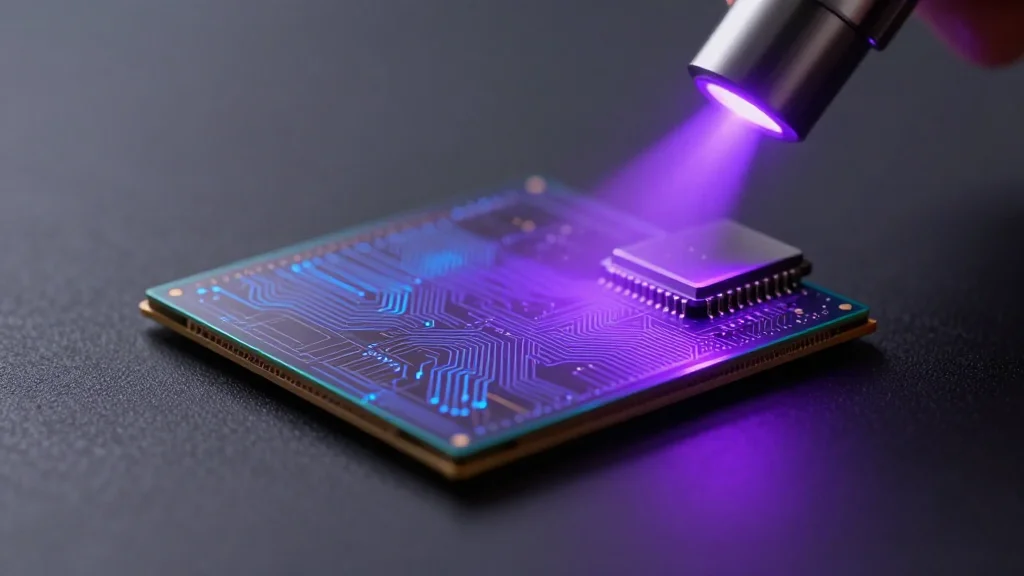
EUV ETF: The Chip-Making Technology Fueling AI
Companies Mentioned

Why It Matters
The fund lets investors bet on the indispensable manufacturing step behind AI and high‑performance chips, while its concentration risk highlights broader supply‑chain vulnerability in semiconductor capex cycles.
Key Takeaways
- •ASML's EUV machines cost over $200 million each.
- •EUV ETF gives concentrated exposure to ASML, TSMC, Samsung, equipment suppliers.
- •AI chip demand drives rising need for EUV lithography capacity.
- •Geopolitical limits on China boost EUV as a Western tech bet.
- •ETF's heavy ASML weighting creates volatility risk tied to capex cycles.
Pulse Analysis
Extreme ultraviolet (EUV) lithography has become the linchpin of modern semiconductor manufacturing. By projecting 13.5‑nanometer wavelength light onto silicon wafers, EUV can etch billions of transistors at 7 nm nodes and below, a prerequisite for the most powerful AI accelerators such as Nvidia’s H100 and Apple’s M4. The technology’s precision enables higher transistor density, lower power consumption, and the performance margins that drive data‑center and edge‑computing growth. Because only one supplier—Dutch firm ASML—produces machines capable of this scale, the entire advanced‑chip ecosystem now hinges on a single, high‑cost capital asset.
The EUV ETF (ticker EUV) translates that strategic importance into a tradable basket, weighting heavily toward ASML while also holding the primary EUV users—TSMC and Samsung—and ancillary equipment makers like Applied Materials and Lam Research. Compared with broader funds such as SMH or SOXX, EUV offers a more concentrated play on the equipment layer rather than chip design, delivering higher conviction exposure to the supply‑chain bottleneck. Investor interest has surged, reflected in over 2,600 monthly page views, as AI‑driven chip demand, U.S. export curbs on China, and the spillover from the DRAM ETF collectively amplify the fund’s relevance.
Concentration risk remains the ETF’s chief downside; ASML alone accounts for a sizable share, so regulatory shifts, trade disputes, or a slowdown at its biggest customers could trigger outsized volatility. Moreover, EUV machines cost upwards of $200 million and require a global network of 5,000 suppliers, making the sector highly sensitive to semiconductor capex cycles. For investors who view AI infrastructure as a long‑term growth engine, the EUV ETF provides a unique avenue to capture the indispensable manufacturing step that underlies both logic and memory chips. Careful position sizing and a view on macro‑technology policy are essential to manage exposure.
EUV ETF: The Chip-Making Technology Fueling AI
Comments
Want to join the conversation?
Loading comments...