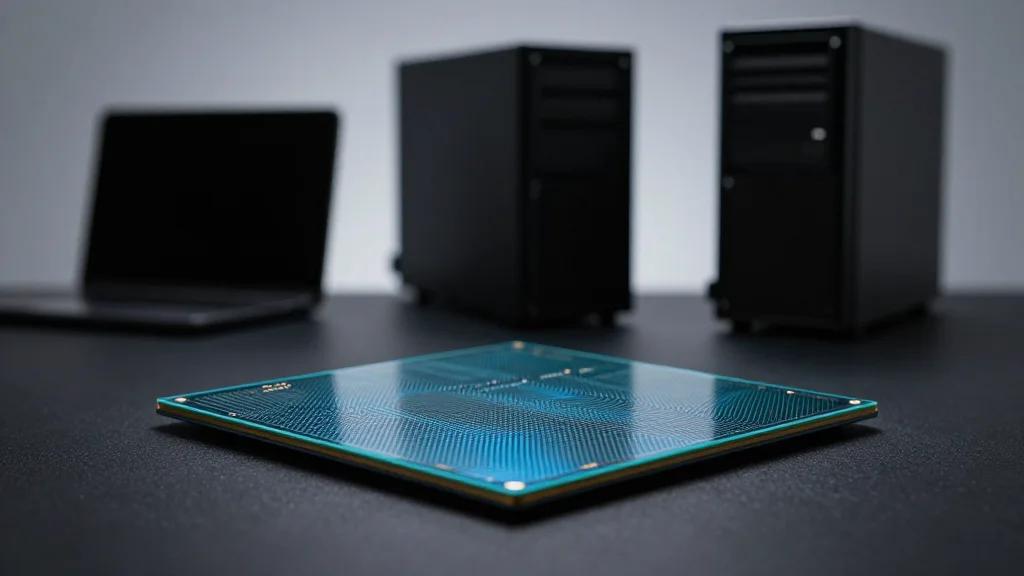
Intel to Showcase 18‑Angstrom Chip Family at Computex 2026, From Handhelds to 288‑Core Servers

Companies Mentioned

Why It Matters
Intel’s decision to align handheld, desktop and server silicon around a single 18‑angstrom process signals a strategic shift from pure integrated device manufacturing to a broader foundry model. By offering a U.S.-based advanced node, Intel aims to attract customers concerned about supply‑chain resilience and geopolitical risk, potentially reshaping the global semiconductor ecosystem. The move also reflects the growing importance of CPU‑centric AI workloads. As AI inference workloads migrate from GPUs to CPUs, Intel’s integrated Xe3 GPU and NPU blocks, combined with massive core counts, could give it a competitive edge in data‑center and edge applications, challenging the dominance of AMD and Nvidia in those segments.
Key Takeaways
- •Intel will preview Panther Lake handheld, Nova Lake desktop and Clearwater Forest server chips at Computex 2026 on June 2.
- •All three products are built on Intel’s 18‑angstrom (1.8 nm) RibbonFET and PowerVia process, the most advanced US‑made node.
- •Panther Lake handheld uses a 14‑core CPU (2P+8E+4L) and a 10‑ or 12‑core Xe3 GPU with a 25‑80 W power envelope.
- •Nova Lake scales to 52 cores, supports LGA 1954 socket, Thunderbolt 5, Wi‑Fi 7, and a 35‑175 W power range.
- •Clearwater Forest server packs 288 Darkmont efficiency cores, 12 chiplets, and a 17 % IPC uplift over the prior generation.
Pulse Analysis
Intel’s Computex reveal is less about a single product launch and more about a platform play. By unifying its handheld, desktop and server offerings on the 18A node, Intel is attempting to create a virtuous cycle: design wins in one segment can feed engineering momentum in the others, reducing R&D duplication and accelerating time‑to‑market. This mirrors the approach taken by TSMC, which leverages a single process to serve a diverse customer base, but Intel adds a geopolitical twist by emphasizing domestic production.
The timing aligns with a broader industry pivot toward AI‑centric workloads that favor CPUs with integrated accelerators. Intel’s Xe3 GPU and NPU, delivering 180 TOPS on Panther Lake, suggest the company is betting on heterogeneous compute to stay relevant against GPU‑only solutions from Nvidia. If the performance claims hold up, Intel could capture a slice of the burgeoning AI inference market, especially in edge and cloud‑native scenarios where power efficiency and integration matter more than raw GPU throughput.
However, the strategy carries risk. Intel must prove that its 18A node can match or exceed TSMC’s yield and performance metrics, or else third‑party designers may continue to favor the Taiwanese foundry despite supply‑chain concerns. Moreover, the lack of disclosed pricing leaves analysts uncertain about the economic viability for OEMs. The upcoming benchmarks and design‑win announcements at Computex will be the first real test of whether Intel’s foundry ambitions can translate into sustainable revenue beyond its traditional IDM business.
Intel to Showcase 18‑Angstrom Chip Family at Computex 2026, From Handhelds to 288‑Core Servers
Comments
Want to join the conversation?
Loading comments...