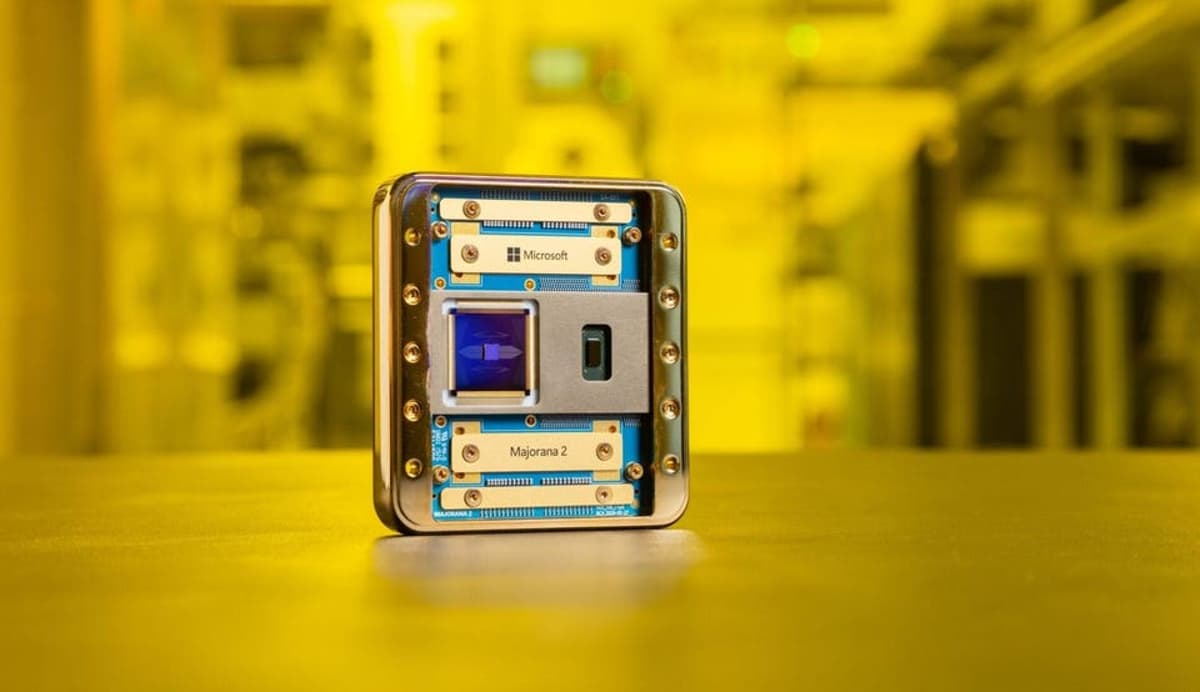
Microsoft Says It Will Have A Useful Quantum Computer In Three Years
Companies Mentioned


Why It Matters
A 2029 target compresses the timeline for commercial quantum advantage, forcing rivals to speed up development and potentially reshaping enterprise computing, cryptography, and AI workloads.
Key Takeaways
- •Majorana 2 achieves 20‑second qubit coherence, 1,000× previous generation
- •Microsoft now targets a useful quantum computer by 2029, earlier than 2033
- •Topological qubits provide hardware‑level error protection, differentiating Microsoft’s approach
- •Industry rivals like Quantinuum and D‑Wave also announce major quantum milestones
Pulse Analysis
Microsoft’s latest quantum chip, Majorana 2, marks a decisive step toward practical quantum computing. By extending qubit coherence to 20 seconds—a thousand‑fold improvement over its first‑generation device—the firm demonstrates that topological qubits can mitigate the fragile nature of quantum states. This hardware‑based error protection reduces the need for complex error‑correction algorithms, potentially lowering the cost and energy footprint of future quantum processors. The shift from a 2033 to a 2029 horizon reflects both internal confidence and external pressure as competitors race to commercialize quantum advantage.
The topological approach, championed by Microsoft for years, contrasts with the superconducting qubits favored by IBM and Google and the annealing systems of D‑Wave. While topological qubits remain less mature, their inherent robustness could simplify scaling to millions of qubits, a prerequisite for tackling real‑world problems such as drug discovery, materials design, and cryptographic analysis. Analysts note that Microsoft’s partnership ecosystem—spanning Azure cloud services and DARPA collaborations—positions it to monetize quantum capabilities through hybrid cloud offerings, accelerating adoption across finance, logistics, and AI research.
Industry observers see Microsoft’s accelerated timeline as a catalyst for broader investment. Quantinuum’s $1.68 billion IPO and JPMorgan’s joint quantum‑AI platform underscore the growing convergence of finance and quantum tech. If Microsoft delivers a usable quantum machine by 2029, it could trigger a wave of enterprise pilots, prompting a re‑evaluation of data‑security protocols and prompting regulators to address quantum‑ready encryption standards. The race is now less about who builds the first quantum computer and more about who can integrate it into existing cloud and AI infrastructures at scale.
Microsoft Says It Will Have A Useful Quantum Computer In Three Years
Comments
Want to join the conversation?
Loading comments...