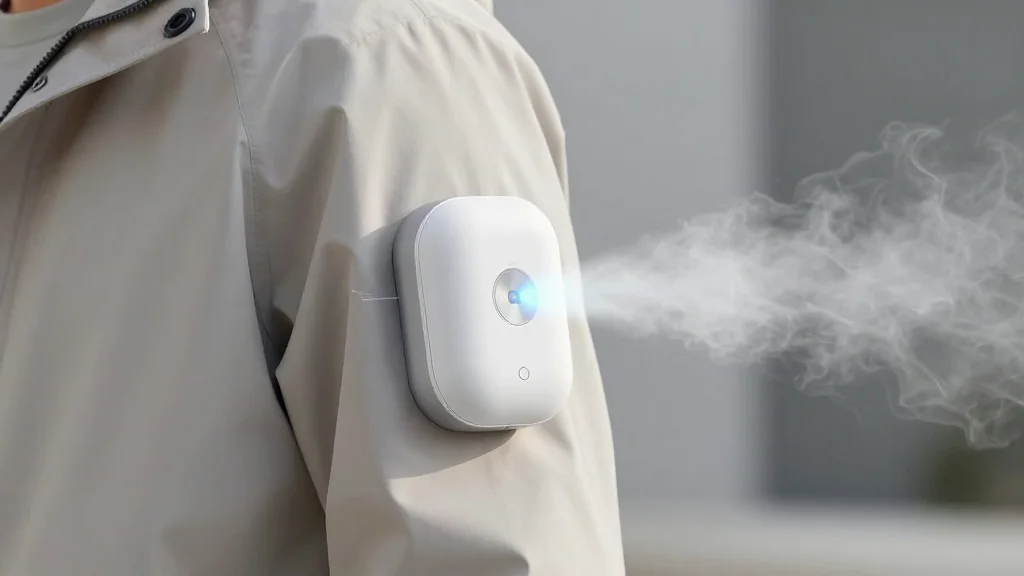
Sony Launches Reon Pocket Pro Plus Wearable Air Conditioner with 20% Cooler Performance

Companies Mentioned
Why It Matters
Personal thermal management is emerging as a critical hardware category as climate change drives more frequent heat events. Sony’s Reon Pocket Pro Plus demonstrates that active cooling can be miniaturized into a wearable form factor without sacrificing battery life, signaling a shift from ad‑hoc fans to integrated, algorithm‑driven devices. The product also showcases how established consumer‑electronics firms can repurpose core competencies—thermal engineering, battery tech, and software integration—to create new revenue streams in a market traditionally dominated by low‑cost accessories. If the Reon Pocket Pro Plus gains traction, it could spur broader industry investment in Peltier‑based wearables, prompting competitors to explore similar approaches for health monitoring, sports performance, and even workplace safety. The device’s success would validate a business model where premium pricing is justified by measurable comfort gains, potentially expanding the hardware ecosystem around personal climate control.
Key Takeaways
- •Sony launches Reon Pocket Pro Plus, a wearable air conditioner with 20% more cooling power
- •Device delivers up to 10 hours of operation on its second‑highest setting
- •New fin design improves stability on the neck by roughly 40%
- •Includes second‑gen Pocket Tag accessory for ambient temperature and humidity monitoring
- •Priced at £199 (≈$253) in the UK and €220 (≈$240) in Europe; U.S. launch pending
Pulse Analysis
Sony’s Reon Pocket Pro Plus arrives at a moment when the hardware industry is re‑examining the boundaries of wearable technology. Historically, wearables have focused on data capture—heart‑rate monitors, smart watches, AR headsets—but the Reon series flips the script by delivering a tangible physiological benefit: active cooling. This shift reflects a broader trend where manufacturers are seeking to monetize comfort and health outcomes, not just information.
From a technical standpoint, the use of the Peltier effect in a consumer‑grade product is noteworthy. Peltier modules have long been relegated to niche applications because of their modest efficiency and heat‑dissipation challenges. Sony’s decade‑long refinement—expanding battery capacity, optimizing thermal pathways, and integrating a smarter cooling algorithm—demonstrates that incremental engineering can overcome these hurdles. The result is a device that can sustain a perceptible temperature drop for hours, a performance level that could redefine user expectations for personal cooling.
Market-wise, Sony is leveraging its brand equity and distribution network to position the Reon Pocket Pro Plus as a premium accessory, differentiating it from low‑cost neck fans that merely circulate air. By pricing the device in the $240‑$250 range, Sony signals confidence that consumers will pay for measurable comfort, especially in regions facing heatwave threats. The decision to launch first in Europe and the UK, while holding back the U.S., may be a strategic test of demand in markets with higher consumer willingness to adopt niche tech. Should sales meet expectations, we can anticipate a rapid expansion of the product line, possibly integrating the cooling module into other wearables such as jackets or backpacks.
In the longer view, Sony’s move could catalyze a wave of hardware innovation focused on personal climate control. Competitors may explore hybrid solutions that combine Peltier cooling with evaporative or phase‑change materials, aiming for higher efficiency or lower cost. Moreover, the data collected by the Pocket Tag—ambient temperature, humidity, and user‑controlled settings—could feed into broader IoT ecosystems, enabling predictive cooling that syncs with smart home HVAC systems. If Sony can turn the Reon Pocket Pro Plus into a platform rather than a single product, it could unlock a new category of hardware that blends comfort, health, and connectivity.
Overall, the Reon Pocket Pro Plus is more than a novelty; it is a proof point that sophisticated thermal management can be packaged into a sleek, wearable form factor. Its market reception will likely influence how quickly the industry moves from passive cooling accessories to active, algorithm‑driven personal climate solutions.
Sony launches Reon Pocket Pro Plus wearable air conditioner with 20% cooler performance
Comments
Want to join the conversation?
Loading comments...