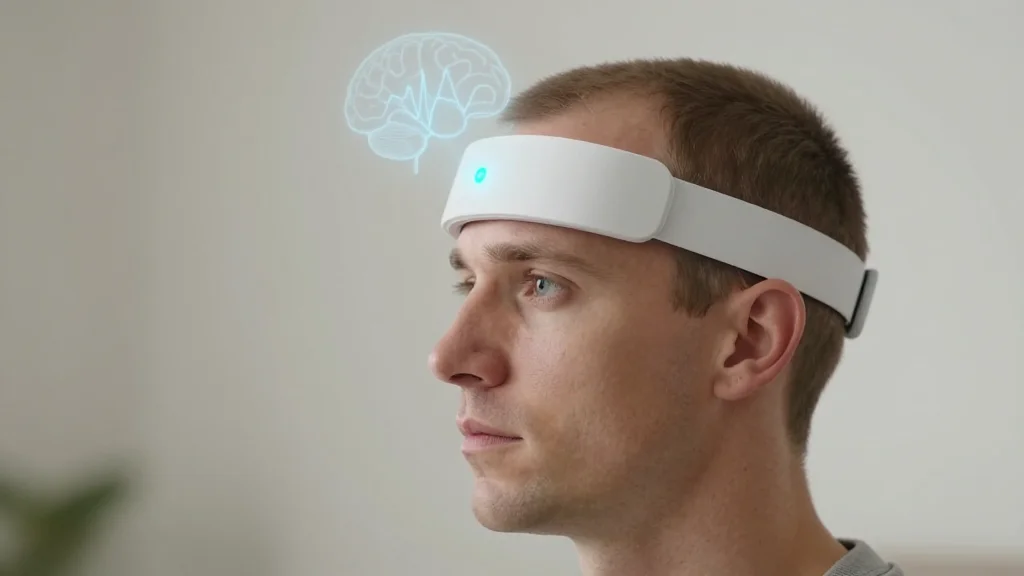
Clinical, Biophysical and Market Evaluation of the Temple Wearable and Its Real Time Autonomic Entropy Biomarker
Companies Mentioned
Why It Matters
If validated, Temple’s entropy metric could provide a more immediate proxy for metabolic rate than heart‑rate, opening a new data stream for performance optimization and longevity monitoring. Success would also signal a shift toward cranial wearables in the consumer health market.
Key Takeaways
- •Temple raised $54 M seed, valuing it at $190 M.
- •Device uses temporal‑region NIRS/PPG to capture autonomic entropy.
- •Entropy biomarker claims real‑time metabolic insight, outperforming wrist HR.
- •Early launch targets elite athletes and bio‑hackers for data collection.
- •Critics say sensor measures external artery, not direct brain perfusion.
Pulse Analysis
The convergence of consumer electronics and longevity science has spawned a new wave of deep‑tech wearables, and Temple is positioned at the forefront. Founded in 2024 by Deepinder Goyal—Zomato’s creator—the startup emerged from the research arm of Eternal after a two‑year stealth phase. A $54 million seed round, bolstered by Goyal’s own $25 million, placed the company at a $190 million post‑money valuation. The capital infusion reflects a broader pattern of tech entrepreneurs channeling personal wealth into neuro‑physiological monitoring platforms aimed at elite performance and preventive health.
Temple’s hardware diverges from the wrist‑centric paradigm by anchoring a minimalist headband to the temporal artery, a site that offers dense sympathetic innervation and minimal sub‑cutaneous fat. Using near‑infrared spectroscopy and reflective photoplethysmography, the device records pulse‑to‑pulse intervals with reduced motion artifact, enabling real‑time calculation of Sample Entropy or Multiscale Entropy. The resulting “Entropy™” metric is marketed as a proxy for instantaneous metabolic demand, claiming sub‑second alignment with indirect calorimetry while traditional heart‑rate sensors lag behind. 49 %. Despite the technical intrigue, the venture faces scientific and regulatory headwinds.
Critics argue that measuring the superficial temporal artery cannot reliably infer cerebral blood flow or hypothalamic oxygenation, limiting the biomarker’s diagnostic credibility. Moreover, the prototype lacks FDA clearance, confining it to a wellness‑only classification. Temple’s go‑to‑market plan hinges on an early‑access cohort of athletes, founders and researchers to amass a crowdsourced dataset that could substantiate its algorithms. If the company can translate this data into peer‑reviewed validation, it may carve a niche between consumer bio‑hacking and clinical neuro‑monitoring.
Clinical, Biophysical and Market Evaluation of the Temple Wearable and its Real Time Autonomic Entropy Biomarker
Comments
Want to join the conversation?
Loading comments...