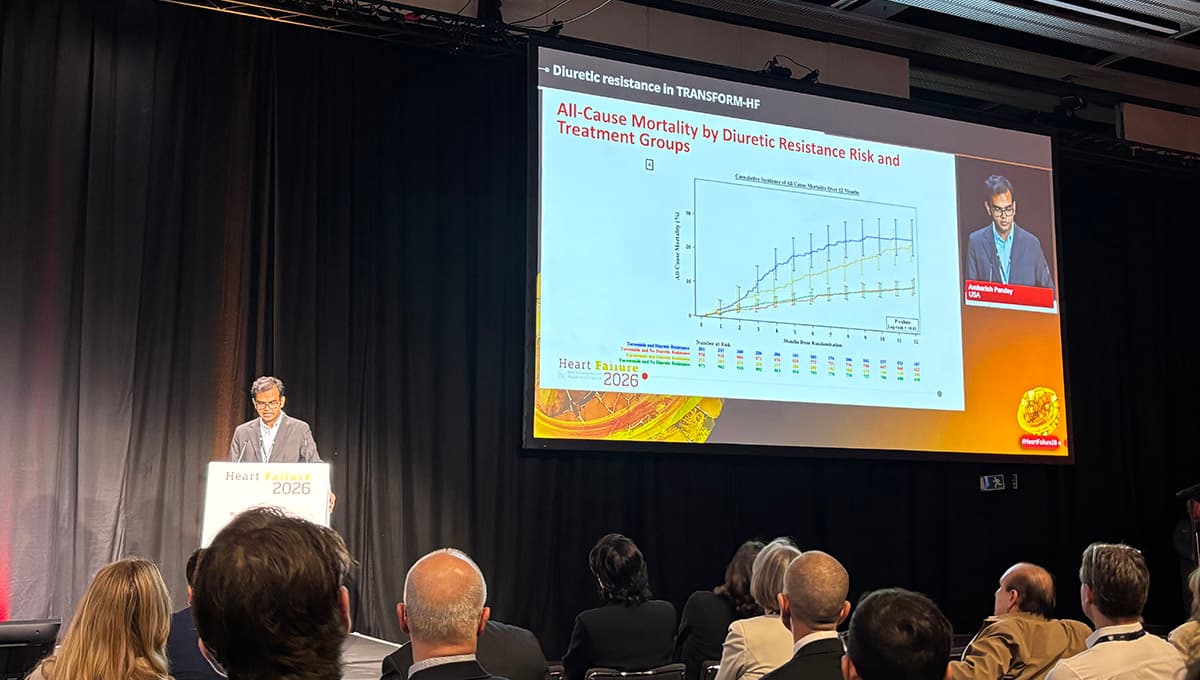
Diuretic Resistance Score Confirms TRANSFORM-HF’s Message
Why It Matters
The findings highlight a sizable, high‑risk subgroup of heart‑failure patients who do not benefit from simply switching loop diuretics, prompting clinicians to consider more aggressive or novel decongestion therapies.
Key Takeaways
- •BAN‑ADHF score identifies 21% high diuretic‑resistance risk in TRANSFORM‑HF
- •High‑risk patients show 79% higher mortality, 34% more hospitalizations
- •Loop diuretic choice (torsemide vs furosemide) does not affect outcomes
- •Score available online for clinicians; prospective testing planned
- •Alternative decongestion strategies needed for diuretic‑resistant phenotype
Pulse Analysis
Diuretic resistance remains a critical hurdle in managing acute heart failure, contributing to persistent congestion and elevated readmission rates. The BAN‑ADHF score, introduced in 2023, aggregates eight readily available clinical variables—renal function, natriuretic peptide levels, serum bicarbonate, prior loop use, and key comorbidities—to flag patients likely to fail standard loop‑diuretic therapy. By making this tool publicly accessible, clinicians now have a pragmatic method to stratify risk at the bedside, enabling earlier identification of the subset that may require intensified treatment.
In a recent post‑hoc evaluation of the TRANSFORM‑HF trial, researchers applied the BAN‑ADHF score to 2,421 hospitalized heart‑failure patients. Roughly one‑fifth were classified as high‑risk, a group that experienced significantly higher all‑cause mortality (hazard ratio 1.79) and hospitalizations (HR 1.34) compared with low‑risk peers. Crucially, the analysis demonstrated that the choice between torsemide and furosemide did not modify these outcomes, underscoring that loop‑diuretic selection alone cannot overcome the adverse trajectory associated with diuretic resistance.
The practical implication is clear: clinicians should look beyond swapping one loop diuretic for another and instead explore alternative decongestion strategies, such as combination diuretic regimens, ultrafiltration, or novel agents under investigation. Ongoing prospective validation of the BAN‑ADHF score will solidify its role in guiding these decisions, while parallel studies in trials like ADVOR and PUSH‑AHF suggest that more aggressive diuretic protocols may improve survival for resistant patients. Embracing a risk‑based approach promises to refine heart‑failure care and reduce the costly burden of repeat admissions.
Diuretic Resistance Score Confirms TRANSFORM-HF’s Message
Comments
Want to join the conversation?
Loading comments...