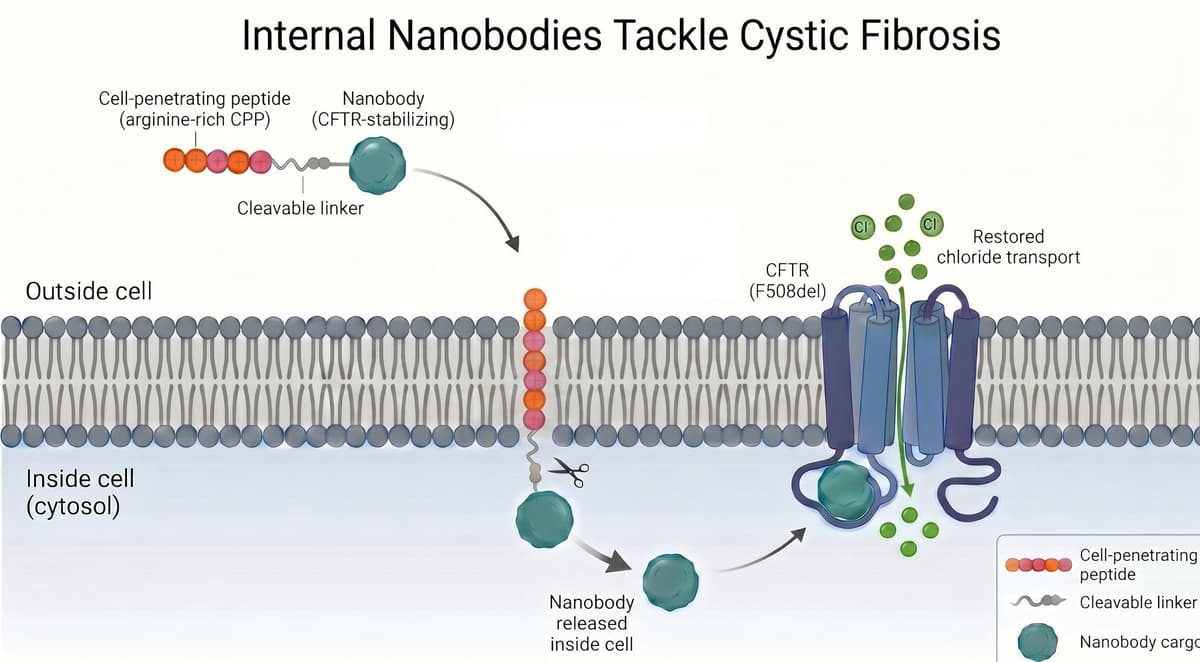
Internal Nanobodies Tackle Cystic Fibrosis
Why It Matters
The approach offers a tangible way to correct intracellular disease mechanisms, potentially expanding treatment options for cystic fibrosis and other protein‑misfolding disorders. It also sidesteps gene‑therapy complexities, accelerating clinical translation of intracellular biologics.
Key Takeaways
- •Cell‑penetrating nanobody restores up to 90% CFTR function in patient cells
- •Hybrid peptide‑nanobody crosses membrane without gene therapy
- •Combines with existing modulators for near‑normal chloride transport
- •Platform could target intracellular proteins across diverse diseases
Pulse Analysis
The latest study showcases how a nanobody—an antibody fragment only about one‑tenth the size of a full antibody—can be turned into an intracellular drug. By attaching a short, positively charged peptide composed of ten arginine residues, scientists gave the nanobody the ability to breach the cell’s lipid barrier, a feat traditional antibodies cannot achieve. Once inside, the nanobody latches onto a destabilized region of the CFTR protein, guiding it to fold correctly and travel to the cell surface where it resumes its chloride‑channel function. This direct protein‑delivery strategy sidesteps the need for viral vectors or DNA editing, reducing safety concerns associated with gene‑therapy approaches.
In laboratory models, the nanobody alone boosted mature CFTR levels, but the real breakthrough emerged when it was paired with FDA‑approved CFTR modulators. The dual regimen drove chloride transport to roughly 90% of healthy levels, a performance gap that no single therapy has previously closed. This synergy suggests that intracellular nanobodies can act as precision enhancers, targeting mutation‑specific domains that small‑molecule drugs miss. For clinicians, the implication is a potential new combination regimen that could dramatically improve lung function and quality of life for patients with the most stubborn CFTR mutations.
Beyond cystic fibrosis, the technology signals a paradigm shift for biologic drug design. Many diseases—from rare genetic disorders to common cancers—are driven by malfunctioning proteins hidden inside cells, traditionally deemed “undruggable.” A library of cell‑penetrating nanobodies could be rapidly generated using AI‑guided design, offering a modular platform to neutralize or correct intracellular targets without altering the genome. As delivery methods mature and scale, the pharmaceutical industry may see a wave of intracellular biologics that expand the therapeutic landscape far beyond the extracellular space.
Internal Nanobodies Tackle Cystic Fibrosis
Comments
Want to join the conversation?
Loading comments...