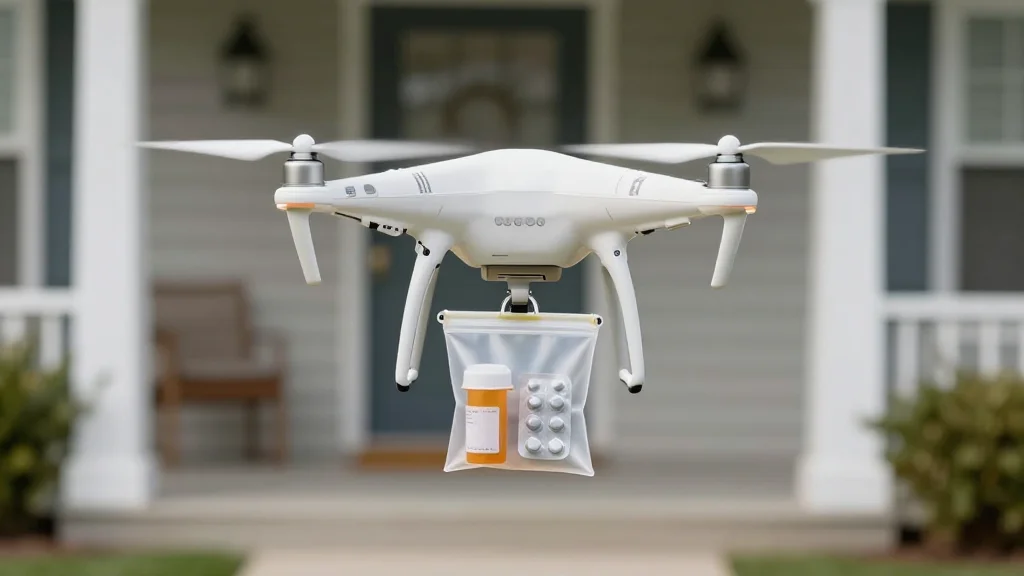
Pharmacy Deliveries Take Flight: Can Drones Solve America’s Pharmacy Access Gap?
Companies Mentioned
Why It Matters
By shrinking delivery times and lowering costs, drone logistics can improve medication adherence and health outcomes for underserved populations, while offering a resilient supply chain during emergencies.
Key Takeaways
- •15.8‑57.1 million Americans live in pharmacy deserts, limiting medication access.
- •FAA Part 135 certification enables BVLOS drone flights for compensated medical deliveries.
- •Fixed‑wing drones cover 50‑120 mi round trips, multicopters handle 4‑12 mi.
- •Pilot programs show $1‑$1.23 per delivery, far cheaper than $5‑$5.33 traditional.
- •State regulations vary; Texas permits prescriptions, Virginia applies existing pharmacy rules.
Pulse Analysis
Pharmacy deserts affect a staggering portion of the U.S. population, with estimates ranging from 15.8 million to 57.1 million people lacking convenient access to a pharmacy. The gap translates into delayed therapy initiation, reduced medication adherence, and heightened vulnerability during natural disasters when traditional supply chains falter. Rural residents often travel ten miles or more for a prescription, and low‑income urban neighborhoods face similar barriers, creating a public‑health equity challenge that traditional courier services have struggled to resolve.
The regulatory tide is shifting. The FAA’s Part 135 air‑carrier pathway now authorizes beyond‑visual‑line‑of‑sight (BVLOS) operations for compensated cargo, including temperature‑sensitive pharmaceuticals. Coupled with NEPA‑driven environmental assessments, this framework imposes rigorous safety, noise, and community‑impact standards while granting operators the legal certainty needed for commercial scale. State boards are catching up; Texas explicitly permits drone‑based prescription delivery, whereas Virginia applies existing pharmacy rules to unmanned aircraft, illustrating a patchwork that nonetheless signals growing acceptance.
Early pilots demonstrate both feasibility and economic promise. Fixed‑wing platforms such as Zipline can travel 50‑120 mi round trips, delivering 2‑10 lb payloads while maintaining 2‑8 °C cold‑chain conditions, whereas multicopters excel in short‑range, precise drops. Cost analyses reveal per‑delivery expenses of $1‑$1.23, dramatically undercutting the $5‑$5.33 typical of van or courier trips. Successful trials in Virginia’s flood‑prone coastal communities, Cleveland Clinic’s specialty‑medication service, and Amazon’s Prime Air program suggest a scalable model, though broader adoption hinges on uniform state regulations, patient acceptance, and integration with pharmacy‑grade handling protocols. As these hurdles recede, drone logistics could become a cornerstone of equitable, resilient medication access in America.
Pharmacy Deliveries Take Flight: Can Drones Solve America’s Pharmacy Access Gap?
Comments
Want to join the conversation?
Loading comments...