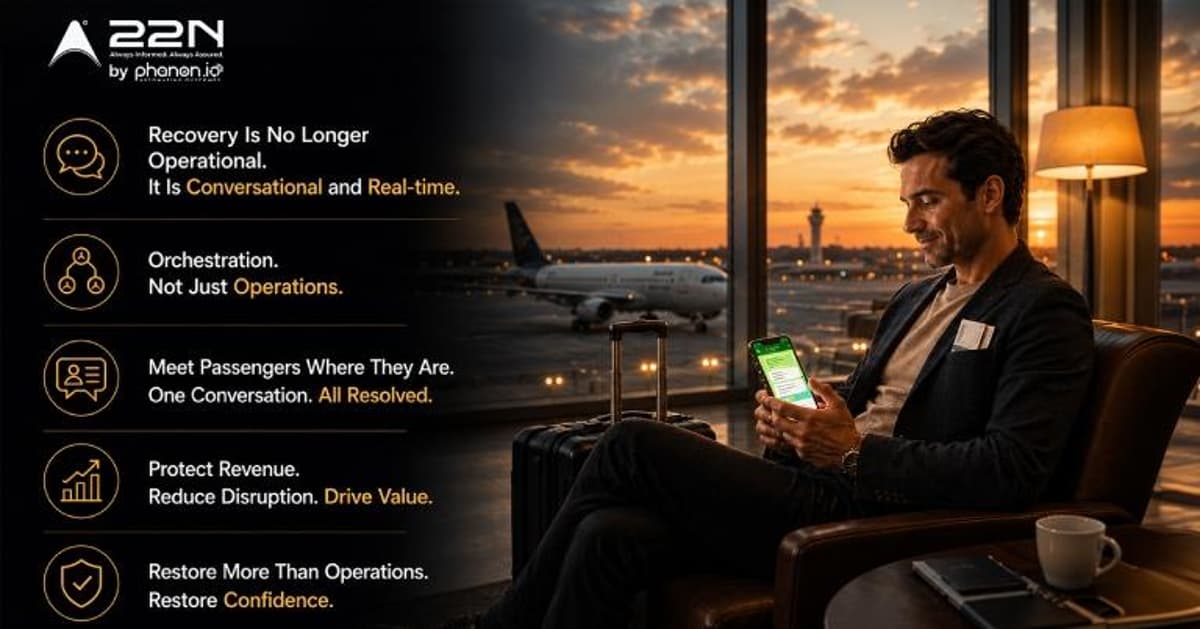
22North: New-Generation Disruption Recovery and Passenger Servicing
Why It Matters
The technology transforms costly, fragmented disruption handling into a revenue‑protecting, customer‑centric process, giving airlines a decisive competitive edge in a market where 78% of travelers expect a seamless digital experience.
Key Takeaways
- •22North platform automates disruption recovery via WhatsApp, SMS, voice, RCS.
- •Real‑time orchestration cuts decision time from 25 minutes to seconds.
- •Airlines can offset up to 8% revenue loss, saving $60 bn industry‑wide.
- •Messaging costs reduced by up to 40% through unified conversation channel.
- •Personalized offers boost ancillary revenue during irregular operations.
Pulse Analysis
Airlines have long grappled with the financial fallout of irregular operations, which IATA estimates cost the sector up to 8% of annual revenue—roughly $60 bn worldwide. Traditional recovery relies on manual coordination across operations, crew, and customer service, creating delays, fragmented communications, and dissatisfied passengers. As travelers increasingly demand a unified digital journey—78% expect consistency across touchpoints—airlines are under pressure to replace legacy processes with agile, data‑driven solutions that can react in seconds rather than minutes.
Enter 22North’s disruption recovery platform, a conversational AI engine that fuses operational data with passenger‑facing messaging channels such as WhatsApp, SMS, voice assistants and RCS. The system instantly models cascading effects of a delay, proposes optimal recovery paths, and pushes personalized rebooking, upgrade or compensation offers directly to each traveler’s preferred app. By eliminating manual cross‑functional handoffs, decision time shrinks from the typical 25‑minute window to a single screen click, while ancillary sales—upgrades, vouchers, and fee waivers—are captured in real time, offsetting a portion of the disruption cost.
The broader implication for the airline industry is a shift from reactive crisis management to proactive, revenue‑protecting orchestration. Airlines that adopt such platforms can expect up to a 40% reduction in messaging expenses and stronger brand loyalty as passengers experience seamless, human‑like interactions during disruptions. The upcoming showcase at APEX FTE Ancillary & Retailing 2026 signals that real‑time conversational recovery is moving from pilot projects to mainstream adoption, positioning early adopters to win both cost efficiencies and market share in an increasingly digital travel ecosystem.
22North: New-generation disruption recovery and passenger servicing
Comments
Want to join the conversation?
Loading comments...