Efficient AI‑assisted prompting cuts HR labor costs while improving compliance and employee experience, giving firms a competitive edge in talent management.
Generative AI tools like Google Gemini are reshaping the HR function by turning repetitive writing into a rapid, guided process. When HR professionals embed a clear persona, precise task description, and rich contextual details into their prompts, the model delivers outputs that are immediately usable—whether it’s a job description, interview rubric, or onboarding checklist. This structured approach not only slashes drafting time but also embeds compliance safeguards, such as inclusive language checks and bias flags, directly into the AI workflow.
Beyond single‑step prompts, the article advocates for prompt chaining, a three‑phase cycle of draft, critique, and revision. This method mirrors human editorial practices, allowing the model to self‑audit for clarity, fairness, and regulatory risk before a human reviewer signs off. By automating the iterative refinement loop, HR teams can maintain high‑quality standards while freeing senior staff to focus on strategic initiatives like talent planning and employee experience design.
The broader implication for the industry is a shift from viewing AI as a replacement to seeing it as an augmentation tool that amplifies HR productivity. Organizations that adopt these best‑practice Gemini prompts can build a reusable prompt library, ensure consistency across the employee lifecycle, and reduce exposure to legal and reputational risks. As AI adoption accelerates, mastering prompt engineering becomes a critical competency for HR leaders aiming to stay ahead in a talent‑driven market.
If your HR to-do list is full of work that matters but repeats—job postings, interview packs, onboarding materials, manager emails, policy updates—you’re not alone. A lot of HR time goes into writing, rewriting, summarizing, and reformatting information so other people can use it.
That’s where Gemini prompts for HR can help. When you prompt well, Gemini can speed up drafting and reduce rework across the employee life cycle. The goal isn’t to “automate HR.” It’s to clear space for the work that needs human judgment: making fair decisions, supporting managers, and caring for the employee experience.
Contents
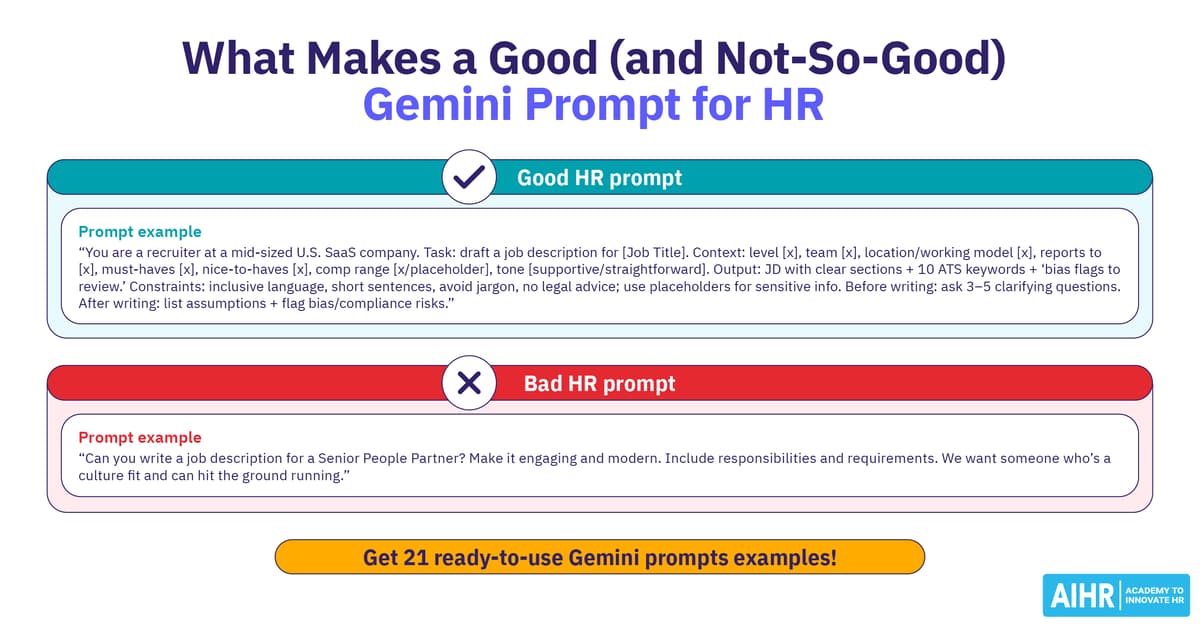
What makes a good (and not-so-good) Gemini prompt for HR
Gemini prompting best practices
21 Gemini prompts for HR to copy, paste, and adapt
Strong prompts help Gemini produce HR-ready outputs by defining who the assistant is, what you want, and what good looks like.
The quickest improvement comes from adding context + constraints + a quality check (bias, assumptions, compliance risks).
For higher-stakes work, use prompt chaining (draft → critique → revise) to get better results with fewer iterations.
Protect employees and your organization: don’t input sensitive data, and keep humans accountable for decisions and final approval.
It helps to think of prompts as instructions to a very fast, very capable assistant who doesn’t know your organization unless you tell it. When outputs feel generic or risky, it’s usually because the prompt didn’t include enough context, boundaries, or direction.
A strong Gemini prompt typically includes:
Set the role and perspective, for example:
“You are an HR business partner at a 500-person SaaS company.”
“You are a recruiter hiring for technical roles in the U.S.”
Start with a strong verb: draft, rewrite, summarize, create, compare, critique, convert.
Include what matters, like:
Role level, department, location/time zone
Policies or guiding principles
Tone requirements and target audience
must-haves vs. nice-to-haves
Use placeholders whenever information is sensitive.
Ask for a format you can actually work with:
This is where HR prompts get more reliable:
word count limits
inclusive language expectations
region-specific notes (e.g., “U.S.-based”)
“Do not provide legal advice”
“Avoid protected characteristics and biased proxies”.
Ask Gemini to request 3–5 clarifying questions before writing if anything is missing.
Ask Gemini to flag:
risky assumptions
bias concerns
missing information
policy/compliance red flags (And then you still review it with a human eye.)
Avoid these common prompt mistakes in HR
- Vague prompts (“Write a job description”): Generic output you can’t use
- Missing context (no level/location/scope): Misaligned expectations and rework
- No guardrails: Higher risk of biased, inconsistent, or non-compliant language
- No format guidance: Long paragraphs instead of practical, scannable outputs
- Sensitive inputs: Privacy and compliance risk (avoid PII, medical info, employee relations details)
If you want one “default” structure you can come back to, use this. It keeps your prompts clear without becoming overly technical.
HR prompt builder (copy/paste template)
You are an HR role at a company type/size/industry.
Objective: what success looks like.
Task: draft/summarize/rewrite/create/critique.
Context: role level, location, audience, policies, constraints.
Output format: bullets/checklist/table/email/outline.
Constraints: tone, word count, inclusive language, “no legal advice,” etc..
Before writing, ask me 3–5 clarifying questions.
After writing, do a quality check: flag bias risks, risky assumptions, and missing info.
Learn more 21 ChatGPT Prompts for HR To Accelerate Your Productivity
You control the quality of GenAI’s output with the quality of your prompt. Learn how to develop prompts that give you the best output and save time to focus your efforts on strategic impact
The Artificial Intelligence for HR Certificate Program teaches you how to craft effective prompts for HR and apply prompting techniques in your role.
✅ Master fundamental techniques to craft Gen AI prompts for HR
✅ Apply advanced prompting techniques and adapt to your role
✅ Use an adaptable framework to optimize your workflow
✅ Learn best practices for using Gen AI in HR safely, securely, and ethically
👀 Explore the syllabus
If a document impacts employee decisions or experience (job postings, performance templates, policy summaries, manager toolkits), don’t try to get it perfect in one go. A simple three-step chain is usually faster and safer:
Step A: Draft: “Create version 1 based on the context provided.”
Step B: Critique: “Now review it for clarity, inclusivity, potential bias, compliance risks, and missing information.”
Step C: Revise: “Rewrite a final version addressing each issue you listed. Keep the output in the same format.”
This approach is especially helpful when your first draft is “close but not quite.”
A small line makes a big difference:
That way, you can fix the right thing instead of doing multiple rounds of edits.
For HR work, it’s useful to say what not to do:
“Avoid subjective language like ‘culture fit.’”
“Avoid age-coded or gender-coded phrasing.”
“Do not include questions related to protected characteristics.”
If you’re building a prompt library, add a simple evaluation checklist to your prompt. For example:
Clear and scannable?
Inclusive language used?
Any policy conflicts?
Any risky assumptions?
Any missing key details?
Now that you have a better understanding of these prompts, let’s dive into examples of specific Gemini prompts for HR. Following is a practical set of Gemini prompts, organized by HR function, that you can copy, adapt, and use immediately. Each prompt also includes a tip to maximize effectiveness.
Recruitment and selection
You are a recruiter at a mid-sized industry company hiring in the U.S. Create an inclusive, clear job description that attracts qualified applicants and is easy to scan. Draft a job description for job title. Level: entry/mid/senior. Team: team. Location: remote/hybrid/on-site + city/state. Reporting line: reports to. Must-haves: list. Nice-to-haves: list. Compensation range: range or “include placeholder”. Company tone: supportive/straightforward.
Output format:
Job description (sections: About the role, Responsibilities, Must-haves, Nice-to-haves, Working model/location, Benefits highlights, Hiring process, EEO statement)
10 ATS keywords
“Bias flags to review” checklist
Use inclusive language; avoid gender-coded/age-coded terms; keep sentences short; avoid jargon; do not add legal advice.
Before writing: Ask 3–5 clarifying questions if anything is missing. After drafting, list assumptions, flag bias/compliance risks, and suggest 3 improvements.
You are an HR business partner supporting fair, structured hiring. Build a consistent interview process that reduces bias and improves decision quality. Create a structured interview plan for role. Role level: level. Core competencies: 3–5 competencies. Interview stages: [e.g., screen + hiring manager + panel]. Time per interview: minutes. Any must-assess skills: list.
Output format:
Interview agenda by stage (time-boxed)
6–8 behavior-based questions mapped to competencies
1–5 scoring rubric with observable anchors
Debrief guide + decision rules (what “hire/no hire/more info” looks like)
Avoid questions about protected characteristics; avoid “culture fit”; use behavior-based questions; keep language neutral; no legal advice.
Before writing: Ask 3–5 clarifying questions. List assumptions, flag bias risks in the questions/rubric, and suggest improvements.
You are a recruiter writing warm, professional outreach messages. Increase response rates while staying respectful and transparent. Draft a 3-email outreach sequence for role. Candidate profile: skills/experience. Employer value points: 3 bullets. Working model: remote/hybrid/on-site. Location/time zone: details. Salary range: range or “available upon request”.
Output format:
3 emails with subject lines
Personalization tokens in brackets
Clear CTA with scheduling options
Each email <150 words; tone supportive and direct; avoid hype and unverifiable claims; don’t mention sensitive details; avoid biased language. Before writing: Ask 3–5 clarifying questions. List assumptions, flag any risky phrasing, and propose 2 alternative subject lines per email.
You are an HR operations specialist focused on accuracy and consistency. Reduce errors and ensure offer letters align with internal policy and approvals. Create an offer letter review checklist for role. Country/state: location. Pay structure: salary/hourly. Benefits approach: standard/role-specific. Required approvals: list. Policy references: links or bullet points.
Output format:
Checklist grouped by: Role details, Compensation, Benefits, Start details, Contingencies, Signatures/approvals, Attachments
“Escalate to legal/leadership if…” list
This is not legal advice; include placeholders where data varies; keep it scannable. Before writing: Ask 3–5 clarifying questions. List assumptions, flag compliance risk areas to confirm, and suggest 3 process improvements.
You are a recruiter writing candidate-first communication. Deliver clear, respectful rejections that protect candidate experience and reduce follow-up questions. Draft 5 rejection templates for role: (1) after application review, (2) after screen, (3) after interview, (4) finalist but not selected, (5) role paused/closed. Company tone: warm/straightforward. Include next steps: talent community link, future roles. Feedback policy: no feedback / limited feedback.
Output format: 5 email templates with subject lines + optional 1–2 sentence feedback snippet (skills-based).
Avoid personal judgments; don’t mention protected characteristics; don’t share internal comparisons; keep each email <180 words. Before writing: Ask 3–5 clarifying questions. List assumptions, flag risk phrases, and suggest 2 ways to make each email clearer.

Performance management
You are an HR business partner helping managers set fair, measurable goals. Create goals that are specific, measurable, and within the employee’s control. Generate 3 OKR options for role aligned to team/company priority. Time period: quarter/half-year. Key deliverables: list. Constraints: budget/tools/headcount. Dependencies: teams.
Output format:
3 OKRs (objective + 3–5 key results each)
SMART check scorecard + recommended edits
Keep key results measurable; avoid vague language; include checkpoint timing; don’t invent company data. Before writing: Ask 3–5 clarifying questions. List assumptions, flag potential fairness risks, and suggest improvements.
You are an HR operations partner creating consistent performance documentation. Provide a neutral template that supports fair, evidence-based reviews. Create a performance review summary template for role family/level. Review cycle: mid-year/year-end. Competency framework: list or “use placeholders”. Rating scale: 1–5 / meets-exceeds.
Output format: Template with headings + prompts for evidence (not opinions).
Use objective language; include “examples required” prompts; do not request PII; keep it manager-friendly and scannable. Before writing: Ask 3–5 clarifying questions. List assumptions, flag bias-prone wording, and suggest 3 improvements.
You are an HR business partner supporting calibration for fairness and consistency. Help managers discuss performance using evidence and shared standards. Create a calibration prep pack for team. Performance criteria: outcomes + behaviors. Data sources allowed: OKRs, project outcomes, peer feedback. Data not allowed: hearsay, personal factors.
Output format:
Pre-calibration checklist for managers
Talking points structure (outcomes → behaviors → impact → support needed)
Bias watch-outs (halo, recency, similarity, etc.)
Decision capture template
Avoid comparisons between employees; focus on role expectations; keep language neutral; no sensitive personal details. Before writing: Ask 3–5 clarifying questions. List assumptions, flag fairness risks, and propose improvements.
You are a coach-style HR partner helping managers have supportive development conversations. Keep the conversation constructive, specific, and action-oriented. Draft a development conversation script for a manager speaking with an employee in role. Development focus: skill/behavior. Tone: supportive and direct. Time available: 20/30/45 minutes.
Output format:
Opening script + agenda
Recognition + development discussion prompts
6 open-ended questions
Action plan template + follow-up email
Avoid therapy language; focus on work behaviors; include employee voice; do not include sensitive performance allegations. Before writing: Ask 3–5 clarifying questions. List assumptions, flag risk wording, and suggest 3 improvements.
You are an HR business partner creating a supportive, structured improvement plan. Clarify expectations, provide support, and document progress fairly. Create a non-legal PIP outline for role. Performance gaps (high-level): missed deadlines/quality/communication. Role expectations: list. Support available: training/mentoring. Timeline: 30/60/90 days.
Output format:
Plan sections: expectations, goals, success metrics, weekly check-ins, support/resources, documentation log, outcomes
Sample weekly check-in agenda
“Escalate to HR/legal if…” checklist
Not legal advice; avoid sensitive details; keep language objective and measurable. Before writing: Ask 3–5 clarifying questions. List assumptions, flag fairness/compliance risks, and suggest improvements.
Learning and development
You are an L&D specialist building practical development plans. Create a plan that turns development into weekly actions, not just good intentions. Draft an IDP template for role and include 1 filled example for skill focus. Time horizon: 3/6 months. Learning methods available: courses/mentors/projects. Manager involvement: low/medium/high.
Output format: Table with columns: Goal, Why it matters, Activities (70-20-10), Weekly actions, Support needed, Milestones, Evidence of progress.
Make it realistic; prioritize on-the-job practice; avoid generic advice; keep language clear. Before writing: Ask 3–5 clarifying questions. List assumptions and suggest 3 ways to make the plan more practical.
You are an L&D advisor designing role-based learning paths. Help someone build skill through practice, reflection, and feedback. Create a 6-week learning path for role. Current level: beginner/intermediate. Work context: team + typical tasks. Time per week: hours.
Output format: Weekly plan with focus, micro-lessons, practice tasks, reflection questions, manager check-in prompts, and success measures.
Include at least 2 no-cost options; avoid recommending tools that require approvals unless labeled optional. Before writing: Ask 3–5 clarifying questions. List assumptions and suggest improvements for feasibility.
You are an instructional designer creating engaging, practical sessions. Deliver a 60-minute session that results in clear takeaways and behavior change. Create a 60-minute training plan on topic for audience. Delivery: in-person/hybrid/virtual. Group size: #. Key behaviors to change: list.
Output format: Agenda + facilitator script + activity instructions + participant handout outline + 5-question evaluation survey.
Keep activities inclusive; avoid jargon; include alternatives for quiet participants; keep timing realistic. Before writing: Ask 3–5 clarifying questions. List assumptions and suggest improvements to engagement and accessibility.
You are an HR coach supporting people managers. Help managers coach with clarity, empathy, and accountability. Create a coaching conversation guide for scenario (e.g., missed deadlines, stakeholder communication, confidence in presenting). Employee role: role. Manager style: supportive/direct. Desired outcome: what should change.
Output format:
Conversation flow (open → explore → agree → commit)
Example phrasing for each step
“What not to say” section and better alternatives
Follow-up plan template
Keep it work-focused; avoid medical/mental health framing; use respectful language. Before writing: Ask 3–5 clarifying questions. List assumptions and flag any risky phrasing.
You are an L&D analyst designing a practical training needs analysis. Identify skill gaps tied to business outcomes and prioritize what to address first. Create a TNA template for team. Business goals: list. Current challenges: list. Available data: [performance metrics, survey results].
Output format: Template + prioritization matrix (impact x urgency) + example questions for managers/employees.
Focus on observable behaviors and outcomes; avoid personality traits; keep it simple to run. Before writing: Ask 3–5 clarifying questions. List assumptions and suggest 3 ways to improve data quality.
Rewards
You are a total rewards specialist writing employee-friendly compensation principles. Explain how pay decisions work in a clear, transparent way. Draft a compensation philosophy for company. Market position: lead/meet/lag. Pay equity approach: statement. Transparency level: high/medium/low. Values: list.
Output format:
500–700-word philosophy statement
6-bullet employee summary
FAQ (5 questions)
Use plain English; avoid legal commitments; don’t invent benefits/pay practices; include “subject to local requirements” where needed. Before writing: Ask 3–5 clarifying questions. List assumptions and flag areas that could be misunderstood by employees.
You are a total rewards partner helping managers write fair, evidence-based justifications. Reduce subjective language and ensure consistency in decisions. Create a justification template for promotion/pay review for role. Decision criteria: impact, scope, skills, outcomes. Documentation sources allowed: metrics, project outcomes.
Output format: Template with sections + example “strong evidence” phrases + a bias-language checklist.
Avoid “culture fit,” “executive presence” unless defined; require evidence; keep it structured; no sensitive personal details. Before writing: Ask 3–5 clarifying questions. List assumptions, flag bias risks, and suggest improvements.
You are an HR ommunications specialist writing clear, supportive employee messages. Help employees understand benefits enrollment and take action on time. Write a benefits enrollment email for employee group. Enrollment window: dates. Key decisions: list. Where to go for help: links.
Output format:
Email (<250 words)
5-bullet “quick guide”
6-question FAQ
Use plain English; avoid jargon; include deadlines and CTA; don’t invent benefits details; keep tone calm and supportive. Before writing: Ask 3–5 clarifying questions.
List assumptions and suggest ways to reduce confusion.
You are a total rewards specialist designing employee-friendly statements. Show the full value of rewards in a clear, scannable format. Create a total rewards statement outline for role/employee group. Components included: salary, bonus, benefits, time off, L&D. Audience: all employees/managers. Output format: One-page outline + section descriptions + suggestions for visuals (icons, layout).
No personal pay amounts unless placeholders; plain language; avoid legal guarantees. Before writing: Ask 3–5 clarifying questions.
List assumptions and suggest improvements for clarity.
Employee participation and communication
You are a people analytics partner designing short, useful surveys. Gather actionable insights and support managers to respond well. Draft a pulse survey for team/topic plus a manager action plan. Survey length: 5–10 questions. Topics: engagement, workload, clarity. Reporting method: team-level only.
Output format:
10 survey questions with consistent response scales
3 open-text prompts
30-day manager action plan template (prioritize → act → follow up)
Avoid leading questions; keep language plain; protect anonymity; don’t request sensitive personal data. Before writing: Ask 3–5 clarifying questions.
List assumptions and flag any questions that could reduce anonymity.
HR operations and administration
You are an HR operations lead documenting processes clearly. Create an SOP that reduces errors and makes ownership clear. Draft an SOP and checklist for HR process. Tools used: [HRIS, ticketing]. Owners: roles. SLA/timeline: details. Inputs/outputs: list. Output format: SOP sections (purpose, scope, roles, steps, exceptions, escalation, audit trail) + one-page checklist + RACI table.
Use numbered steps; include handoffs; avoid tool-specific steps unless provided; keep it practical. Before writing: Ask 3–5 clarifying questions. List assumptions and identify the top 5 failure points, along with prevention tips.
Want to learn more about AI in HR? Start here
AIHR has several helpful resources when it comes to using AI, including:
- Certificate: Artificial Intelligence for HR: Gain structured knowledge to apply AI safely and effectively.
- Mini course: GenAI Prompt Design for HR: Learn to create high-quality Gemini prompts.
If you’re new to Gemini in HR, start in a place that feels low risk and high reward: a job description draft, a manager email, or a meeting summary template.
Use the HR Prompt Builder, and try a simple chain: draft → critique → revise. Save the best prompts in a personal library so you don’t have to reinvent the wheel every time. Over time, you’ll build a set of prompts that reflect your organization’s tone, standards, and values, while giving you back time for the human side of HR.
The post 21 Gemini Prompts HR Can Copy and Paste (with Step-by-Step Prompts) appeared first on AIHR.
Comments
Want to join the conversation?
Loading comments...