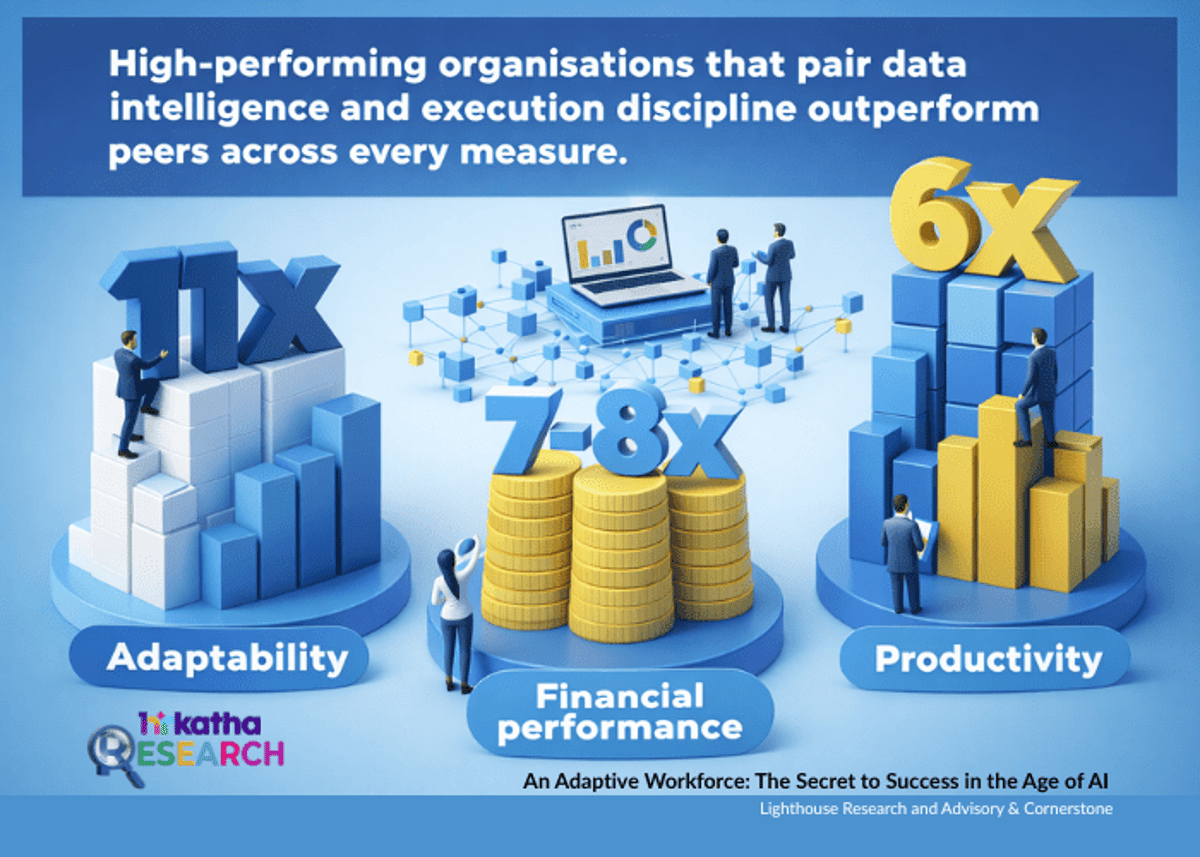
Companies that Act on Workforce Data Are 11 Times More Adaptable: Study
Companies Mentioned
Why It Matters
Activation of workforce data directly drives adaptability, financial health, and productivity, making it a decisive competitive advantage in fast‑changing markets.
Key Takeaways
- •Workforce intelligence + activation yields 11x adaptability
- •Activation boosts internal hiring ninefold versus external
- •Manager support multiplies productivity four times
- •Agentic AI can compress insight‑action lag
- •High performers outpace peers 40% on execution metrics
Pulse Analysis
The Lighthouse Research report reframes the current AI‑centric narrative by showing that raw talent data alone does not create value. Companies that have invested heavily in skills platforms, assessments and dashboards often stall at the insight stage, leaving decision‑makers to rely on intuition or periodic reviews. This inertia limits responsiveness, especially when strategic priorities shift faster than traditional hiring cycles. By treating workforce intelligence as a dynamic asset rather than a static repository, firms can unlock the hidden elasticity needed to navigate volatile markets.
Activation—translating skill visibility into concrete staffing and development actions—emerges as the true differentiator. The study reveals that organisations with strong activation practices are nine times more likely to fill new initiatives with internal talent, dramatically reducing time‑to‑productivity and hiring costs. Middle managers act as valves in this pipeline; when equipped with the right tools and incentives, they can amplify productivity fourfold and improve retention. Conversely, managerial resistance throttles mobility, leaving less than 3% of initiatives staffed internally. Aligning leadership incentives with talent mobility therefore becomes a strategic imperative.
Agentic AI promises to accelerate the activation loop by continuously monitoring work patterns, surfacing emerging skill gaps, and recommending redeployment in real time. Rather than replacing human judgment, these systems shrink the lag between knowing and doing, allowing high‑performing firms to compound their adaptability advantage. As 80% of employers report that role requirements have already shifted since hiring, the ability to recalibrate capabilities on the fly will separate market leaders from laggards. Executives should therefore prioritize building the governance, data visibility, and managerial accountability frameworks that enable AI‑enhanced activation, turning workforce intelligence into a sustainable competitive edge.
Companies that act on workforce data are 11 times more adaptable: Study
Comments
Want to join the conversation?
Loading comments...