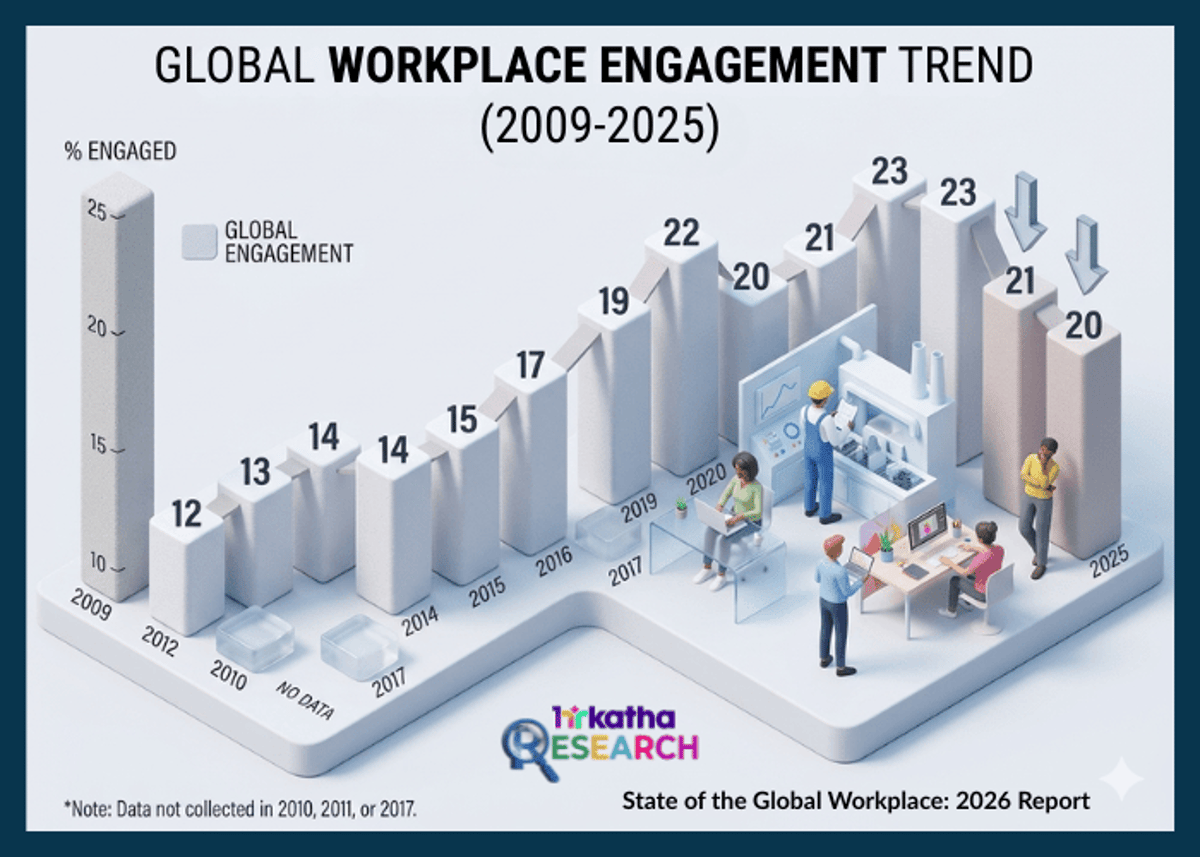
Global Employee Engagement Falls to 20% as Managers Disengage
Why It Matters
When the people who translate strategy into action become disengaged, productivity plummets and costly AI rollouts falter, threatening competitive advantage across industries.
Key Takeaways
- •Global employee engagement dropped to 20%, lowest since 2020.
- •Manager engagement fell to 22%, erasing the traditional engagement premium.
- •Larger spans of control and AI adoption amplify manager disengagement.
- •Best‑practice firms achieve 79% manager engagement, four times the global average.
- •South Asia saw an eight‑point manager engagement plunge in 2025.
Pulse Analysis
The latest Gallup data underscores a systemic crisis: employee engagement, once a leading indicator of performance, has fallen to a mere 20% worldwide. This dip is not a fleeting sentiment but a measurable drag on the global economy, costing an estimated $10 trillion in lost output—roughly one‑tenth of global GDP. While the headline figures capture attention, the underlying dynamics reveal that disengagement is concentrated among managers, whose motivation traditionally drives team performance. The erosion of the manager‑engagement premium signals deeper structural shifts in how organizations are designed and led.
A confluence of organizational flattening and rapid AI adoption is intensifying the manager dilemma. Companies are cutting middle‑management layers to reduce costs, expanding spans of control and stretching managers thin. Simultaneously, AI tools promise efficiency, yet their successful deployment hinges on managerial endorsement; employees are 8.7 times more likely to view AI as transformative when their manager actively supports it. The paradox is stark: fewer, overburdened managers are expected to champion technology adoption, while their own engagement wanes, creating a feedback loop that hampers both human and digital performance.
The contrast between lagging firms and best‑practice organizations offers a roadmap. Companies that treat engagement as a strategic priority achieve nearly 80% manager engagement, delivering superior productivity and smoother AI integration. For regions like South Asia, where manager engagement fell eight points in a single year, the imperative is clear: invest in managerial development—coaching, prioritization, and connection—rather than relying solely on technology. Elevating managers from a cost‑center to a strategic asset can reverse the disengagement tide, safeguard productivity, and ensure that AI augments rather than replaces effective leadership.
Global employee engagement falls to 20% as managers disengage
Comments
Want to join the conversation?
Loading comments...