Walmart
WMT
Target
Employee trust directly influences retail market share and operational resilience, making early people‑first actions a strategic imperative across industries.
Frontline listening has become a cornerstone of modern leadership, especially in high‑volume sectors like retail where employee turnover can erode profit margins. New CEOs at Walmart and Target are leveraging direct communication tools—memos, town halls, and store visits—to surface pain points before they translate into lost sales or brand dilution. By positioning themselves as accessible, these leaders aim to transform the employee experience from a cost center into a competitive advantage, a shift that aligns with broader industry data linking engagement to revenue growth.
Walmart’s approach is underscored by its recent $1 trillion market valuation, suggesting that a people‑first mindset can coexist with aggressive growth targets. Furner’s hands‑on outreach mirrors a value‑creation strategy that ties employee satisfaction to sales performance. Target, facing brand and financial headwinds, has articulated a four‑step roadmap that emphasizes clarity, urgency, and purposeful investment in both physical stores and digital platforms. The parallel tactics illustrate how relational leadership can be tailored to distinct corporate challenges while maintaining a common goal: turning employee insight into actionable strategy.
Beyond retail, Bridgestone West’s Michele Herlein is extending the listening model globally, conducting a months‑long tour across four continents to capture cultural nuances and operational feedback. This cross‑industry adoption signals that relational leadership is no longer a niche practice but a strategic imperative for talent retention and brand reputation. Companies that institutionalize open‑door communication are better positioned to anticipate market shifts, innovate responsibly, and sustain long‑term growth in an increasingly employee‑centric economy.
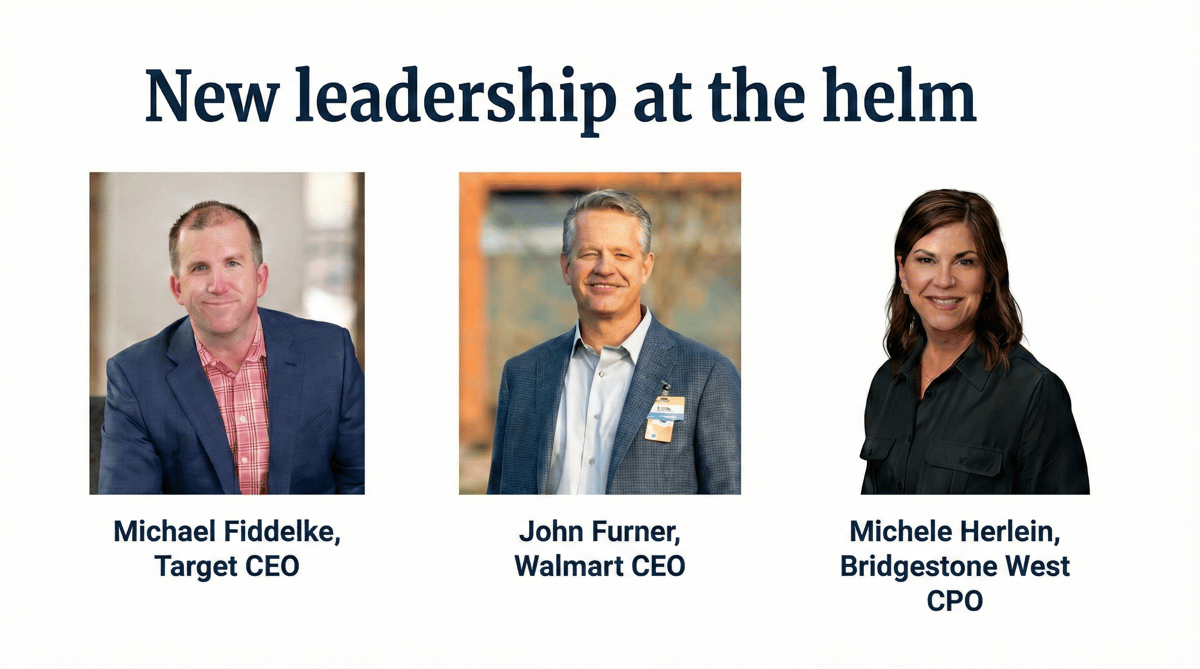
New leadership: Michael Fiddelke (Target CEO), John Furner (Walmart CEO), and Michele Herlein (Bridgestone West CPO)
Key insight: Learn how new CEOs at Walmart, Target and Bridgestone West prioritize frontline listening to reset strategy.
What’s at stake: Employee trust or turnover could materially affect retail market share and operational resilience.
Expert quote: “Leadership is primarily relational,” says executive coach Peter Schwartz — leaders must “walk their talk.”
With new CEOs at the helm, Walmart and Target are beginning the month with change. How each leader moves forward from this point will make all the difference for their business — and the employee experience.
Walmart’s John Furner and Target’s Michael Fiddelke began their respective roles with a hands‑on approach, by connecting and communicating directly with employees. It’s a promising start, according to executive coach and Vistage chair Peter Schwartz.
“Leadership is primarily a relational skill,” says Schwartz, who has mentored CEOs and business owners for over 20 years. “That’s the ability of the CEO to genuinely connect with all the stakeholders and allow them to see that this is a person of high integrity.”
Furner, who started at Walmart as an hourly employee more than 30 years ago, began his CEO tenure by sending out a company‑wide memo asking workers to voice their pain points, according to Bloomberg, and spent time visiting Walmart stores and supply facilities in multiple countries. Increasing sales by taking care of its people is a value strategy that has paid off for Walmart, which just announced a $1 trillion market value as of February 3, according to Companies Market Cap.
Meanwhile, Target CEO Fiddelke is facing complex financial and brand issues, but made his priorities for positive change clear in a town hall with staff and a letter to stakeholders. Like Furner, he highlights his intention to connect and listen. After listing out a four‑step strategy for the future, Fiddelke wrote:
“In the weeks ahead, my focus is simple: Listen closely, move with clarity and urgency, and lead with purpose. We will make clear choices, invest where it matters most and bring this strategy to life through our stores, our digital experiences, and — most importantly — our people.”
Maintaining a positive perception is equally important as these initial meet‑and‑greets, and this comes from consistent proof that employees and other key groups have an open door to voice thoughts, needs and concerns. While leaders don’t have to agree with everything they hear, people should always feel comfortable sharing, says Schwartz.
“[Good leaders] walk their talk and they’re courageously authentic, which means they’re willing to have truth in the conversation, despite how difficult that is,” he says.
Starting off with a visible people‑first approach isn’t just for incoming CEOs. Whether someone is new to leadership or a C‑suite veteran, connection and communication with employees will set the tone for a smooth transition and culture continuity, says tire‑manufacturer Bridgestone West’s new chief people officer Michele Herlein.
“People trust people. They want to know who their new leaders are and what they stand for, and they’re wondering what their experience is going to be,” Herlein says. “It’s important for leaders to listen, then to create their agenda on what’s important in terms of where they’re going, what the strategic pillars and the defining values of the organization are, and then behave in ways that demonstrate that. That builds trust and consistency, and it’s something people have to see.”
Herlein is putting these practices to work as she settles into the role of CPO at Bridgestone West, which she started in January. She oversees an employee population that spans four continents, and one of her first orders of business has been to embark on a months‑long global listening tour. The goal is to find out what’s working along with what’s not, and strike a balance between stability and making improvements where they’re needed, she says.
“Respect what is working and be informed by the people in the culture,” suggests Herlein. “Let that inform you on the decisions and the actions you will take, instead of just jumping in and making changes for the sake of change.”
While back home and working in Bridgestone’s Nashville office, Herlein has been devoting any free time to visiting the building’s 31 floors, saying hello and learning about the various businesses and functions on each. Even quick, informal interactions make an impression, she says.
“I started at the lowest level, and walked around and looked at where everybody was, and was saying hi,” she says. “I met with a leader yesterday, and he said, ‘Oh yeah, I got a text message that you were walking around.’ People notice that kind of stuff.”
Establishing trust with a team through early actions is important; keeping it is essential. Schwartz advises all leaders to remember their success moving forward banks on the acknowledgement that leadership is a team sport.
“How you’re experienced as a leader determines your impact,” he explains. “With all these constituencies, these brand‑new CEOs have to be mindful and deliberate about how they’re being experienced by all these stakeholders. These leaders are trying to impact and influence the future — you can’t do that by yourself.”
Editor, Employee Benefit News
Comments
Want to join the conversation?
Loading comments...