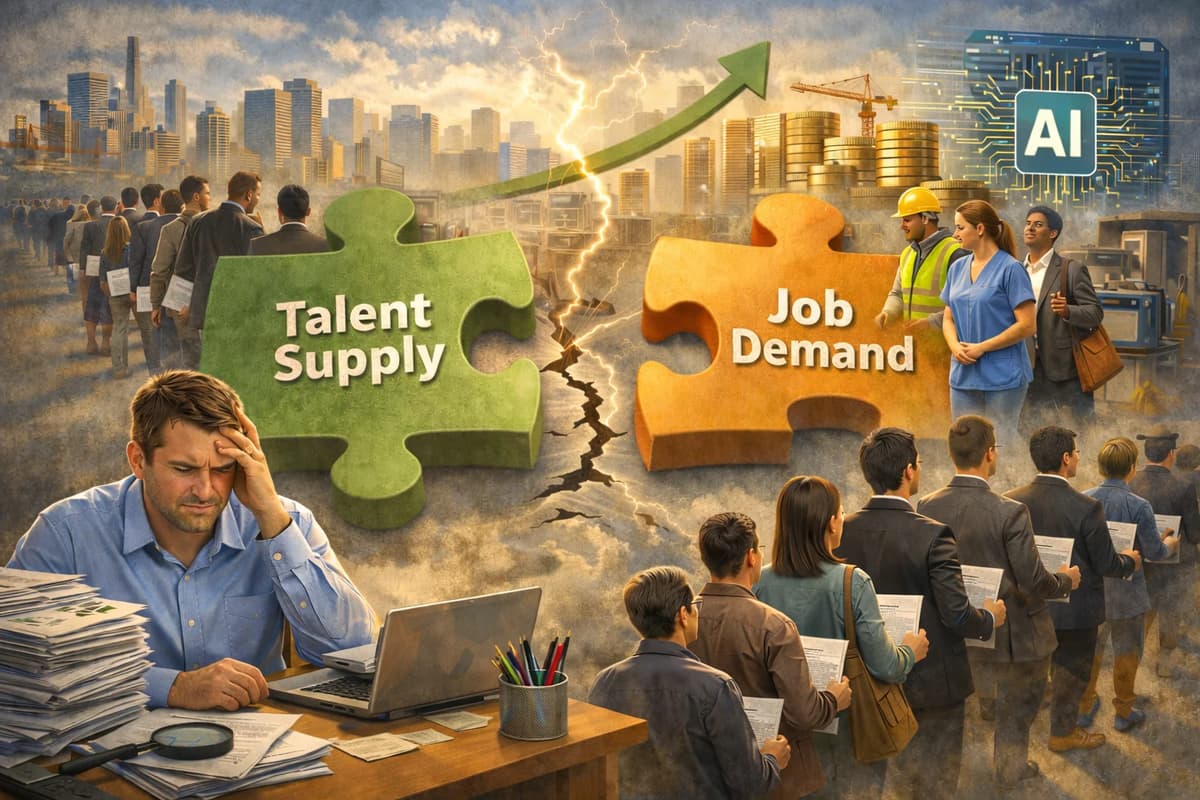
The mismatch between booming demand and stagnant supply will pressure hiring costs and productivity, forcing companies to rethink talent strategies. Recruiters must adapt now, as tight labor conditions are becoming a permanent feature rather than a temporary cycle.
The 2026 economic outlook signals a classic demand‑driven expansion, yet the labor market is fragmented. While tax relief and lower borrowing costs stimulate business activity, they do not generate new workers. Industries that rely on specialized skills—healthcare, skilled trades, logistics—continue to see chronic vacancies, driving up time‑to‑fill metrics across the board. This structural scarcity forces firms to confront higher recruiting spend and longer vacancy cycles, even as overall hiring volumes rise.
Artificial intelligence is reshaping the recruiting equation, automating screening and compressing certain roles, but it does not create additional qualified talent. At the same time, tighter immigration policies and an aging baby‑boomer cohort erode traditional pipelines that once offset domestic shortfalls. The result is a paradox where applications flood job boards, yet the pool of qualified, available candidates remains thin. Companies that rely solely on wage increases find diminishing returns, as offer acceptance rates dip into the 70‑80% range.
Strategic leaders must pivot from a pure acquisition mindset to a holistic talent‑management approach. Prioritizing internal mobility, robust retention programs, and skills‑based hiring can mitigate chronic vacancies. Redesigning roles with AI‑enabled efficiencies and flexible work structures improves fillability, while tracking vacancy persistence—not just time‑to‑fill—highlights positions that need process redesign. Embracing these tactics equips organizations to thrive in an economy where growth outpaces labor supply, turning a hiring paradox into a competitive advantage.
January 23, 2026

Economic forecasts for 2026 are improving. Fiscal stimulus is returning. Interest rates are easing. Investment—especially in AI—is accelerating. By traditional measures, the U.S. economy is set to grow faster than expected. For recruiters, that should be good news. Historically, growth made hiring easier.
This time, it won’t.
The coming expansion is demand‑driven: tax relief, government spending, lower borrowing costs, and rising asset prices. These forces increase business activity and generate more requisitions.
But they do not expand the labor supply.
Recruiters are already seeing the disconnect. Even during periods of modest growth, time‑to‑fill remains elevated:
20–30 % longer than pre‑pandemic norms for professional roles
40–60 + days for many non‑entry positions
Much longer for healthcare, skilled trades, and technical roles
This isn’t a slowdown problem. It’s a scarcity problem.
At this point, many may ask – How can there be labor shortages when companies are laying people off and every job posting gets hundreds of applicants?
The answer is simple: today’s labor market is misaligned, not oversupplied.
Recent layoffs have been highly concentrated, especially in:
Venture‑backed tech
Corporate support and coordination roles
Recruiting, marketing, and duplicated white‑collar layers built during the 2020–2022 hiring surge
Meanwhile, shortages persist in roles that can’t be automated, offshored, or deferred—healthcare delivery, skilled trades, logistics, frontline services, and experienced specialists. A surplus in one area doesn’t solve shortages in another. Recruiters live this every day.
High applicant counts are often cited as proof that hiring should be easy. In reality, applications per posting is one of the least useful recruiting metrics. Recruiters know that:
Many applicants are unqualified or out of location
Others are mass‑applying due to uncertainty, not fit
AI‑driven application tools have inflated volume without increasing usable supply
What matters is qualified, available, and willing candidates. In many roles, that pool remains thin—even when postings attract hundreds of resumes. That’s how applicant overload and hiring difficulty can coexist.
For decades, immigration absorbed growth shocks by supplying working‑age labor. That mechanism is now constrained. With net immigration lower than prior baselines, recruiters see:
Thinner pipelines
Fewer replacement candidates
Heavier reliance on poaching instead of net‑new supply
Because immigrants historically account for a disproportionate share of workforce growth, even modest reductions translate into persistent vacancy pressure, not just slower hiring.
At the same time, retirements continue to rise. Participation gains among prime‑age workers have largely plateaued. Operationally, this shows up as:
Repeated reposting of the same roles
Backfills taking longer than net‑new hires
10–20 % of open roles becoming chronically open (90 + days), especially in frontline, care, and operational functions
Hiring slows not because roles aren’t needed—but because they’re hard to fill reliably.
Another signal recruiters recognize immediately is offer‑acceptance erosion. Across industries, acceptance rates have drifted into the 70–80 % range, down from pre‑pandemic norms closer to 85–90 %. Counteroffers are more common. Candidates decline for reasons beyond pay: workload, flexibility, burnout, and career risk.
Higher wages alone no longer clear the market.
AI is often framed as a solution to labor shortages. In practice, it changes how shortages are managed. AI enables:
Role compression
Elimination of coordination work
Growth without proportional headcount
That helps employers cope—but it also reduces hiring elasticity. Fewer roles open, but the ones that remain are more critical and harder to fill. Recruiters face fewer “easy” requisitions and higher consequences when vacancies persist.
Put it all together, and the next expansion creates a paradox recruiters must plan for:
Business demand accelerates
Hiring volumes remain constrained
Time‑to‑fill stays high
Offer declines increase
Vacancies persist
Layoffs, applicant overload, and labor shortages coexist—not because the data is wrong, but because the market is segmented and structurally tight.
Stop planning for labor‑market normalization. Tight conditions are now a feature, not a phase.
Track vacancy persistence—not just time‑to‑fill. Chronic roles require redesign, not more sourcing.
Partner earlier on role and workflow design. AI, scope, and flexibility drive fillability more than comp bands.
Shift from acquisition to retention and mobility. Internal fills reduce vacancy duration dramatically.
Expand the labor pool deliberately. Flexibility, accessibility, and skills‑based hiring are now supply strategy.
The economy may grow faster in 2026.
Your candidate pool will not.
The organizations that win will stop waiting for hiring conditions to improve—and start building recruiting systems designed for permanent labor scarcity.
Comments
Want to join the conversation?
Loading comments...