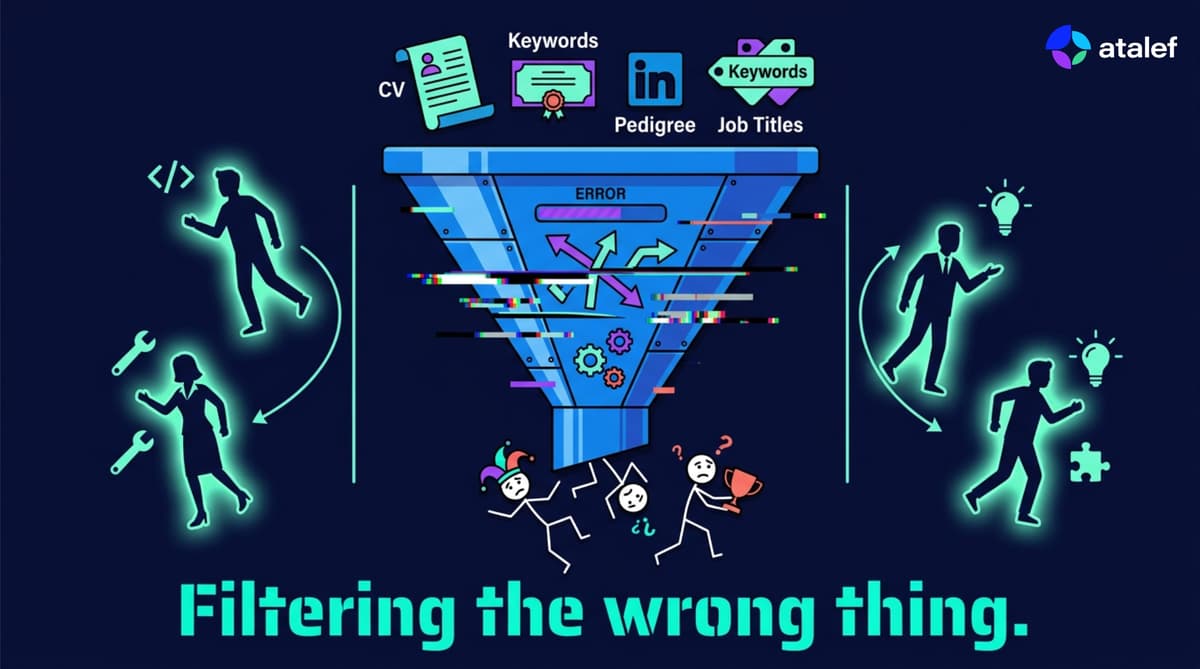
The Real Hiring Problem Isn’t Talent—It’s That You’re Measuring the Wrong Things
Key Takeaways
- •One in five new hires in Europe quit before probation ends
- •Resumes often reflect writers or AI, not candidates' true abilities
- •Skills‑validation platforms like Atalef.ai’s DeepMatch replace CV proxies
- •Skill tests can surface candidates lacking formal credentials but high competence
- •Accurate capability data boosts early‑stage retention and shrinks perceived talent gaps
Pulse Analysis
The hiring landscape has long been dominated by résumé‑driven screening, a practice that treats education, past employers, and keyword density as proxies for performance. Recent data from McKinsey reveals a startling churn rate—20% of European hires leave before probation—signaling that these proxies are increasingly unreliable. As organizations scramble to fill roles, they often mistake a perceived talent shortage for a genuine lack of qualified candidates, overlooking the fact that many capable individuals are filtered out by superficial criteria.
Enter skills‑validation platforms such as Atalef.ai’s DeepMatch, which leverage AI to benchmark candidates against concrete role requirements. By administering targeted assessments, these tools generate objective data on coding proficiency, problem‑solving speed, and domain‑specific knowledge, bypassing the noise of embellished résumés. Companies that adopt capability‑based screening report higher shortlist conversion rates and a broader, more diverse talent pool, because the focus shifts from pedigree to proven ability. This paradigm also mitigates bias introduced by AI‑optimized résumés that chase keyword matches rather than real competence.
The business implications are profound. When hiring decisions are grounded in measurable skill sets, early‑stage attrition drops, saving firms the average $30,000 cost of a failed hire in the United States. Moreover, accurate capability mapping enables better workforce planning, allowing firms to anticipate skill gaps and upskill internally. As the market evolves, firms that invest in robust skill assessment frameworks will gain a competitive edge, turning the perceived talent shortage into a strategic advantage.
The Real Hiring Problem Isn’t Talent—It’s That You’re Measuring the Wrong Things
Comments
Want to join the conversation?