When Will AI Take Your Job? This Tool Thinks It Knows
•February 20, 2026
0
Companies Mentioned


Why It Matters
The tool highlights the rapid pace of AI‑driven automation, forcing HR to prioritize reskilling or risk talent loss and competitive disadvantage.
Key Takeaways
- •Tool predicts personal AI job displacement year
- •Up to 300 million jobs at risk globally
- •Gartner: 20% firms cut half middle managers by 2026
- •WEF forecasts 170 million new jobs by 2030
- •Only ~20% U.S. workers actively use AI now
Pulse Analysis
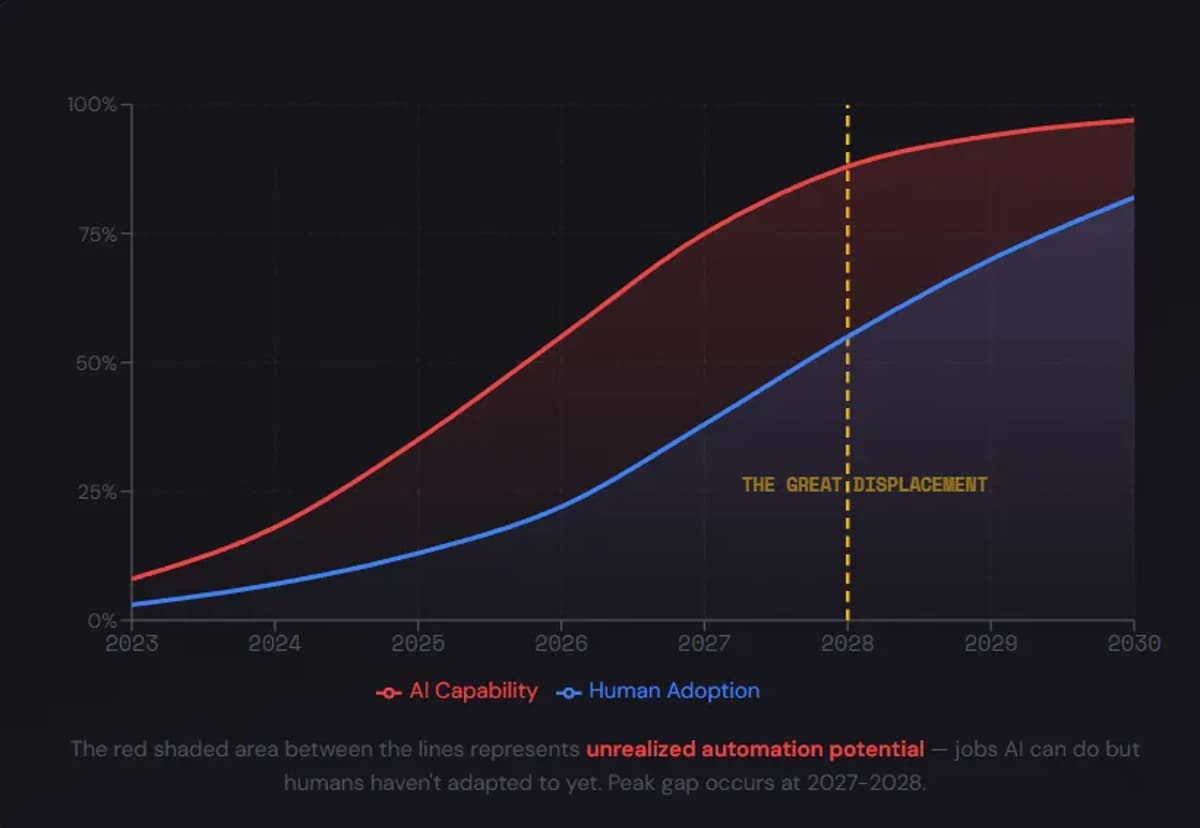
TheGreatDisplacement.ai arrives at a moment when executives are scrambling for concrete signals about automation’s timeline. By aggregating forecasts from Goldman Sachs, Gartner and the World Economic Forum, the calculator translates macro‑level projections into a personalized year when AI could render a specific role obsolete. While the methodology is not peer‑reviewed, the underlying figures—such as Goldman’s estimate of 300 million jobs affected and Gartner’s prediction that a fifth of organizations will halve middle‑management headcount by 2026—provide a stark quantitative backdrop for strategic planning.
Those headline numbers sit alongside more optimistic projections from the World Economic Forum, which anticipates roughly 170 million new positions and 92 million displaced roles by 2030. The net gain reflects a shift toward tech‑enabled occupations—data‑science, AI‑ethics, and automation maintenance—rather than a simple replacement of existing work. However, the transition hinges on a massive upskilling effort; current surveys show only about one‑in‑five U.S. workers regularly leveraging AI tools, leaving a sizable talent gap that could slow adoption and exacerbate displacement risks. Without coordinated training programs, many industries may face productivity shortfalls and heightened competitive pressure. Policymakers and corporate boards are therefore urged to fund continuous learning pipelines.
From an HR perspective, the calculator is less a crystal ball than a call to action. Gartner warns that firms lagging in AI adoption will fall behind, yet only a dozen percent of HR teams currently use AI‑driven assessments in hiring. To stay competitive, leaders must embed AI literacy into onboarding, create clear pathways for reskilling, and partner with external providers that can scale up‑training quickly. By turning the anxiety of displacement into a structured talent‑development agenda, organizations can capture the emerging job wave while mitigating the risk of mass layoffs.
When will AI take your job? This tool thinks it knows
0
Comments
Want to join the conversation?
Loading comments...