Why Are Singapore’s Younger Workers Less Engaged?
Why It Matters
Low engagement erodes productivity, talent retention, and economic growth, making it a critical issue for Singapore’s competitiveness. Addressing the underlying structural pressures can transform the workforce into a growth engine and strengthen social cohesion.
Key Takeaways
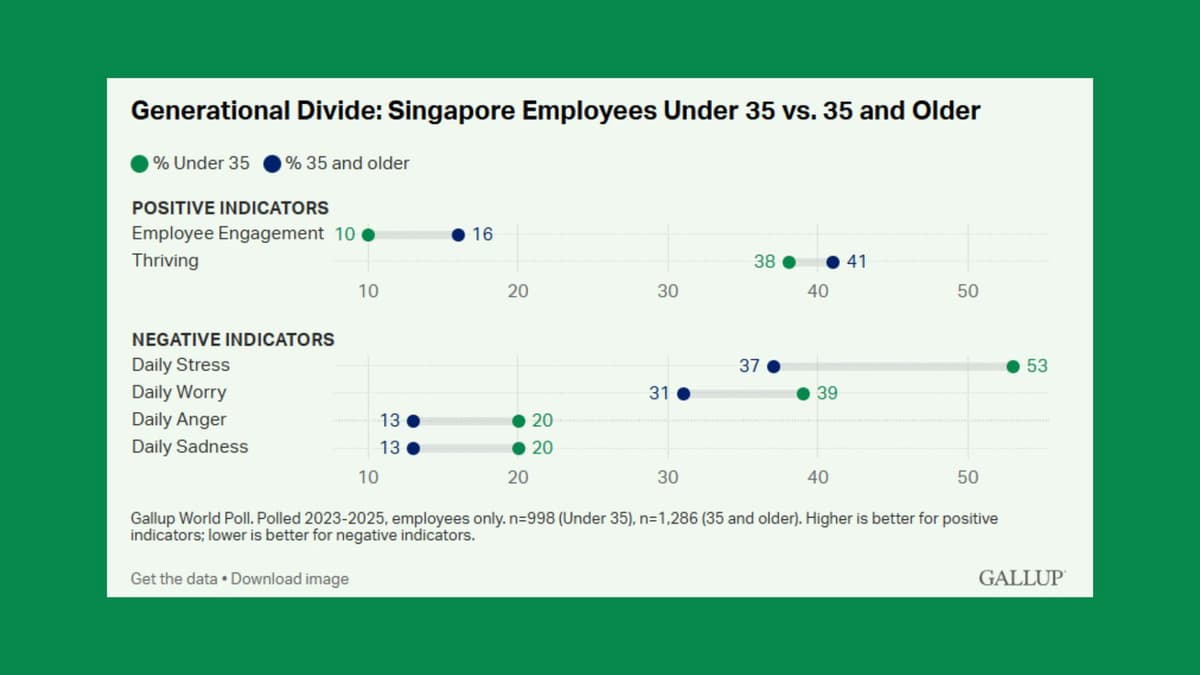
- •Under‑35s in Singapore report 53% daily stress, far above older peers
- •Engagement among Singapore workers sits at just 14%, lowest regionally
- •Leaders cite high living costs and national service as stress drivers
- •Organizations score 3.25/5 on adapting practices for younger staff
- •Minister outlines three pillars of a “good job”: fair treatment, development, relationships
Pulse Analysis
Gallup’s 2026 Singapore Workplace Report spotlights a widening engagement chasm that sets the city‑state apart from global trends. While the worldwide gap between under‑35s and older workers hovers around two percentage points, Singapore’s younger cohort lags far behind, with only 14% of the overall workforce feeling engaged and more than half reporting daily stress. The data underscores how macro‑economic pressures—sky‑high housing, mandatory national service, and volatile career prospects—compound the psychological strain on millennials and Gen Z, translating into measurable productivity losses for employers.
Beyond macro factors, the report flags a cultural lag in workplace design. Senior leaders gave a modest 3.25 out of 5 on adapting policies for younger staff, suggesting that many firms still cling to legacy practices that clash with modern expectations for flexibility, continuous learning, and purpose‑driven work. The pervasive "strawberry generation" stereotype obscures these structural issues, framing younger workers as entitled rather than reacting to real constraints. Companies that recalibrate benefits, career pathways, and managerial styles to align with the aspirations of a digitally native cohort stand to improve both wellbeing and output.
In response, Minister Dinesh Vasu Dash outlined three pillars of a "good job": fair treatment, empowerment through development, and strong workplace relationships. Embedding these elements can lift engagement, reduce turnover, and fuel innovation—especially as Singapore prepares for an AI‑enabled future. Employers are urged to tighten protection policies, showcase exemplary human‑capital practices, and reskill staff, turning the engagement gap into a strategic advantage for the nation’s long‑term economic resilience.
Why are Singapore’s younger workers less engaged?
Comments
Want to join the conversation?
Loading comments...