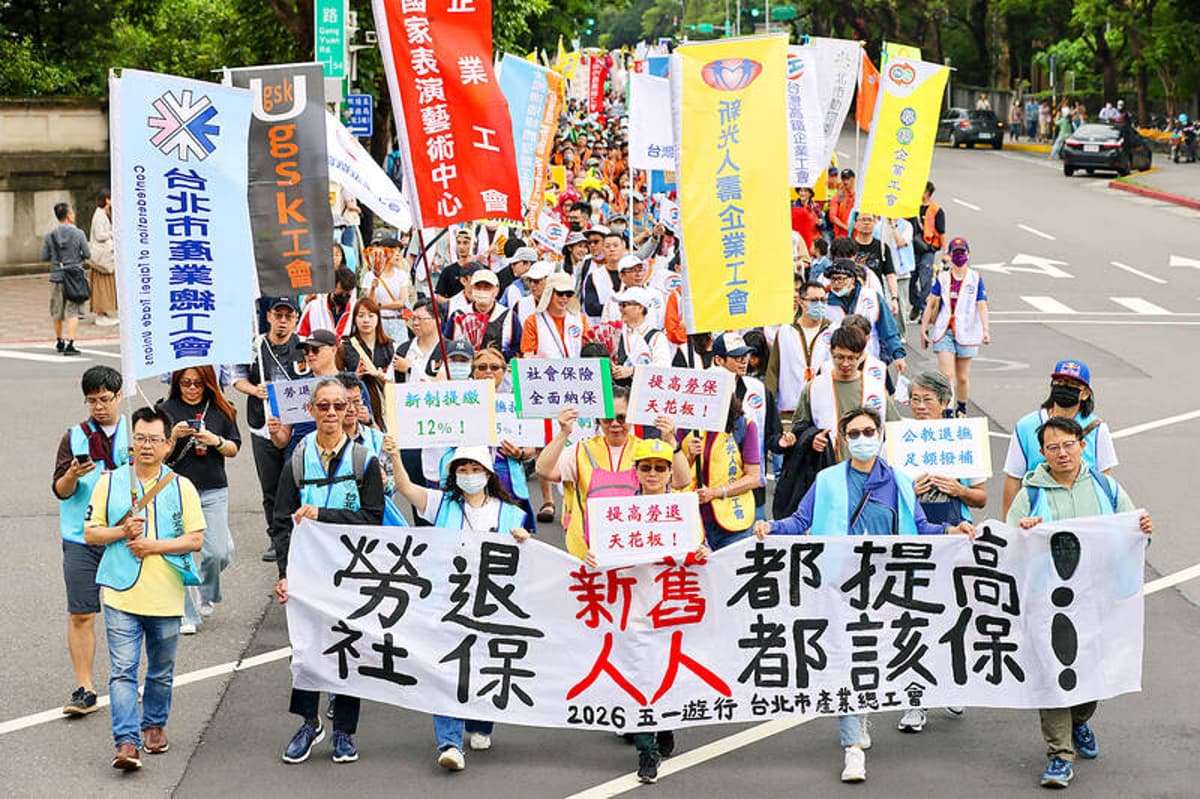
Workers March for a Reform of Pension System
Why It Matters
The proposals target Taiwan’s aging demographic and growing income inequality, aiming to prevent future pension shortfalls and preserve social stability. Successful reform could set a regional benchmark for inclusive retirement systems amid rapid technological disruption.
Key Takeaways
- •Employers' pension contribution proposed to double from 6% to 12%.
- •Coverage extension to live‑in, migrant, and sub‑5‑employee workers.
- •Salary caps raised to NT$48,200 (~$1,530) and NT$313,000 (~$10,000).
- •Upper limit on service years for pension calculation to be abolished.
- •Public Service Pension Fund to be fully appropriated and reparations reinstated.
Pulse Analysis
Taiwan faces a demographic crossroads: a rapidly aging population combined with a persistently low birthrate is straining its pension reserves. As life expectancy climbs, the current contribution framework—anchored at a modest 6% employer rate—fails to keep pace with rising benefit obligations. Adding to the pressure, AI‑driven automation and the nation’s net‑zero energy transition are reshaping labor demand, creating pockets of unstable employment and widening wage gaps. Policymakers therefore confront a dual challenge of financing longer retirements while adapting to a transformed job market.
The eight‑point agenda unveiled by the Taiwan Confederation of Trade Unions seeks to shore up the system through higher contributions, broader coverage, and more generous benefit calculations. Doubling the employer contribution to 12% directly boosts the fund’s inflow, while removing the cap on years of service ensures that long‑tenured workers accrue full pensions. Extending mandatory labor insurance to live‑in caregivers, migrant laborers, and firms with fewer than five employees expands the safety net to previously excluded segments, and raising the insured‑salary ceiling to NT$48,200 (≈$1,530) and the contribution ceiling to NT$313,000 (≈$10,000) aligns benefits with modern wage levels.
If enacted, these reforms could reverberate beyond Taiwan’s borders, offering a template for other Asian economies grappling with similar demographic headwinds and the socioeconomic fallout of rapid technological change. For businesses, clearer pension obligations and a more inclusive insurance regime may reduce turnover costs and improve workforce morale. However, higher employer contributions could compress profit margins, especially for SMEs, prompting a need for phased implementation or fiscal incentives. The outcome will hinge on the Ministry of Labor’s willingness to mediate between unions, employers, and the state treasury, balancing fiscal sustainability with social equity.
Workers march for a reform of pension system
Comments
Want to join the conversation?
Loading comments...