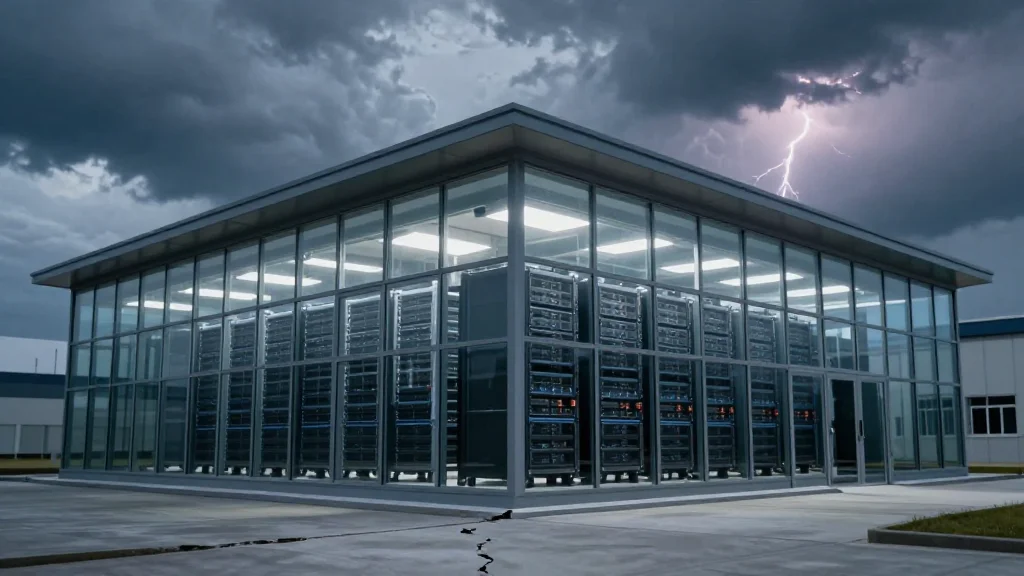
Insurers Flag $800 Billion at Risk as 56% of U.S. Data Centers Target Disaster‑Prone States

Why It Matters
The exposure of $800 billion in data‑center assets to natural hazards creates a systemic underwriting challenge. A single catastrophic event—such as a major hurricane hitting the Gulf Coast—could generate losses that strain insurers’ capital buffers, potentially leading to higher premiums or reduced coverage for tech firms. This, in turn, could raise the cost of cloud services that underpin everything from fintech to telemedicine. Beyond immediate financial risk, the concentration of critical digital infrastructure in disaster‑prone zones raises broader concerns about national resilience. If a storm or earthquake disrupts a significant share of AI‑driven services, the ripple effects could impact supply chains, emergency response systems and the broader economy. Insurers’ warnings therefore signal a need for coordinated policy, engineering and financial solutions to safeguard the digital backbone of modern society.
Key Takeaways
- •56% of planned U.S. data centers are located in high‑risk disaster zones
- •Nearly $800 billion of investment is exposed to hurricanes, tornadoes, winter storms and earthquakes
- •Severe convective storms account for 51% of at‑risk sites, generating $52 billion in insured losses last year
- •Existing data‑center value in these zones is $20 billion; planned projects are ~40× larger
- •Insurers view the concentration as both a risk and a growth opportunity, urging advanced risk‑modeling
Pulse Analysis
The data‑center boom is colliding with climate reality, and insurers are the first line of defense. Historically, underwriting for large‑scale infrastructure has relied on geographic diversification to spread risk. The current trend—driven by cheap land and abundant power in the Sun Belt—undermines that principle, creating a dense aggregation of high‑value assets in a few hazard corridors. As Martin Burke notes, the potential loss severity can spike dramatically when assets of this magnitude cluster together.
From a market perspective, insurers face a dilemma. Tightening underwriting standards could protect capital but also choke the supply of cloud capacity that fuels AI innovation. Conversely, maintaining lax standards may expose insurers to tail‑risk events that could trigger massive claims, similar to the $52 billion loss from severe convective storms last year. The sector is likely to see a wave of bespoke reinsurance treaties and parametric products designed to cap exposure while keeping premiums competitive.
In the longer term, the pressure may catalyze a geographic shift. The Texas A&M study’s identification of low‑risk zones in the Upper Midwest suggests an emerging alternative corridor. If insurers begin to price risk more aggressively in traditional hotspots, developers may be incentivized to locate new facilities where climate risk is lower, even if it means higher upfront costs for land and power. This realignment could reshape the U.S. data‑center landscape, spreading digital infrastructure more evenly and reducing systemic vulnerability.
Insurers Flag $800 Billion at Risk as 56% of U.S. Data Centers Target Disaster‑Prone States
Comments
Want to join the conversation?
Loading comments...