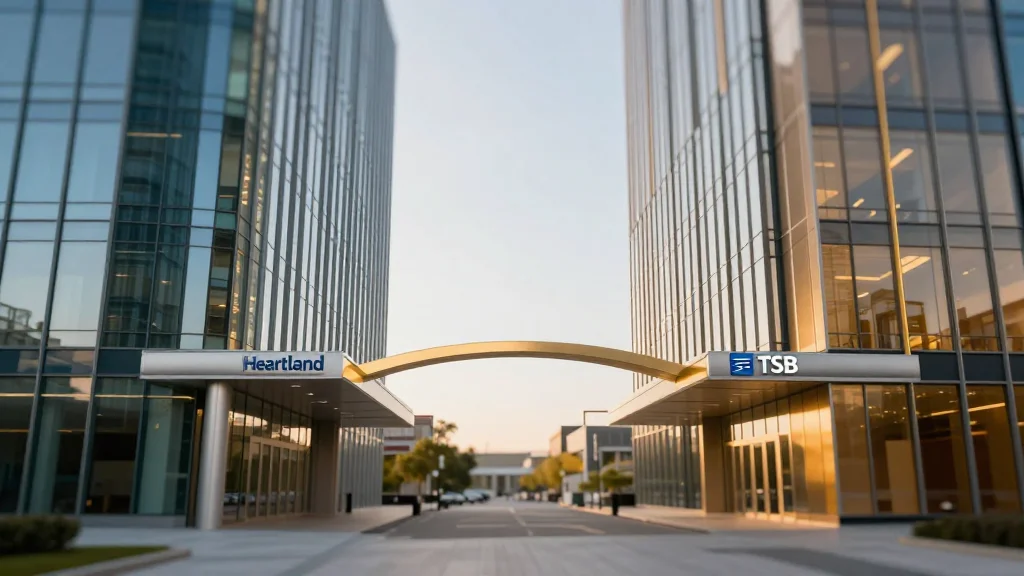
Heartland to Acquire TSB for $620 M, Creating New Zealand’s Seventh‑Largest Bank

Companies Mentioned
Why It Matters
The Heartland‑TSB merger represents one of the most consequential banking consolidations in Oceania this year, directly affecting the investment‑banking landscape that underwrites such transactions. By creating a new challenger bank with $15 billion in assets, the deal expands the pool of mid‑size institutions that can service corporate clients, potentially increasing demand for advisory, capital‑raising, and risk‑management services from investment banks. Moreover, the transaction underscores the appetite for scale in a market traditionally dominated by a handful of large players, signaling that regional banks are willing to pursue bold M&A strategies to compete. For investors and lenders, the merger introduces a new credit profile to assess, while regulators will need to evaluate the competitive impact on pricing, product availability, and systemic risk. The successful completion of the deal could encourage other regional banks to explore similar partnerships, further energising the M&A pipeline and creating opportunities for investment‑banking firms to advise on future consolidations, divestitures, and capital‑raising initiatives.
Key Takeaways
- •$620 million cash consideration for TSB shares
- •Transaction costs estimated at $15 million, split across FY 2026 and FY 2027
- •Combined assets of approximately $15 billion, a 171 % increase for Heartland
- •Target completion date set for December 2026, pending regulatory approvals
- •New entity to become New Zealand’s seventh‑largest bank
Pulse Analysis
Heartland’s aggressive expansion through acquisition reflects a broader shift in New Zealand’s banking sector, where scale is increasingly viewed as essential to compete with the entrenched big‑four. Historically, the market has been resistant to large‑scale M&A due to regulatory caution and the high cost of integration. However, Heartland’s successful cross‑border acquisition of an Australian ADI demonstrates its capability to navigate complex regulatory environments and integrate disparate operations, giving it a competitive edge in executing the TSB deal.
From an investment‑banking perspective, the merger creates a fertile ground for ancillary services. The combined bank will likely seek to diversify its funding sources, refinance existing debt, and possibly pursue further strategic acquisitions to cement its regional presence. Investment banks can capture advisory fees from these activities, as well as underwriting opportunities for any future capital raises. Additionally, the transaction’s size and complexity may attract global banks to provide financing or co‑lead advisory, further integrating New Zealand’s market with international capital flows.
Looking ahead, the success of the Heartland‑TSB merger could catalyse a wave of consolidation among mid‑tier banks seeking to achieve economies of scale and broaden product offerings. If the regulatory process proceeds smoothly, the deal may set a benchmark for valuation multiples in the region, influencing how future deals are priced. Conversely, any delays or community pushback could temper enthusiasm, highlighting the importance of stakeholder engagement in regional banking M&A. Overall, the transaction underscores the pivotal role of investment banks as both facilitators and beneficiaries of consolidation trends in the Oceania financial services landscape.
Heartland to Acquire TSB for $620 M, Creating New Zealand’s Seventh‑Largest Bank
Comments
Want to join the conversation?
Loading comments...