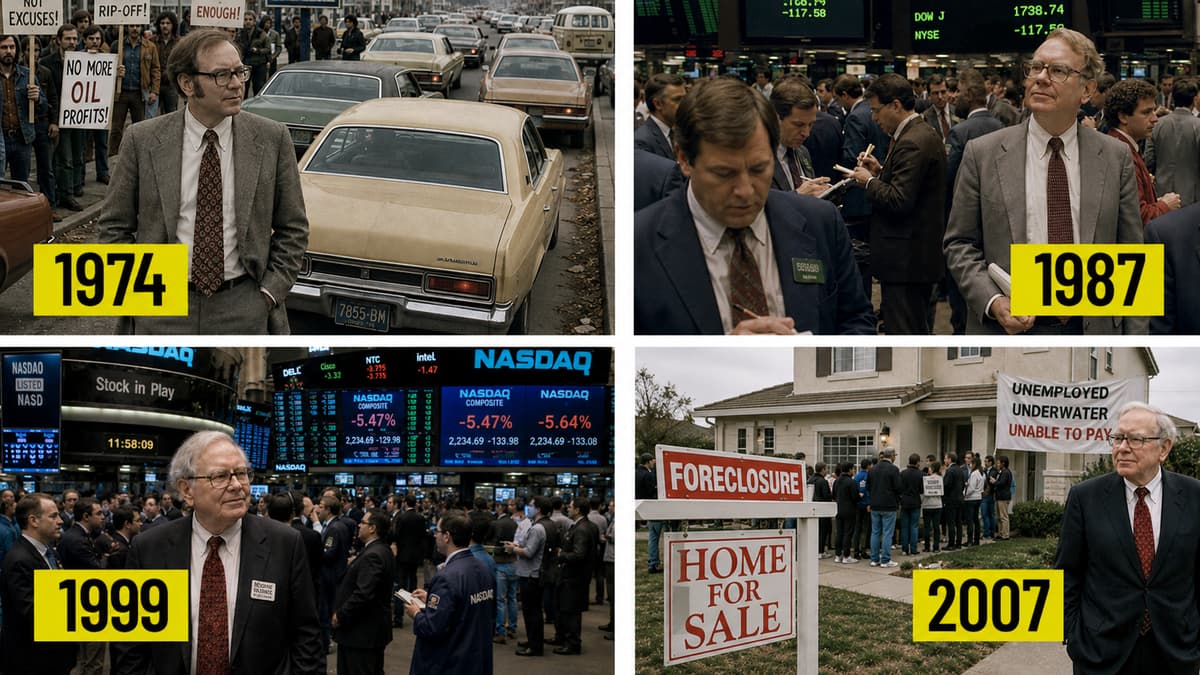
Buffett Spent 60 Years Ignoring Tech and the Bill Is Coming Due
Companies Mentioned
Why It Matters
The size of Berkshire’s cash hoard forces a strategic choice between waiting for a market crash or redeploying capital into undervalued, technology‑exposed assets, a decision that could reshape its long‑term return profile. For value investors, the contrast between idle cash and the tech‑driven market rally highlights where risk‑adjusted opportunities may be hiding.
Key Takeaways
- •Berkshire holds $347 billion cash, ~40% of market cap
- •BRK.B underperforms S&P 500 by 2.6% annualized over ten years
- •Gap widened to 39% over the past year
- •Constellation Software seen as Buffett‑like AI‑resilient SaaS play
- •Berkshire’s AI adoption lagging in rail and insurance units
Pulse Analysis
Berkshire Hathaway’s $347 billion cash pile is the most visible sign of a strategic crossroads. Historically, the conglomerate has used excess cash to fund opportunistic acquisitions when markets dip, a play that Warren Buffett described as “waiting for blood in the streets.” In a market that has surged to new highs, idle cash represents an opportunity cost, especially as the S&P 500’s technology‑heavy “Magnificent Seven” generate outsized multiples. Analysts argue that the longer Berkshire sits on cash, the more pressure it faces to justify its defensive posture to shareholders who demand capital efficiency.
The performance gap between BRK.B and the broader index underscores Buffett’s long‑standing aversion to high‑growth tech stocks. Over the last decade the stock has trailed the S&P 500 by 2.6 percentage points annually, and that lag ballooned to roughly 39% in the past twelve months as investors poured capital into mega‑cap platforms. While Berkshire’s public portfolio now includes Apple, Alphabet and Amazon—adds driven by Todd Combs and Ted Weschler—the core businesses remain rooted in rail, insurance and energy, sectors that lack the growth velocity of the tech giants. This divergence raises questions about whether the conglomerate can capture the next wave of compounding returns without a more aggressive tech exposure.
Against this backdrop, James Early’s endorsement of Constellation Software offers a nuanced contrarian narrative. Constellation’s strategy of acquiring niche, vertical‑market SaaS firms creates durable cash flows and high customer retention, traits that align with classic Buffett criteria. Moreover, the company’s perceived resilience to an AI‑driven disruption—because its solutions are highly specialized—makes it an attractive hedge against the broader market’s AI hype. For investors watching Berkshire’s cash decisions, Constellation illustrates how value‑oriented capital can still find upside in technology, provided the exposure is disciplined and focused on long‑term competitive moats.
Buffett Spent 60 Years Ignoring Tech and the Bill Is Coming Due
Comments
Want to join the conversation?
Loading comments...