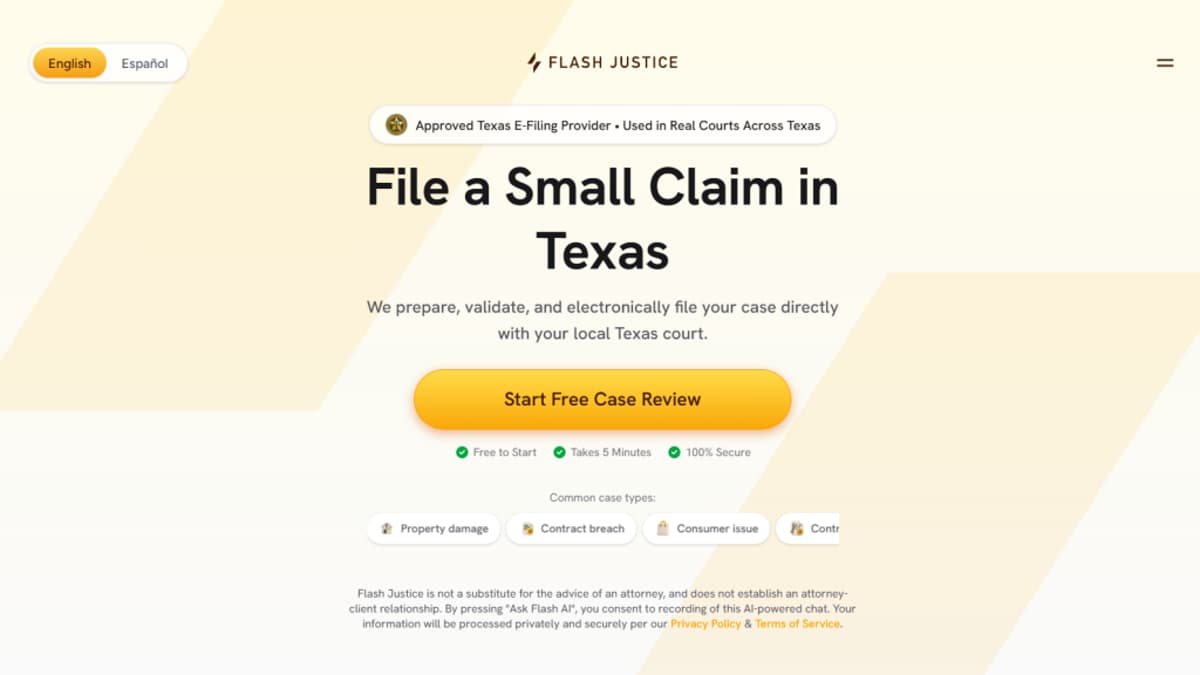
Flash Justice Aims to Take Small-Claims Plaintiffs Not Just to the Form, But All the Way Through Filing
Key Takeaways
- •Flash Justice offers full‑service small‑claims filing in Texas
- •Platform includes free case review and automated form completion
- •Users file claims up to 80% faster than traditional DIY
- •Service priced at $199 per claim, undercutting attorney fees
- •Targets $5 billion U.S. small‑claims market, starting with Texas
Pulse Analysis
Small‑claims courts handle disputes under a modest monetary threshold, typically $10,000 in Texas, offering a faster, cheaper alternative to full‑scale litigation. Yet the process remains daunting for laypeople: locating the correct jurisdiction, completing paper forms, and meeting strict filing deadlines can deter many from pursuing legitimate grievances. Legal‑tech firms have begun to address this gap, but most solutions stop at form‑generation, leaving users to navigate the final filing steps alone. The resulting friction contributes to a persistent justice‑access problem, especially among consumers and micro‑businesses.
Flash Justice, founded by Israeli entrepreneur Erez Vega‑Kadoch, launches an end‑to‑end platform that guides plaintiffs from an initial free case review through automated form completion to electronic filing with the Texas district clerk. The service bundles a questionnaire that maps facts to the appropriate claim type, auto‑populates the official PDF, and submits it via the state’s e‑filing portal, eliminating manual uploads. Priced at $199 per claim, the offering undercuts traditional attorney retainers that can exceed $1,000 for a simple dispute, while promising filing times up to 80 % faster than DIY attempts.
If Flash Justice can scale beyond Texas, it could reshape the $5 billion U.S. small‑claims market by turning a traditionally paper‑heavy process into a digital commodity. Competitors such as LegalZoom and Rocket Lawyer already provide form templates, but none combine free legal triage, AI‑driven document assembly, and direct e‑filing in a single workflow. Success will hinge on court acceptance of third‑party submissions and the platform’s ability to maintain data security across jurisdictions. Investors are watching closely, as a proven model may inspire similar services for other low‑value courts, expanding access to justice while generating recurring SaaS revenue.
Flash Justice Aims to Take Small-Claims Plaintiffs Not Just to the Form, But All the Way through Filing
Comments
Want to join the conversation?