Intelligence, Rearranged: How Agents Are Changing Legal Work
Key Takeaways
- •Harvey agents now self‑prompt, select tools, and iterate without human‑coded paths
- •Daily execution exceeds 700,000 tasks; weekly term extraction tops 50 million
- •Agent accuracy jumped from 41% to 88% in recent experiments
- •Judgment becomes the scarce resource; firms can scale it via AI
Pulse Analysis
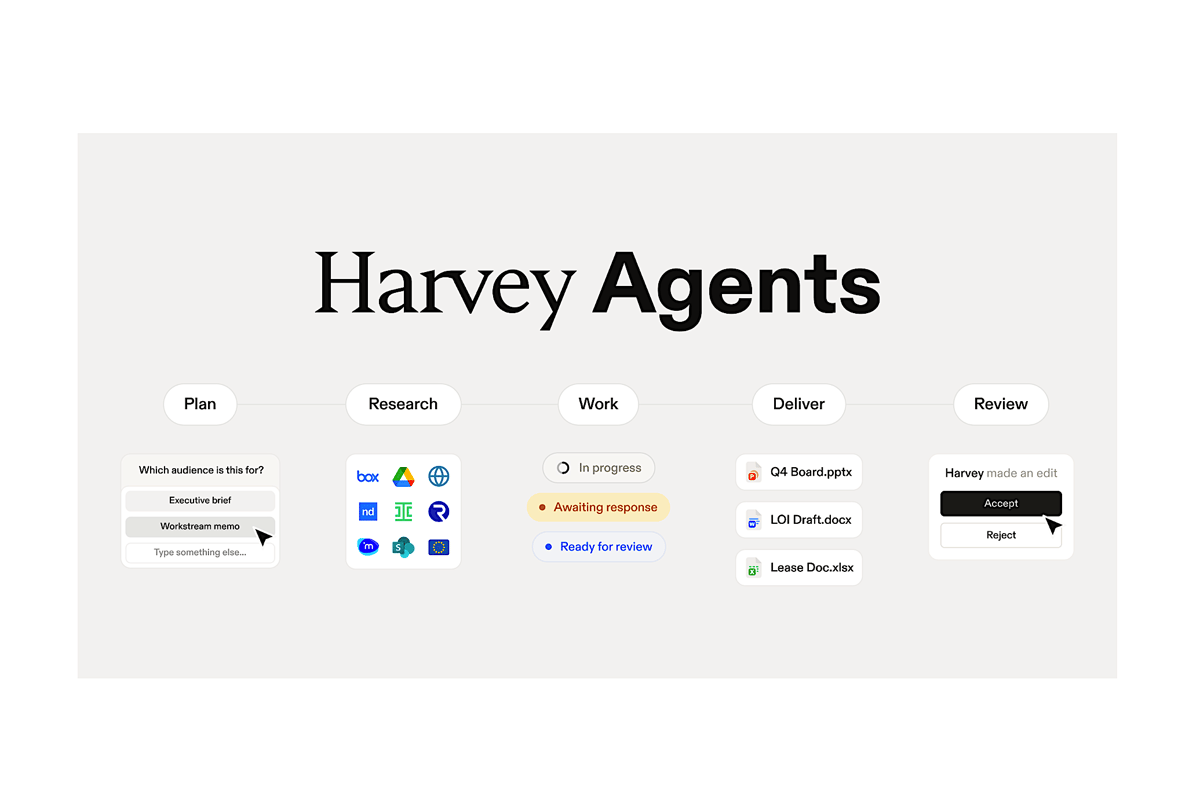
The legal industry has long relied on layered work: systematic research and extraction followed by nuanced judgment. Harvey’s latest AI agents blur that line by taking control of the reasoning loop, planning their own approach, evaluating intermediate results, and iterating until a quality threshold is met. This evolution mirrors a broader AI trend where foundation models sustain coherent multi‑step reasoning, turning them from narrow assistants into autonomous problem‑solvers.
Two technical breakthroughs made this possible. First, large language models now maintain logical consistency across extended sequences, a qualitative leap from earlier versions that degraded after a few steps. Second, Harvey’s execution infrastructure—sandboxed environments, scoped tool access, and durable audit trails—provides the reliability needed for high‑stakes legal work. The platform already handles more than 700,000 agentic tasks each day and extracts over 50 million contractual terms weekly. In a controlled experiment, agents improved their success rate on complex assignments from roughly 41% to 88% after self‑guided refinement, demonstrating the practical upside of AI‑driven reasoning.
For law firms, the implication is profound. When routine intelligence becomes abundant, the limiting factor shifts to human judgment. Firms that embed strategic frameworks into reusable AI workflows can extend a partner’s expertise across dozens of matters, compressing the production base while expanding service scope. This reallocation of resources promises higher leverage ratios, lower reliance on billable hours, and new revenue models centered on insight rather than output. Early adopters who integrate Harvey’s agents into their practice stand to redefine the economics of legal service delivery and gain a decisive market advantage.
Intelligence, Rearranged: How Agents Are Changing Legal Work
Comments
Want to join the conversation?