Universal Migrator Releases Scripts to Migrate Tussman, CollectMax and LeadDocket to Clio, MyCase, Litify and Lawmatics
•February 26, 2026
0
Why It Matters
The scripts accelerate law‑firm technology transitions while lowering migration risk, giving consultants a faster, more reliable path to modern practice‑management solutions.
Key Takeaways
- •New scripts cover Tussman, CollectMax, LeadDocket migrations
- •Supports major platforms: Clio, MyCase, Litify, Lawmatics
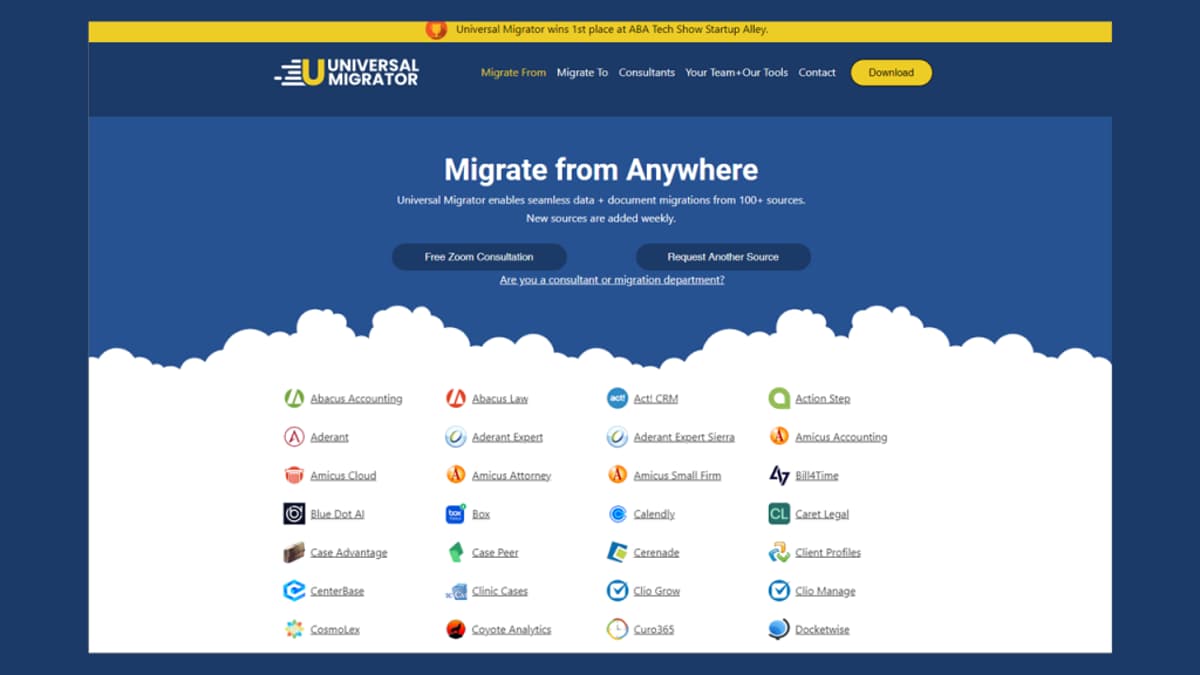
- •Library now exceeds 138 integrated legal applications
- •Enables faster, lower‑cost law firm system switches
- •Boosts consultants’ ability to offer seamless data transfers
Pulse Analysis
Data migration has long been a bottleneck for law firms seeking to upgrade their practice‑management stacks. Legacy systems often store case files, billing records, and client communications in proprietary formats, making manual transfers labor‑intensive and error‑prone. As firms chase cloud‑based solutions for scalability and compliance, the need for reliable, automated migration pathways has intensified. Universal Migrator’s new scripts directly address this pain point by translating data structures from Tussman, CollectMax and LeadDocket into the schemas used by top‑tier platforms, thereby reducing downtime and preserving data integrity.
The freshly released scripts broaden the company’s integration catalog to more than 138 applications, spanning CRM, billing, and document‑management tools. For legal‑tech consultants, this means a single‑source toolkit that can handle end‑to‑end migrations without resorting to custom code or third‑party services. By supporting Clio, MyCase, Litify and Lawmatics—four of the most widely adopted solutions—the scripts enable consultants to offer clients a plug‑and‑play upgrade experience, cutting project timelines by an estimated 30‑40 percent and lowering overall migration costs.
Industry analysts view this move as a strategic push to cement Universal Migrator’s role as the de‑facto middleware layer in the legal‑tech ecosystem. As competition among practice‑management vendors intensifies, firms will increasingly demand seamless data portability to avoid vendor lock‑in. Universal Migrator’s expanding library not only meets that demand but also creates a network effect: the more platforms it supports, the more valuable its service becomes for both consultants and end‑users. Looking ahead, the company is likely to add scripts for emerging AI‑driven case‑analysis tools, further solidifying its position at the intersection of legal operations and technology.
Universal Migrator Releases Scripts to Migrate Tussman, CollectMax and LeadDocket to Clio, MyCase, Litify and Lawmatics
0
Comments
Want to join the conversation?
Loading comments...