Kirkland Didn't Buy Legal AI. They Bought a Moat.

Key Takeaways
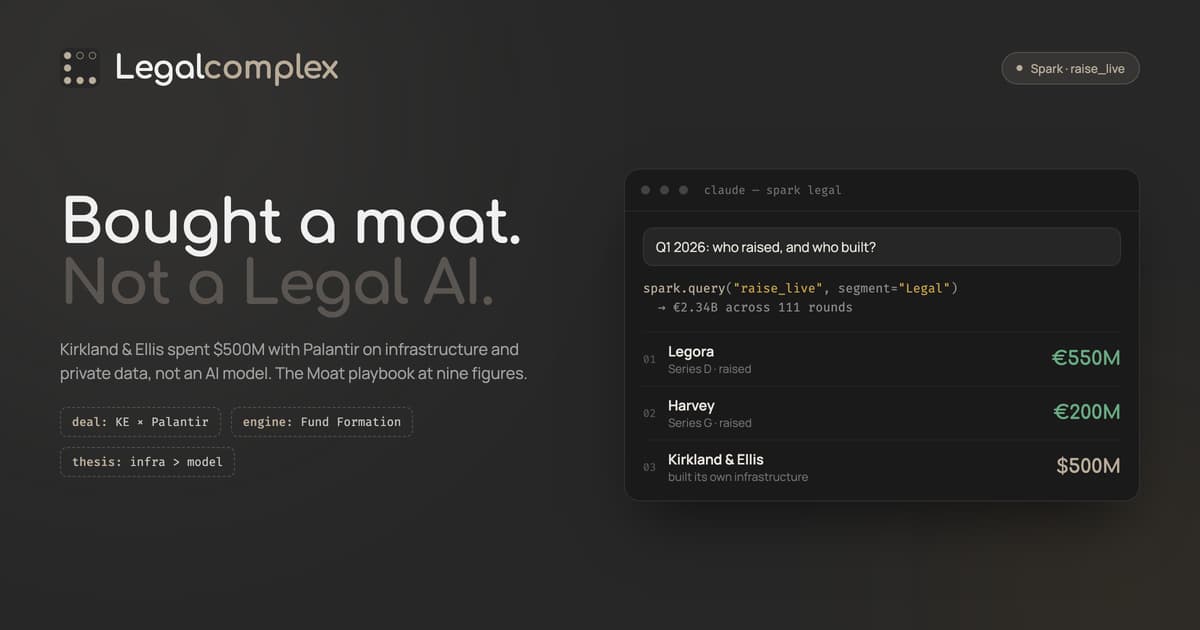
- •Kirkland & Ellis spent $500 M on Palantir‑powered Fund Formation Engine
- •Engine uses ontology with per‑object permissions for LP‑specific data
- •Private‑equity fund terms become the moat, not the AI model
- •Market trend: legal‑tech funding hit $2.55 B in Q1 2026
- •Competitors are buying wrappers; only firms building infrastructure gain durable advantage
Pulse Analysis
Kirkland & Ellis’s partnership with Palantir marks a watershed moment for legal AI, moving the conversation from generic large‑language models to purpose‑built infrastructure. By leveraging Palantir’s Ontology and fine‑grained entitlement graphs, the Fund Formation Engine can isolate each limited partner’s data slice, preventing the cascade of information leaks that can destabilize a fund’s economics. This architecture transforms the firm’s internal knowledge—thousands of side‑letter clauses and bespoke fee structures—into a defensible moat that rivals cannot replicate with off‑the‑shelf AI tools.
The broader legal‑tech landscape is echoing this shift. Venture capital poured roughly $2.55 billion into the sector in the first quarter of 2026, underscoring investor appetite for solutions that marry compliance with competitive advantage. While startups like Legora and Harvey continue to raise sizable rounds for AI wrappers, the real value is emerging in layers that manage data governance, audit trails, and on‑prem model fine‑tuning. Kirkland’s $500 million spend illustrates that firms with deep pockets are willing to invest heavily in infrastructure that safeguards client confidentiality and embeds proprietary judgment, a strategy that could redefine market dynamics for elite practice groups.
However, the moat is not without challenges. Regulatory scrutiny over data‑as‑property and professional ethics concerning monopolistic control of legal workflows could constrain widespread adoption. Moreover, the “seams”—the need to ingest public law while protecting confidential prompts—remain a technical hurdle that only on‑prem GPU deployments can fully address today. As more firms experiment with private AI appliances, the industry will watch whether Kirkland’s model becomes a template for sustainable competitive advantage or a fleeting first‑mover edge.
Kirkland Didn't Buy Legal AI. They Bought a Moat.
Comments
Want to join the conversation?