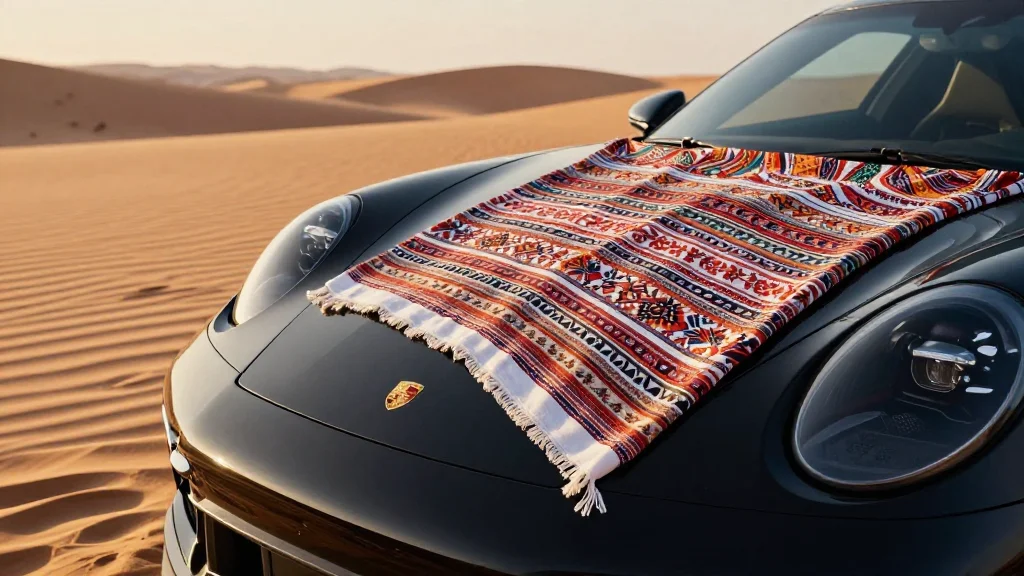
Porsche Rolls Out Ultra‑Exclusive 911 Turbo S Sadu Edition for Kuwait, Handwoven Bedouin Textiles

Companies Mentioned
Why It Matters
The 911 Turbo S Sadu Edition illustrates how luxury automakers are moving beyond performance specs to embed cultural narratives into their products. By partnering with local artisans and limiting production to a single market, Porsche creates a unique value proposition that appeals to both national pride and global collector interest. This approach could set a template for other premium brands seeking deeper market penetration in the Gulf, where wealth and a desire for distinctive, heritage‑linked luxury converge. Moreover, the edition highlights the growing importance of hyper‑localization in the luxury sector. As affluent consumers increasingly seek products that reflect personal identity and regional heritage, manufacturers that can authentically integrate cultural elements stand to gain a competitive edge. Porsche’s Sadu Edition may therefore accelerate a shift toward more bespoke, culturally resonant offerings across the high‑end automotive and broader luxury landscape.
Key Takeaways
- •Porsche unveiled the 911 Turbo S Sadu Edition, limited to 20 units and sold exclusively in Kuwait.
- •The model features hand‑woven Bedouin textiles on seat inserts and a decorative Bedouin‑inspired decal.
- •Mechanically identical to the standard Turbo S, it delivers 701 hp, 590 lb‑ft of torque, 0‑60 mph in 2.4 seconds, and a top speed of 200 mph.
- •The edition commemorates 70 years of Porsche’s presence in Kuwait, dating back to the first 356 Cabriolet imported in 1956.
- •Pricing is undisclosed but expected to exceed the base Turbo S price of $270,300 due to bespoke interior work and exclusivity.
Pulse Analysis
Porsche’s Sadu Edition is more than a marketing stunt; it reflects a strategic pivot toward cultural authenticity in ultra‑luxury. Historically, limited‑run models have relied on performance upgrades or exotic materials to justify premium pricing. This edition, however, leverages a centuries‑old Bedouin weaving tradition, turning a mechanical masterpiece into a cultural artifact. That blend of heritage and horsepower resonates strongly in the Gulf, where consumers value both cutting‑edge technology and a tangible connection to regional identity.
From a market perspective, the Sadu Edition could catalyze a new wave of region‑specific collaborations. Luxury brands across fashion, watches, and even tech have already experimented with localized designs, but automotive makers have been slower due to the high cost of retooling. Porsche’s use of its Exclusive Manufaktur program to integrate hand‑woven textiles demonstrates that bespoke interior work can be scaled without altering the underlying platform, preserving economies of scale while delivering true exclusivity. Competitors such as Ferrari and Lamborghini may feel pressure to develop comparable culturally infused editions, potentially sparking a niche segment of heritage‑driven hyper‑cars.
Looking ahead, the success of the Sadu Edition will hinge on consumer response and resale performance. If the limited run commands a significant premium on the secondary market, it will validate the business case for further regional editions. Conversely, if demand stalls, manufacturers may retreat to more conventional limited‑run strategies focused on performance or technology. Either way, Porsche’s gamble underscores a broader industry reckoning: luxury is no longer defined solely by engineering excellence, but increasingly by the story a product tells and the cultural resonance it carries.
Porsche Rolls Out Ultra‑Exclusive 911 Turbo S Sadu Edition for Kuwait, Handwoven Bedouin Textiles
Comments
Want to join the conversation?
Loading comments...