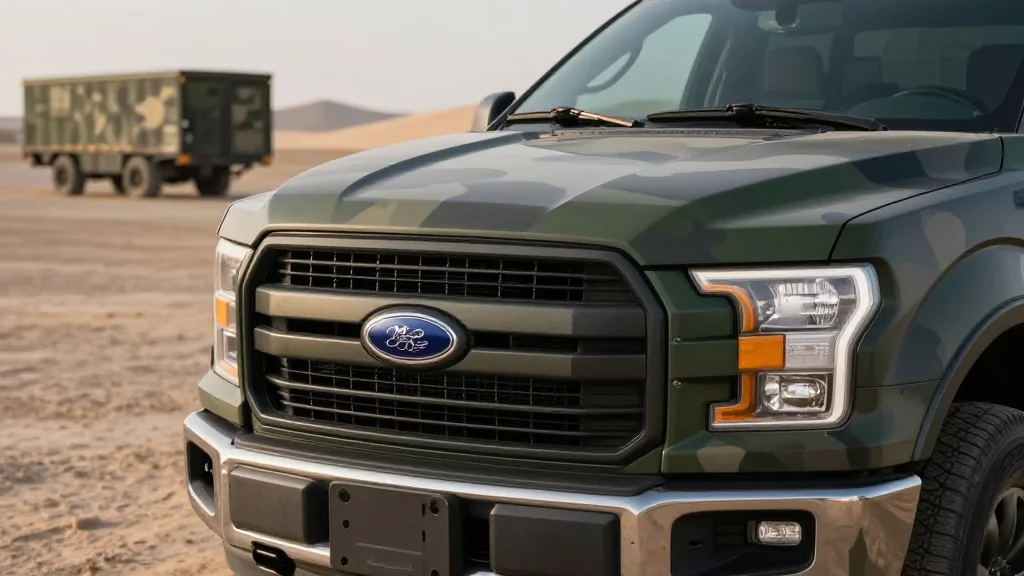
Ford and GM Vie for New U.S. Defense Contracts, Targeting Military Truck Market

Companies Mentioned
Why It Matters
The entry of two of America’s biggest automakers into the defense arena signals a fundamental shift in how the Pentagon sources hardware. By leveraging mass‑produced trucks, the military can cut development cycles and lower unit costs, potentially accelerating fielding of new capabilities in a time of heightened geopolitical tension. Moreover, the move blurs the line between civilian and military manufacturing, raising questions about supply‑chain security, technology transfer, and the future role of traditional defense primes. If Ford and GM secure sizable contracts, the ripple effects could extend to their supplier ecosystems, spurring investment in ruggedized components, advanced powertrains, and autonomous vehicle technologies. Conversely, a failure to win contracts may prompt a strategic reassessment of how commercial OEMs engage with government procurement, influencing future policy on defense‑industrial collaboration.
Key Takeaways
- •Ford announced early talks to supply F‑Series and Ranger trucks for military use.
- •GM Defense received an $18.8 million contract for Infantry Squad Vehicles, part of a $458.4 million program.
- •U.S. Army Secretary Dan Driscoll urged commercial firms to step into defense roles.
- •The Pentagon’s $5.6 billion Salesforce contract exemplifies the shift toward non‑traditional suppliers.
- •Analyst David Whiston highlighted Ford’s larger commercial base as a new revenue opportunity.
Pulse Analysis
Ford’s foray into defense manufacturing is less a diversification gamble than a calculated response to a Pentagon that is actively de‑risking its supply chain. Historically, the U.S. defense sector has relied on a handful of legacy primes, but recent reforms—driven by budget pressures and the need for rapid fielding—have opened doors for commercial OEMs that can deliver proven platforms at scale. Ford’s F‑Series, already produced in volumes exceeding 800,000 units annually, offers a ready‑made chassis that can be hardened, armored, and equipped with mission‑specific modules far faster than a clean‑sheet design.
GM’s head start with GM Defense gives it a competitive edge, but Ford’s broader commercial footprint and deeper relationships with Tier‑1 suppliers could translate into cost advantages and faster iteration cycles. The real contest will be over integration of emerging technologies—such as electric drivetrains and autonomous systems—into rugged military platforms. If either automaker can successfully marry its civilian innovation pipeline with defense requirements, it could redefine the economics of ground‑force logistics and set a new benchmark for public‑private partnership in national security.
Looking ahead, the upcoming FY 2027 defense budget request will likely earmark funds for "commercial‑off‑the‑shelf" (COTS) solutions, making the next six months critical for both Ford and GM to lock in prototype demonstrations and secure early‑stage contracts. Success could usher in a wave of similar moves by other manufacturers, fundamentally reshaping the U.S. defense industrial base and potentially prompting a reevaluation of export controls and technology‑transfer policies.
Ford and GM Vie for New U.S. Defense Contracts, Targeting Military Truck Market
Comments
Want to join the conversation?
Loading comments...