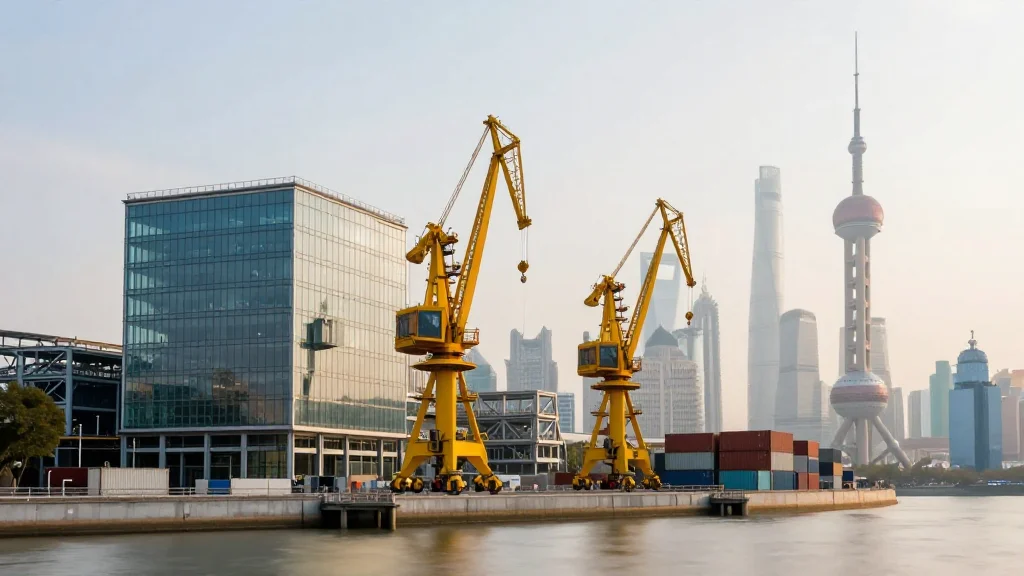
Foreign Firms Invest $175 M in Shanghai Manufacturing Hubs, Doubling New FIEs YoY

Companies Mentioned
Why It Matters
The surge in foreign manufacturing investment signals a re‑balancing of global production networks toward China’s coastal hubs, where advanced automation and supportive local policies lower operational risk. For multinational firms, Shanghai offers a blend of market access, skilled labor, and a regulatory environment that encourages rapid deployment of smart‑factory technologies, potentially reshaping supply‑chain configurations worldwide. If the trend continues, Shanghai could become a benchmark for other Chinese cities seeking to attract high‑tech manufacturing, prompting a cascade of infrastructure upgrades, talent development programs, and further foreign capital inflows. The competitive advantage gained by early adopters like Estée Lauder and ZEISS may also pressure rivals to accelerate their own automation roadmaps, intensifying the race for AI‑driven efficiency in consumer and industrial sectors.
Key Takeaways
- •ZEISS invests 1.2 billion yuan ($174.86 M) in a new Greater China campus, the largest in China.
- •Estée Lauder launches a 24/7 lights‑out supply‑chain center, aiming to double next‑day delivery coverage.
- •Shanghai recorded 996 new foreign‑invested enterprises in Jan‑Feb 2024, up 14.1% YoY.
- •The city now hosts 1,091 multinational regional HQs and 654 foreign‑funded R&D centers.
- •Local government support helped ZEISS start construction ahead of schedule.
Pulse Analysis
Shanghai’s recent investment surge reflects a strategic pivot by multinationals toward China’s high‑value manufacturing ecosystem. The combination of policy incentives, a mature logistics network, and a growing talent pool creates a fertile environment for AI‑enabled factories. Estée Lauder’s lights‑out hub illustrates how consumer brands are leveraging automation not just for cost savings but to meet increasingly demanding delivery expectations in a market where e‑commerce penetration exceeds 80%.
ZEISS’s sizable campus underscores a broader trend: precision‑technology firms are anchoring R&D and production in Shanghai to tap into local supply chains and benefit from government‑driven innovation clusters. This mirrors earlier moves by semiconductor and electric‑vehicle manufacturers, suggesting a convergence of advanced manufacturing domains within the city’s industrial parks.
However, the optimism is not without risk. Geopolitical tensions, especially around technology transfer and export controls, could constrain the flow of critical components. Moreover, the rapid influx of foreign capital may intensify competition for skilled engineers, driving up labor costs and potentially eroding some of the cost advantages that originally attracted investors. Companies will need to balance the lure of Shanghai’s ecosystem with diversification strategies to mitigate supply‑chain disruptions.
In the medium term, Shanghai’s ability to sustain this growth will hinge on continued policy clarity, infrastructure upgrades—particularly in power and data connectivity—and the city’s capacity to integrate foreign firms into its broader industrial agenda without stoking protectionist backlash. If managed well, Shanghai could solidify its status as the premier gateway for high‑tech manufacturing in Asia, reshaping global production maps for the next decade.
Foreign Firms Invest $175 M in Shanghai Manufacturing Hubs, Doubling New FIEs YoY
Comments
Want to join the conversation?
Loading comments...