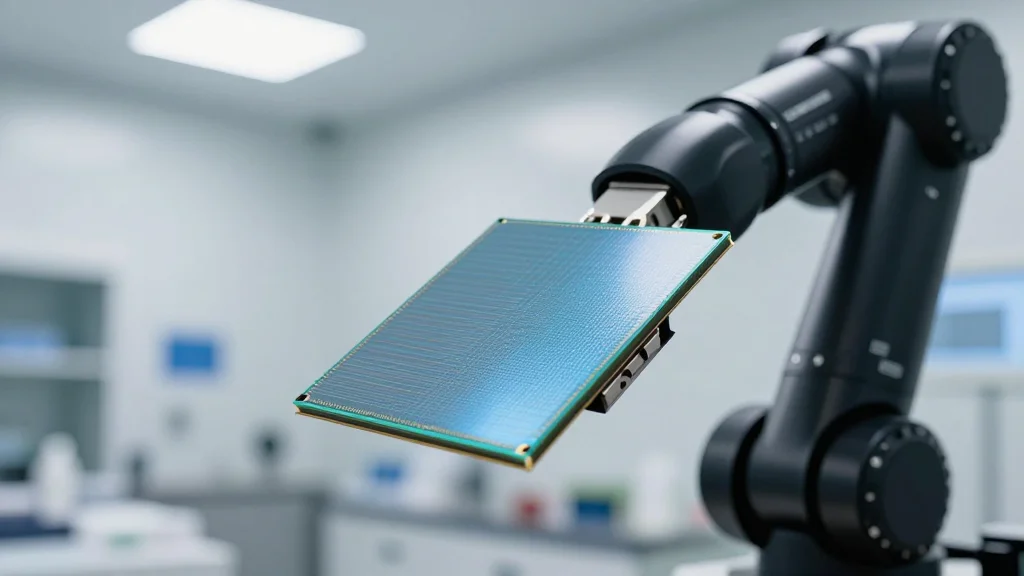
Huawei's HiSilicon Unveils "Tau's Scaling Law" To Bridge China‑West Chip Gap

Companies Mentioned

Why It Matters
Closing the performance gap between Chinese and Western chips could alter the balance of power in AI development, high‑performance computing, and defense applications. By reducing reliance on foreign fabs, China may mitigate the strategic leverage that U.S. export controls currently provide, potentially reshaping global supply‑chain dynamics. For manufacturers, a shift toward architecture‑centric performance gains could lower the barrier to entry for advanced chip design, encouraging a wave of innovation that sidesteps the costly, multi‑billion‑dollar lithography investments that have traditionally defined the industry. This could democratize access to high‑end silicon, but also raise new concerns about standards, interoperability, and security across borders.
Key Takeaways
- •HiSilicon unveiled "Tau's Scaling Law," a design method focused on system‑wide compute acceleration.
- •Prototype chip expected before winter 2026; performance target equals 1.4nm process by 2031.
- •Method replaces Moore's Law with techniques like LogicFolding and high‑speed interconnects.
- •U.S. sanctions force Huawei to use SMIC’s older lithography, creating a >5‑year lag with TSMC.
- •Analyst Lennart Heim warns the approach’s scalability without cutting‑edge fabs is unproven.
Pulse Analysis
Tau’s Scaling Law represents a strategic pivot from the decades‑old transistor‑count race to a holistic performance‑first philosophy. By targeting data‑movement latency and logical operation efficiency, HiSilicon is betting that architectural gains can offset the physical limits imposed by older lithography. If successful, this could inaugurate a new class of chips where system‑level optimization rivals raw transistor density, echoing past shifts such as the move from single‑core to multi‑core designs.
Historically, breakthroughs that sidestepped Moore’s Law—like 3D stacking and chiplet integration—required massive ecosystem support and new manufacturing standards. Huawei’s approach will need to convince not only internal engineers but also external partners, including SMIC and downstream device makers, to adopt new design flows. The winter‑2026 prototype will be the first real test of whether the theoretical speedups translate into silicon yields and cost structures that can compete with TSMC’s 5‑nm and upcoming 3‑nm nodes.
Looking ahead, the broader market impact hinges on two variables: the ability to mass‑produce the new architecture at competitive cost, and the geopolitical response to a potential erosion of U.S. export leverage. Should Huawei demonstrate a viable path, other constrained players—such as those in Europe or emerging markets—may emulate the model, accelerating a diversification of the semiconductor supply chain. Conversely, if the prototype falls short, it could reaffirm the primacy of advanced lithography and reinforce the current sanctions regime’s effectiveness.
Huawei's HiSilicon Unveils "Tau's Scaling Law" to Bridge China‑West Chip Gap
Comments
Want to join the conversation?
Loading comments...