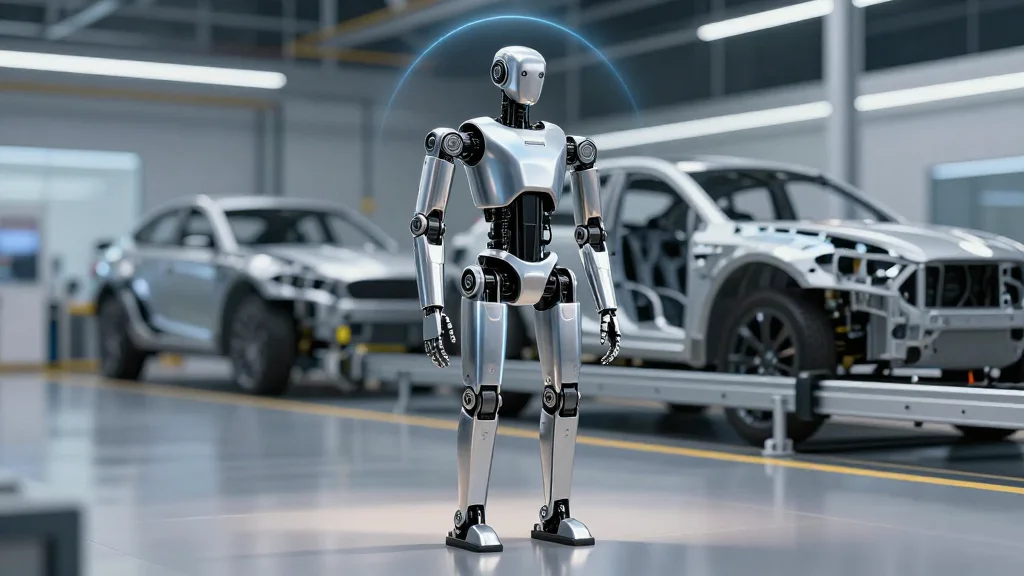
Hyundai Motor Group to Deploy 25,000 Boston Dynamics Atlas Robots by 2028

Companies Mentioned


Why It Matters
The deployment of tens of thousands of humanoid robots in automotive factories could redefine the economics of labor‑intensive assembly tasks, reducing reliance on human workers for repetitive or ergonomically hazardous jobs. By embedding AI‑driven decision‑making at the robot level, Hyundai aims to create a more flexible production system that can adapt in real time to supply‑chain disruptions or model changes, a capability that traditional fixed‑automation lacks. Beyond the auto sector, the success of Hyundai’s robot value chain could serve as a template for other heavy‑manufacturing industries—such as aerospace, shipbuilding, and consumer‑electronics—seeking to modernize their factories. The integration of a dedicated actuator supply line and a data‑rich testbed like RMAC may lower entry barriers for large‑scale humanoid robot adoption worldwide, accelerating the shift toward fully autonomous factories.
Key Takeaways
- •Hyundai Motor Group plans to install >25,000 Boston Dynamics Atlas robots across its factories.
- •Target annual robot production of 30,000 units by 2028, using a "robots assemble robots" model.
- •Robot Metaplant Application Center (RMAC) in Georgia to begin operations this summer.
- •Hyundai Mobis to produce 350,000+ actuators per year to keep robot costs competitive.
- •Internal demand for 25,000 robots provides a guaranteed launch market for the rollout.
Pulse Analysis
Hyundai’s aggressive push into humanoid robotics marks a strategic diversification that could insulate the conglomerate from the cyclical nature of vehicle sales. By leveraging its existing supply‑chain expertise and massive scale, Hyundai can amortize the high upfront R&D costs of Atlas across a broad internal customer base, something smaller OEMs cannot easily replicate. This vertical integration mirrors the approach taken by Japanese manufacturers in the 1990s, who internalized component production to control quality and cost.
The partnership with Boston Dynamics also gives Hyundai a technological edge. Atlas’s reasoning AI, co‑developed with Google DeepMind, promises a level of situational awareness that could make humanoid robots viable for tasks traditionally reserved for human workers, such as complex part handling or on‑the‑fly line reconfiguration. If Hyundai can achieve the projected cost reductions, it may trigger a wave of adoption across sectors that have been hesitant due to price and reliability concerns. Competitors like Toyota and Volkswagen are watching closely; any lag in their own robotics initiatives could widen the competitive gap.
However, the rollout faces significant hurdles. Scaling from a handful of pilot robots to tens of thousands demands robust safety standards, workforce retraining, and clear regulatory frameworks. Moreover, the capital intensity of building a dedicated actuator plant and the RMAC testbed could strain Hyundai’s balance sheet if the expected productivity gains do not materialize quickly. The next 12‑18 months will be critical as pilot data emerges, shaping whether Hyundai’s vision of a robot‑centric factory becomes a new industry norm or a costly experiment.
Hyundai Motor Group to Deploy 25,000 Boston Dynamics Atlas Robots by 2028
Comments
Want to join the conversation?
Loading comments...