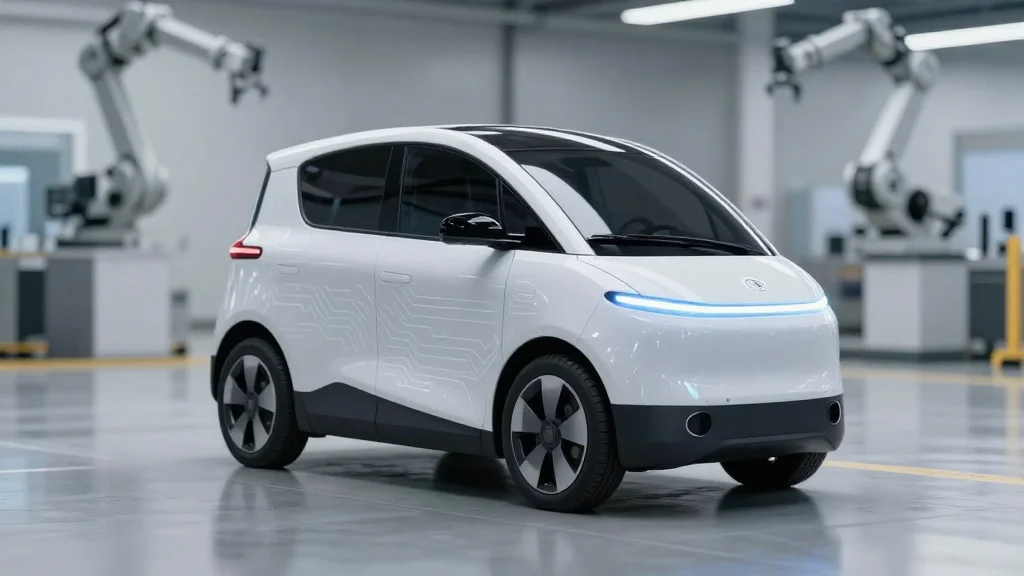
XPeng Unveils Full‑Stack Physical AI Ecosystem at Auto China, Boosting Smart Manufacturing

Companies Mentioned
Why It Matters
XPeng’s Physical AI rollout marks a turning point where artificial intelligence moves from a vehicle‑level add‑on to a core manufacturing pillar. By embedding AI chips and software directly into the assembly line, XPeng shortens the feedback loop between data collection and product improvement, enabling rapid iteration of autonomous‑driving capabilities. This approach also reduces dependence on imported high‑end semiconductors, aligning with China’s strategic goal of semiconductor self‑sufficiency and reshaping global supply‑chain dynamics. For the broader manufacturing sector, XPeng’s model demonstrates how AI can be leveraged to create “software‑defined” products, driving higher margins, new revenue streams (e.g., AI‑as‑a‑service), and a competitive edge in export markets. Moreover, the surge in Ultra series orders—up 118% month‑over‑month—shows that consumers are responding to AI‑enhanced value propositions, not just lower prices. As Chinese automakers continue to export at a 63% year‑on‑year growth rate, the Physical AI paradigm could become the new industry standard, pressuring legacy OEMs worldwide to adopt similar integrated AI manufacturing strategies or risk losing market share.
Key Takeaways
- •XPeng’s Physical AI ecosystem links Turing AI chips, VLA 2.0 software and factory integration.
- •Ultra series orders jumped 118% month‑over‑month after the Auto China showcase.
- •Nearly 100,000 demo participants recorded a 98% satisfaction rate and a 44.7% faster test‑drive‑to‑order cycle.
- •XPeng’s GX robotaxi prototype features up to four Turing chips delivering 3,000 TOPS of compute power.
- •China’s AI Plus plan and domestic chip development aim to cut reliance on foreign semiconductors.
Pulse Analysis
XPeng’s announcement at Auto China is less a product launch than a strategic declaration of manufacturing intent. By treating AI as a production input rather than a post‑sale feature, XPeng is building a virtuous cycle: AI improves manufacturing yield, which in turn generates richer data to train the next generation of AI models. This mirrors the broader shift seen in Silicon Valley’s “AI‑first” hardware firms, but XPeng is executing it within a vertically integrated EV ecosystem that includes battery, chassis and software under one roof.
The timing is critical. With China’s domestic auto market contracting, OEMs are scrambling for differentiation beyond price. XPeng’s Physical AI platform offers a high‑margin, software‑centric moat that can be monetized through subscription services, over‑the‑air updates and robotaxi fleets. Competitors such as BYD and Geely are also racing to embed AI, but XPeng’s early mover advantage—evidenced by the 118% order surge and the GX’s in‑house L4‑ready architecture—could translate into a sustainable lead in the nascent robotaxi market.
Globally, the ripple effects are profound. Western manufacturers that rely on external chip suppliers may find themselves at a disadvantage as Chinese firms like Horizon Robotics and XPeng’s own Turing line accelerate the pace of AI‑enabled vehicle production. The push for domestic chip sovereignty, reinforced by the AI Plus five‑year plan, could reshape the semiconductor supply chain, prompting a realignment of R&D investment toward AI‑optimized silicon. In short, XPeng’s Physical AI ecosystem is a bellwether for a manufacturing renaissance where software, silicon and assembly lines converge, setting a new benchmark for the global auto industry.
XPeng Unveils Full‑Stack Physical AI Ecosystem at Auto China, Boosting Smart Manufacturing
Comments
Want to join the conversation?
Loading comments...