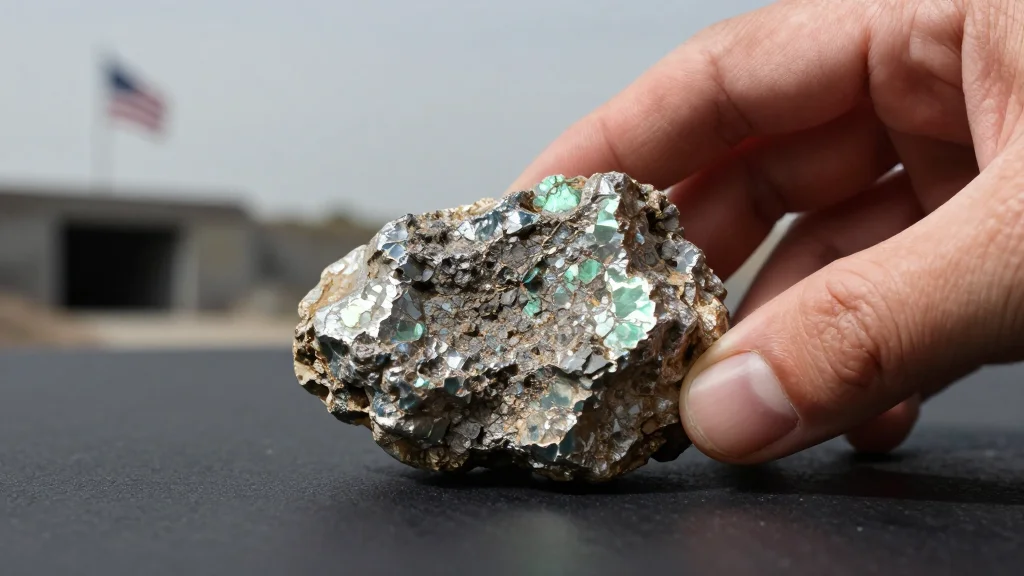
U.S. and South Africa Push Critical Minerals Deal as $50 M DFC Funding Targets Rare Earths

Why It Matters
The United States’ engagement with South Africa marks a strategic shift toward building a resilient, non‑Chinese supply chain for minerals that underpin the clean‑energy transition and national security. By channeling public capital into a low‑risk, waste‑based rare‑earth project, Washington demonstrates a model for leveraging existing industrial by‑products to meet demand quickly. For South Africa, the partnership offers a pathway to monetize its abundant but under‑exploited mineral assets, attract further foreign investment, and strengthen its position as a critical node in the global minerals network. If successful, the framework could reshape trade flows, prompting other resource‑rich nations to pursue similar bilateral deals with the United States. This would diversify global supply, potentially stabilizing prices for PGMs, chrome and manganese, and reducing the geopolitical leverage that China currently holds over the rare‑earth market.
Key Takeaways
- •U.S. DFC commits $50 million to the Phalaborwa rare‑earth project in Limpopo.
- •South Africa holds ~80% of global platinum‑group metal reserves and leads in chrome production.
- •The Phalaborwa model uses phosphogypsum waste, cutting capital costs and shortening project timelines.
- •Talks aim to create a non‑Chinese supply chain for critical minerals used in EVs, hydrogen fuel cells and aerospace.
- •A ministerial follow‑up later in 2026 will outline a detailed cooperation roadmap.
Pulse Analysis
Washington’s decision to back a waste‑derived rare‑earth project reflects a pragmatic approach to supply‑chain security: rather than betting on brand‑new mines, the U.S. is de‑risking projects that can be brought online faster and with fewer environmental hurdles. This strategy mirrors recent moves in the battery sector, where companies are repurposing legacy sites to accelerate production. The $50 million DFC injection is modest in absolute terms but significant as a signal that the U.S. government is willing to use development finance tools to shape market outcomes.
South Africa’s mineral endowment gives it leverage, but the country has historically struggled to translate reserves into sustained investment due to policy uncertainty and infrastructure gaps. The current bilateral talks, coupled with the high‑profile U.S. delegation at Mining Indaba, suggest a convergence of political will on both sides. If the Phalaborwa pilot demonstrates commercial viability, it could unlock a cascade of private‑sector capital, especially from firms seeking to certify a China‑free provenance for their products.
Looking ahead, the real test will be the ability to translate diplomatic rhetoric into binding agreements that include clear financing mechanisms, technology transfer provisions and enforceable supply‑chain monitoring. The upcoming ministerial meeting will be a litmus test for whether the partnership can move beyond pilot projects to a broader, institutionalized framework that reshapes the global critical‑minerals map.
U.S. and South Africa Push Critical Minerals Deal as $50 M DFC Funding Targets Rare Earths
Comments
Want to join the conversation?
Loading comments...