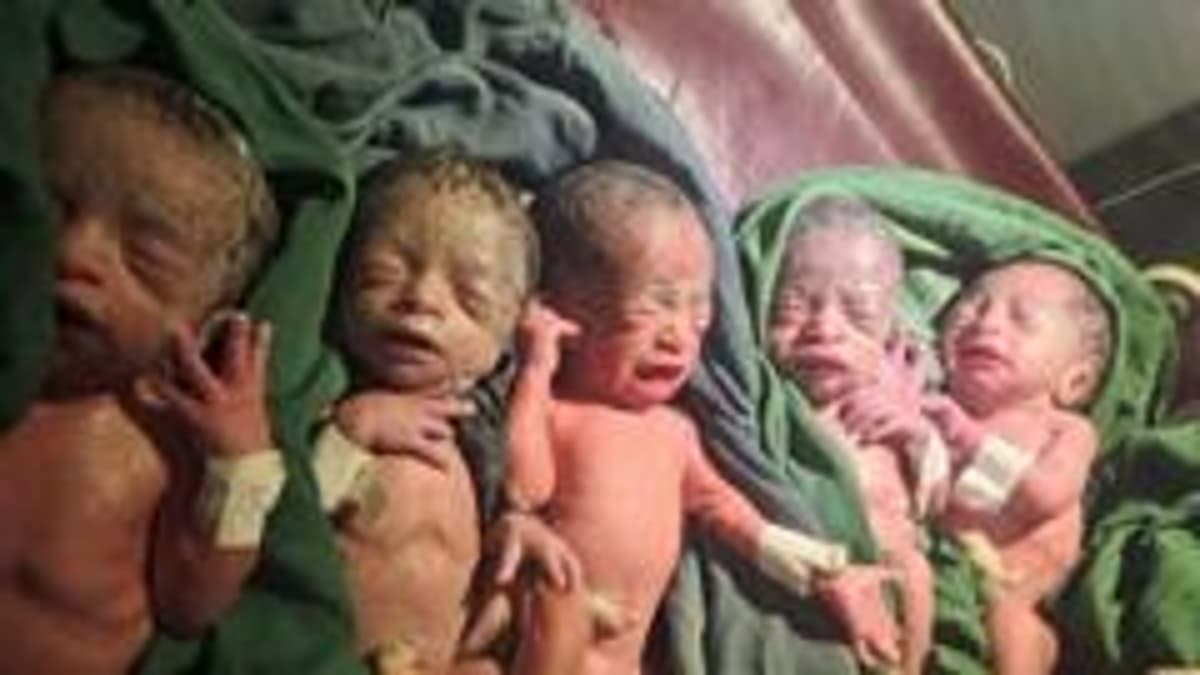
Ethiopian Woman's Joy at Rare Quintuplets After 12 Years Trying for a Baby
Why It Matters
The birth highlights the extreme rarity of high‑order multiple births without IVF and stresses the need for stronger maternal‑child health services in low‑resource settings.
Key Takeaways
- •Natural quintuplets occur roughly one in 55 million pregnancies.
- •All five infants weighed 1.3‑1.4 kg, a survival‑positive range.
- •Mother lacked IVF access; hospital provides only basic obstetric care.
- •New family confronts financial strain despite community and government aid.
Pulse Analysis
The emergence of quintuplets without assisted reproductive technology is a statistical outlier, estimated at roughly one in 55 million natural pregnancies. While IVF clinics worldwide can increase the likelihood of multiple births, the Ethiopian case demonstrates that even in the absence of such interventions, extraordinary outcomes can occur. This rarity draws attention to the broader conversation about fertility access, the role of medical technology, and the cultural pressures faced by women in societies where childbearing is closely tied to social status.
In Ethiopia’s Harari region, the delivery took place at Hiwot Fana Specialised Hospital, a facility that does not offer IVF but provides essential obstetric services. Neonates weighing over one kilogram have a markedly higher chance of survival, and the five infants’ 1.3‑1.4 kg birth weights place them within a favorable prognostic window. Nonetheless, high‑order multiples demand intensive monitoring, specialized neonatal care, and extended hospital stays—resources that are often limited in low‑income settings. The hospital’s ability to perform a Caesarean section and maintain post‑natal care reflects incremental progress in maternal‑child health infrastructure, yet gaps remain in scaling such capabilities nationwide.
Beyond the medical narrative, the family’s socioeconomic reality underscores the broader impact of rare births in developing economies. As a subsistence farmer, the mother must now provide for five newborns, a challenge amplified by limited social safety nets. Community solidarity and government assistance are cited as crucial supports, but the situation highlights the need for targeted policies—such as maternity subsidies, child health programs, and rural economic development—to mitigate the financial burden of high‑order multiple births. Understanding these dynamics can inform both health policy and humanitarian initiatives aimed at improving outcomes for families facing similar extraordinary circumstances.
Ethiopian woman's joy at rare quintuplets after 12 years trying for a baby
Comments
Want to join the conversation?
Loading comments...