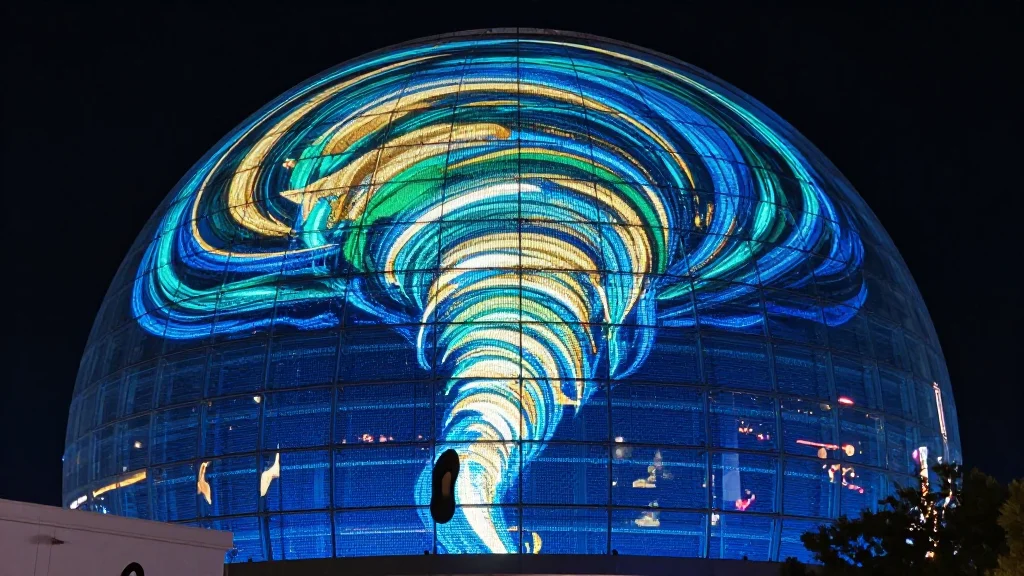
Wizard of Oz Nears 3 Million Tickets, $370 M Gross at Las Vegas Sphere

Companies Mentioned
Why It Matters
The record‑breaking performance of *The Wizard of Oz* at the Las Vegas Sphere demonstrates that immersive, high‑ticket‑price experiences can generate blockbuster‑level revenue from legacy content. This challenges the conventional wisdom that theatrical earnings are limited to new releases and suggests a new revenue frontier for studios willing to partner with technology‑focused venues. Moreover, the success validates AI‑assisted film restoration as a commercially viable tool, potentially unlocking thousands of catalog titles for similar treatment. If the Sphere model proves replicable in other cities, it could reshape the economics of film exhibition, prompting traditional multiplexes to invest in comparable immersive technologies or risk losing high‑margin audiences. The trend also raises strategic questions for streaming platforms, which may need to negotiate new licensing structures for premium‑ticket experiences that sit outside the digital subscription model.
Key Takeaways
- •Almost 3 M tickets sold for *Wizard of Oz* at Las Vegas Sphere
- •Gross revenue reached $370 M, surpassing many modern blockbusters
- •Sphere’s Q1 revenue rose 38 % YoY to $386.4 M, beating forecasts
- •AI restoration led by Google, with Warner Bros. and Jane Rosenthal involvement
- •Plans announced for additional Sphere venues in Abu Dhabi and near Washington, D.C.
Pulse Analysis
The Sphere’s achievement with *The Wizard of Oz* marks a pivotal moment for premium‑ticket cinema. Historically, legacy titles have been relegated to home‑video or streaming windows, generating modest ancillary revenue. By re‑imagining a classic through AI‑enhanced visuals and a physically immersive environment, Sphere has turned a 1939 film into a modern revenue engine. This approach leverages both nostalgia and novelty, tapping into audiences’ willingness to pay for an experience that cannot be replicated at home.
From a competitive standpoint, the success puts pressure on traditional exhibitors to innovate or risk obsolescence. While IMAX and Dolby continue to offer premium formats, their upgrades are incremental compared to the Sphere’s combination of ultra‑high‑resolution screens, spatial audio, and kinetic effects. Studios may increasingly view immersive venues as a strategic distribution channel, especially for catalog titles that can be refreshed with AI‑driven enhancements. However, the model’s reliance on high ticket prices raises concerns about accessibility and market saturation; only affluent or experience‑seeking segments may sustain such pricing.
Looking forward, the scalability of the Sphere concept will hinge on two factors: the ability to secure compelling IP and the cost efficiency of AI restoration pipelines. If the technology matures and licensing terms become more favorable, we could see a wave of AI‑reimagined classics and even new releases designed specifically for immersive venues. Conversely, resistance from purists and potential regulatory scrutiny over AI‑generated content could temper growth. Ultimately, the Sphere’s performance suggests a new, lucrative niche at the intersection of technology, nostalgia, and premium entertainment, one that could reshape how the industry monetizes its back catalog and designs future theatrical experiences.
Wizard of Oz Nears 3 Million Tickets, $370 M Gross at Las Vegas Sphere
Comments
Want to join the conversation?
Loading comments...