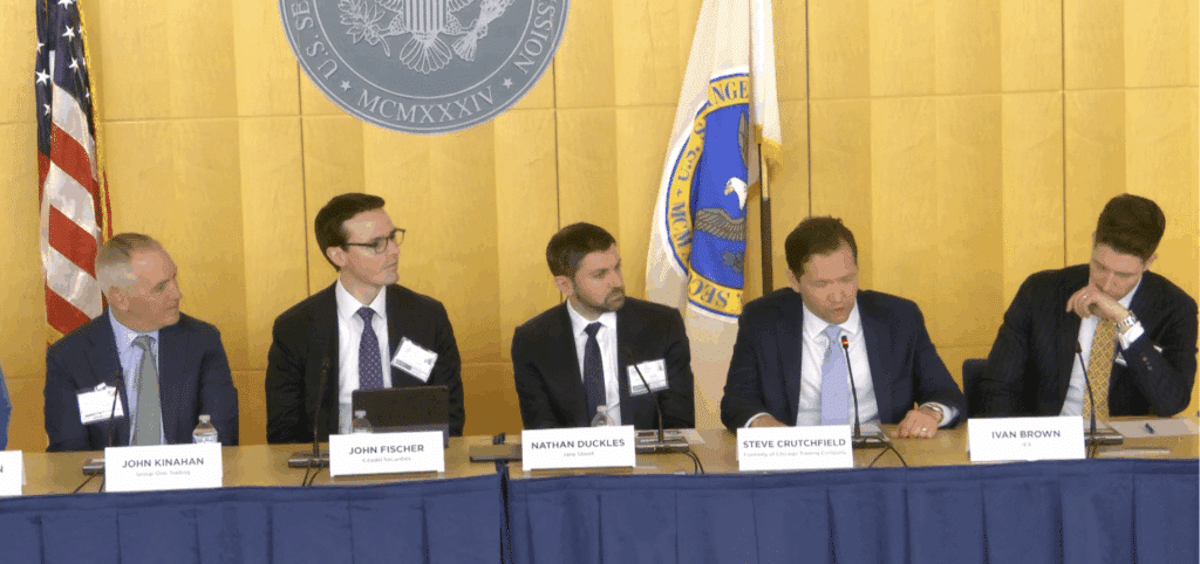
SEC Roundtable Reveals Divide Over Legacy Options Rules
Why It Matters
The outcome will shape future SEC rulemaking on options market structure, influencing competition, liquidity, and execution quality for investors across a rapidly fragmenting market.
Key Takeaways
- •Legacy allocation rules split SEC roundtable, seen as anti‑competitive vs liquidity support
- •Market makers argue five‑lot rule skews competition, especially on liquid names
- •Retail price‑improvement auctions praised, but fee structures may curb competition
- •Physical trading floors deemed less valuable; electronic exposure favored for fairness
- •Over‑million unused option strikes raise concerns about market fragmentation and costs
Pulse Analysis
The Securities and Exchange Commission’s April 16 roundtable on listed options market structure laid bare a growing rift among industry participants. Veteran traders such as Steve Crutchfield and John Kinahan argued that legacy allocation mechanisms—most notably the five‑lot rule that grants designated market makers priority on small orders—have become a competitive handicap in today’s high‑volume, liquid options universe. While the rule once protected thinly traded products, critics say it now discourages tighter pricing and deeper depth. Conversely, representatives from NYSE Amex and IEX maintain that these protections still serve smaller exchanges battling larger rivals, preserving a baseline of liquidity across a fragmented market.
Retail price‑improvement auctions emerged as a rare point of consensus, with most panelists acknowledging their role in delivering better execution prices to end‑users. Yet the conversation turned to the fee architecture that underpins these auctions. Firms such as Susquehanna and Citadel warned that fee differentials between initiating market makers and responding participants can erode the competitive incentive to post the best price upfront. Additionally, the debate over physical trading floors versus electronic exposure highlighted a shift toward fully electronic order routing, which many believe will produce fairer, more transparent executions for retail investors.
A third, less discussed, but equally consequential issue was the explosion of listed option strikes. With nearly two million strikes on the books and roughly half carrying no open interest, market‑making resources are being spread thin, inflating costs for exchanges and participants alike. Economists and industry leaders suggested that the SEC could play a coordinating role in strike rationalization, a move that would curb unnecessary fragmentation without violating antitrust rules. The roundtable’s mixed signals signal that forthcoming SEC guidance will likely balance the need for competition with the practical realities of liquidity provision in an increasingly complex options landscape.
SEC Roundtable Reveals Divide Over Legacy Options Rules
Comments
Want to join the conversation?
Loading comments...