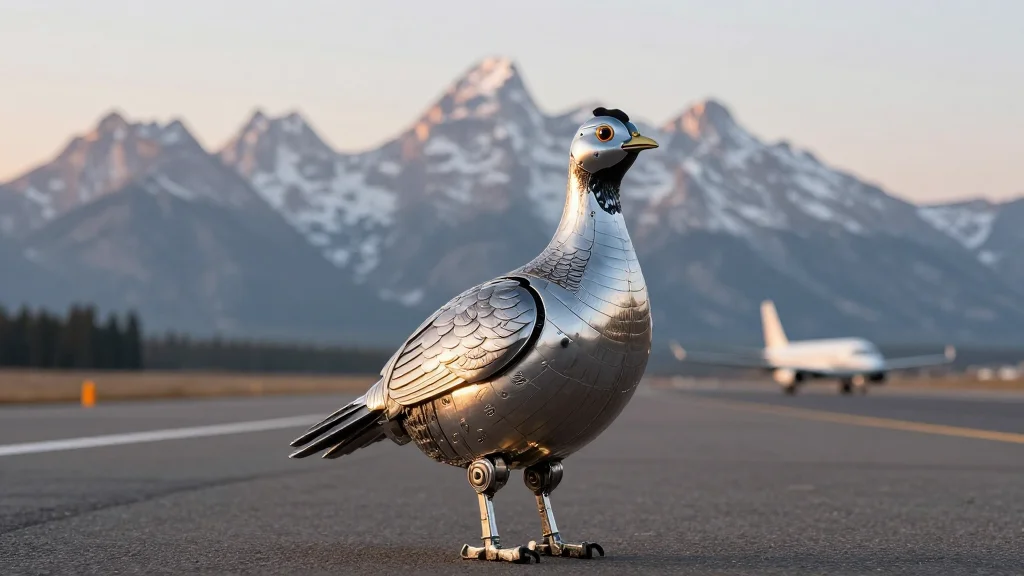
Grand Teton Tests Robotic Sage Grouse to Keep Birds Off Airport Runway

Why It Matters
The experiment sits at the intersection of conservation and aviation safety, two sectors that often compete for land use in protected areas. By using behavior‑based technology, Grand Teton aims to protect a declining sage grouse population while maintaining the operational integrity of a busy regional airport. A successful outcome could provide a template for other parks and airports facing similar wildlife‑strike challenges, reducing reliance on costly runway closures or lethal control measures. Beyond the immediate safety benefits, the project highlights a broader shift toward using robotics and bio‑inspired design in wildlife management. If the decoys prove effective, they could spur investment in similar devices for species ranging from waterfowl at coastal airports to large mammals near highway corridors, expanding the toolkit for coexistence between human infrastructure and native fauna.
Key Takeaways
- •Grand Teton National Park begins testing animated robotic sage grouse near Jackson Hole Airport.
- •Robots mimic courtship displays with motion, chest puffing and recorded calls.
- •Restored habitat of roughly 100 acres provides a natural lure for the birds.
- •Earlier static decoys in 2025 showed limited impact, prompting the robotic upgrade.
- •Trial results will be shared with the FAA and U.S. Fish and Wildlife Service.
Pulse Analysis
The robot‑bird trial reflects a growing trend of applying engineered solutions to ecological problems that have traditionally been addressed through land‑use changes or chemical deterrents. Historically, airports have relied on habitat modification, auditory scare devices, or even lethal control to mitigate bird strikes. Those methods often generate controversy, especially in protected landscapes where the very presence of the airport is a point of contention. By introducing a technology that works with, rather than against, the birds' natural behaviors, Grand Teton is testing a middle ground that could satisfy both conservationists and aviation regulators.
From a market perspective, the project could open a niche for specialized wildlife‑deterrence robotics. Companies that already produce avian radar and monitoring systems may see an opportunity to expand into hardware that actively shapes animal movement patterns. The involvement of a high school robotics team also suggests a low‑cost, community‑driven development model, which could lower barriers to entry for smaller parks and airports.
Looking ahead, the key question will be scalability. If the robotic decoys demonstrate a measurable drop in strike incidents, the next step will be to evaluate cost‑effectiveness compared with traditional mitigation strategies. Moreover, the technology will need to adapt to different species' sensory cues and behavioral repertoires. The Grand Teton experiment could therefore serve as a pilot case, informing a broader industry shift toward bio‑inspired, behavior‑centric wildlife management solutions.
Grand Teton Tests Robotic Sage Grouse to Keep Birds Off Airport Runway
Comments
Want to join the conversation?
Loading comments...