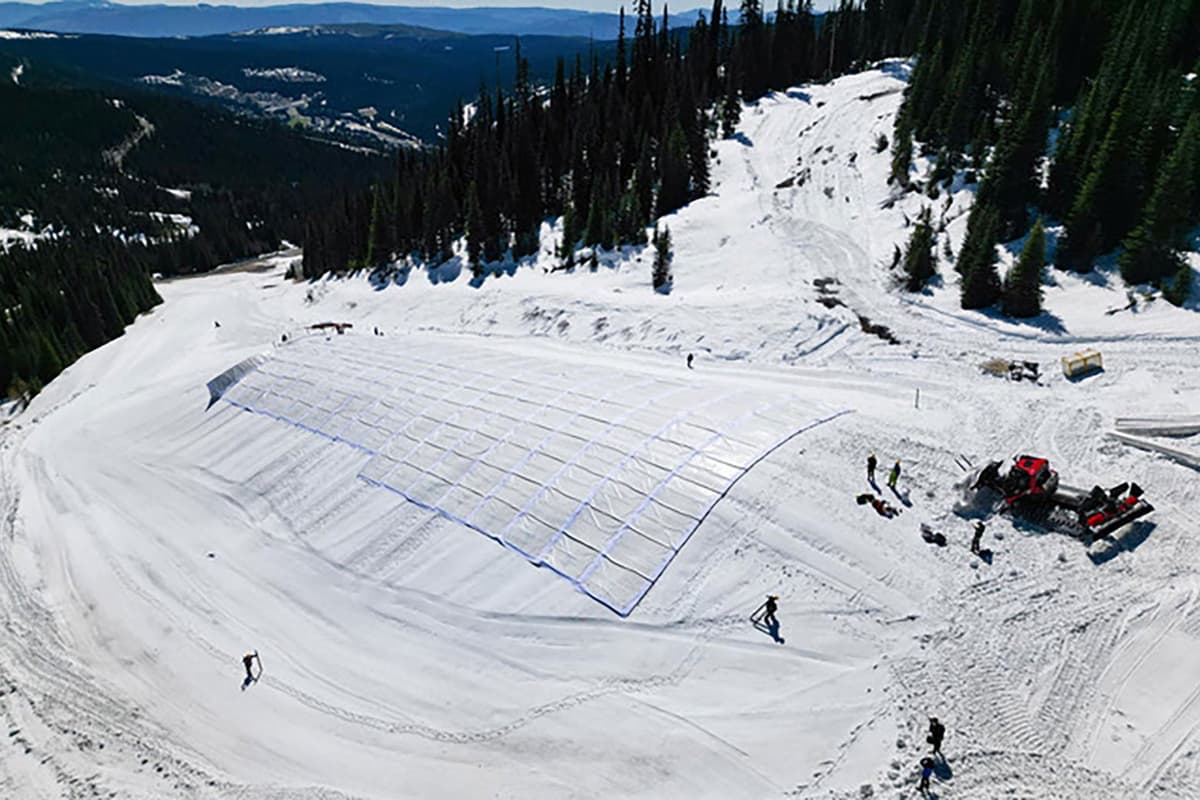
It’s Bizarre, Unnatural, and the Size of a Football Field. It Might Be the Thing to Save Ski Resorts.
Why It Matters
Stored snow provides a climate‑resilient buffer that protects ski‑area revenue and extends operating windows, offering a cost‑effective alternative to ever‑increasing snowmaking demands.
Key Takeaways
- •Snow Secure blankets cost $120k‑$180k, preserve 80% of stored snow.
- •Stored snow kept 39°F under blanket despite 98.6°F ambient temperature.
- •Snow farming adds a third snow source to combat 34‑day season loss.
- •Five U.S. resorts plan snow storage, expanding the technology nationwide.
Pulse Analysis
Climate change is compressing the North American ski calendar, with a Geophysical Research Letters study showing an average 34‑day reduction in season length between 1982 and 2016. Traditional mitigation has relied on natural snowfall and increasingly expensive snowmaking, which only works when wet‑bulb temperatures dip below 28 °F. Snow farming introduces a third, complementary strategy: harvesting excess winter snow, piling it into massive mounds, and shielding it with high‑tech insulated blankets. By preserving the frozen crystals through summer, resorts can tap into a reliable snow reserve that does not depend on nightly low temperatures, thereby stabilizing revenue streams and reducing the carbon footprint associated with continuous snowmaking.
The Snow Secure system, originally derived from Finnish home‑insulation technology, unfolds like an accordion and drapes over the snow pile, creating a barrier against solar radiation, wind, and precipitation. Sensors embedded in the blanket monitor temperature in real time, allowing operators to fine‑tune the cover’s performance. At Sun Peaks, the blanket maintained a sub‑40 °F core despite ambient highs of 98.6 °F, and 80 % of the stored snow survived torrential rainstorms. The upfront investment—$120,000 for Bogus Basin and $180,000 for Sun Peaks—has been justified by extended season openings and avoided early closures, which would otherwise erode ticket sales and ancillary revenues.
Industry response is accelerating. Beyond the two pioneering resorts, Tyrol Basin (Wisconsin), Ski Apache (New Mexico) and Soldier Hollow (Utah) are slated to implement snow storage this spring, while Boyne Resorts monitors the technology for potential rollout across its nine‑mountain portfolio. As more operators adopt snow farming, economies of scale could lower blanket costs and spur ancillary innovations, such as renewable‑energy‑powered cooling systems. Ultimately, stored snow may become a standard asset on the balance sheet of ski resorts, offering a tangible hedge against an increasingly unpredictable climate while preserving the powder‑filled experience that draws skiers to the slopes.
It’s Bizarre, Unnatural, and the Size of a Football Field. It Might Be the Thing to Save Ski Resorts.
Comments
Want to join the conversation?
Loading comments...