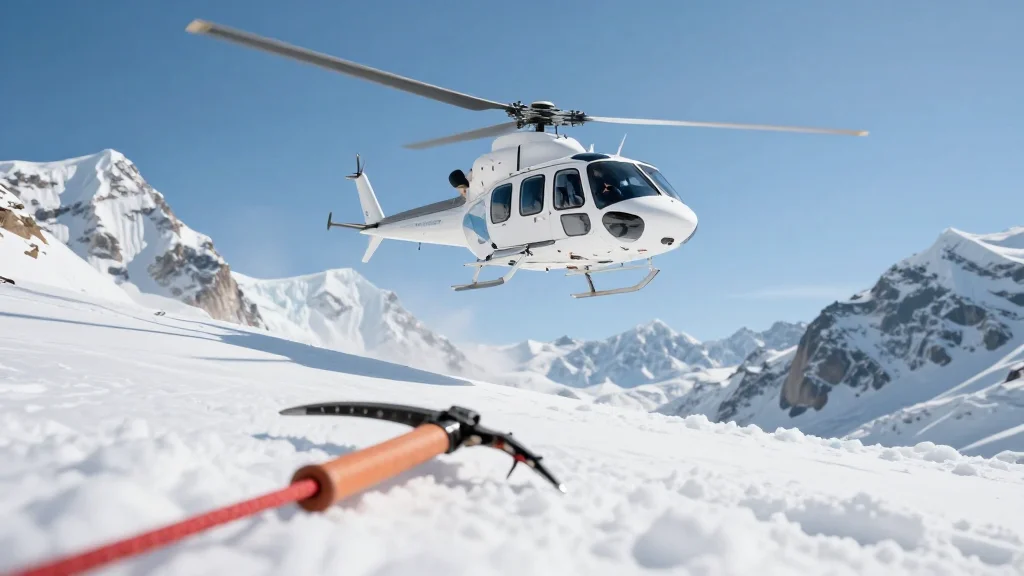
Nepal Authorizes Helicopter Shuttles to Revive Stalled Everest Season

Why It Matters
The Khumbu Icefall is the most hazardous segment of the Everest ascent, and any delay reverberates through Nepal’s high‑altitude tourism economy. By securing a rapid‑response plan, the government protects the livelihoods of Sherpa communities and the broader service ecosystem that supports thousands of international climbers each spring. Moreover, the initiative highlights how climate‑driven glacier instability is forcing mountaineering authorities to adopt more aggressive logistical solutions, setting precedents for safety standards on the world’s highest peaks. Beyond immediate economic stakes, the plan underscores a shift toward greater public‑private coordination in extreme environments. Helicopter use for route‑fixing, once limited to emergencies, signals a willingness to invest in infrastructure that can mitigate natural hazards. This could influence policy discussions in other high‑risk mountain regions, where similar ice‑fall or rock‑fall threats jeopardize both tourism and local safety.
Key Takeaways
- •April 24 decree authorizes up to ten helicopter shuttle flights to Camp II for rope‑fixing equipment.
- •Icefall Doctors team of 6‑8 workers will be reinforced by IFMGA‑qualified guides from EOAN.
- •A massive ice tower in the Khumbu Icefall has halted climbing since early April.
- •Officials project the ice‑fall route could be completed by Sunday, April 26.
- •The plan involves the Sagarmatha Pollution Control Committee, SPCC, EOAN and Nepal’s Department of Tourism.
Pulse Analysis
The rapid deployment of helicopters marks a pragmatic pivot in Nepal’s mountaineering strategy, reflecting both the urgency of the current delay and a broader trend toward mechanized support in high‑altitude logistics. Historically, route‑fixing relied almost exclusively on manual labor, with helicopters reserved for rescue missions. By repurposing air assets for construction, Nepal signals a willingness to invest capital in operational resilience, a move likely to attract higher‑spending expedition operators who value predictability over traditional risk.
Economically, the plan safeguards an estimated $300 million in seasonal revenue, but it also raises questions about cost recovery. Helicopter operations at 19,500 feet are expensive, and the financial burden will likely be passed to expedition companies, potentially inflating permit fees. This could create a tiered market where only well‑funded outfits can afford the added safety net, marginalizing smaller operators and altering the competitive landscape.
From an environmental perspective, increased helicopter traffic introduces noise, emissions, and potential disturbance to the fragile alpine ecosystem. While the government has granted special permission, future seasons may see stricter regulations or the development of alternative, lower‑impact technologies such as cable‑driven freight systems. The success—or failure—of this plan will inform policy decisions not only for Everest but for other glaciated peaks worldwide, where climate change is amplifying ice‑fall hazards.
In the longer term, the collaboration between government bodies, the Icefall Doctors, and private guiding firms could evolve into a permanent joint task force, institutionalizing rapid response capabilities. Such an entity would be better positioned to monitor glacier dynamics in real time, issue early warnings, and coordinate resources before a crisis escalates. If the April 26 deadline is met, Nepal will have a proof‑of‑concept that could be scaled across the Himalayas, reinforcing its status as the premier destination for high‑altitude adventure while enhancing safety for all stakeholders.
Nepal authorizes helicopter shuttles to revive stalled Everest season
Comments
Want to join the conversation?
Loading comments...