
Recent Posts
Video•Jan 26, 2026
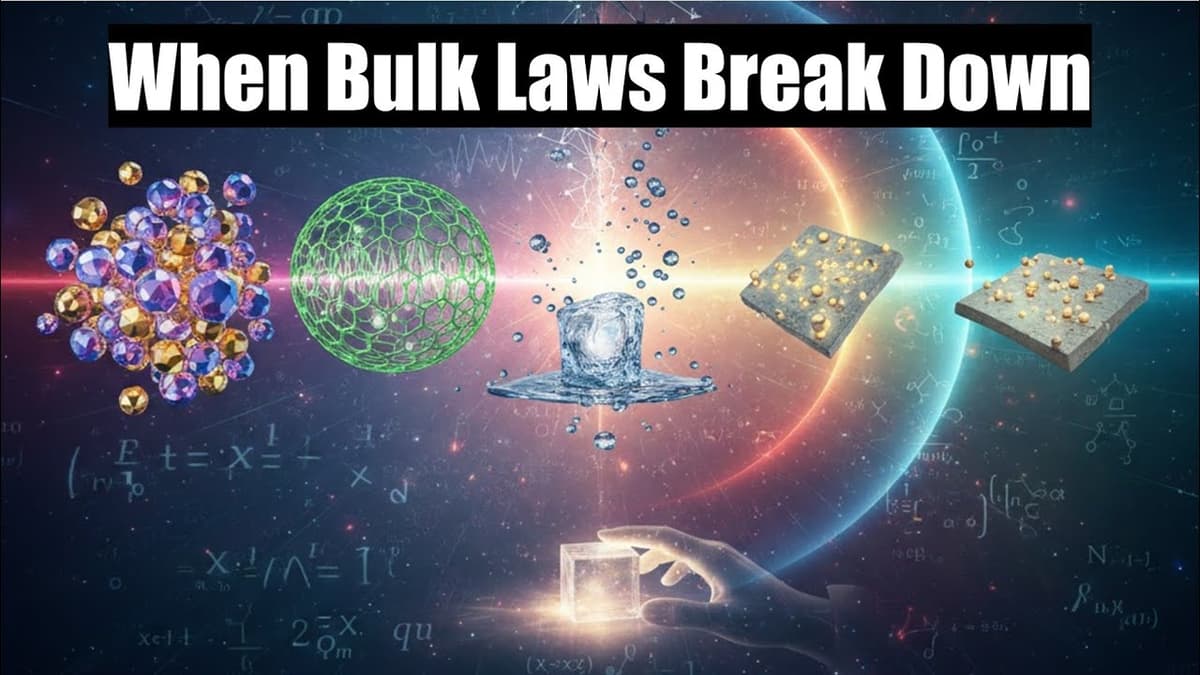
Nanotech When Bulk Laws Break Down
The lecture argues that at the nanoscale (1–100 nm) the assumptions of bulk materials fail: surface-to-volume ratios and quantum confinement dominate, producing qualitatively different thermodynamic, optical, chemical, mechanical, and magnetic behavior. Examples include massive melting-point depression in ~2 nm gold particles, size-tunable plasmonic colors and discrete electronic levels, dramatic catalytic activity of sub-5 nm gold, and near-theoretical mechanical strengths in nanocrystals due to suppression of dislocations. These phenomena are quantitatively linked to surface energy, coordination-number effects, and quantum-size scaling laws, and the bulk limit is only recovered above tens of nanometers. Experimental data confirm these effects and show that nanoscale anomalies are signals of new physics, not measurement error.
By AI Labs: Nanotechnology

Video•Jan 20, 2026
Designing With Chaos: The New Paradigm in Nanoelectronics
The lecture titled “Designing With Chaos” reframes noise from a nuisance to a design asset in nanoelectronics, arguing that stochastic fluctuations become essential as devices shrink to atomic dimensions. Traditional engineering seeks to suppress noise, but at the nanometer scale...
By AI Labs: Nanotechnology
Video•Jan 2, 2026
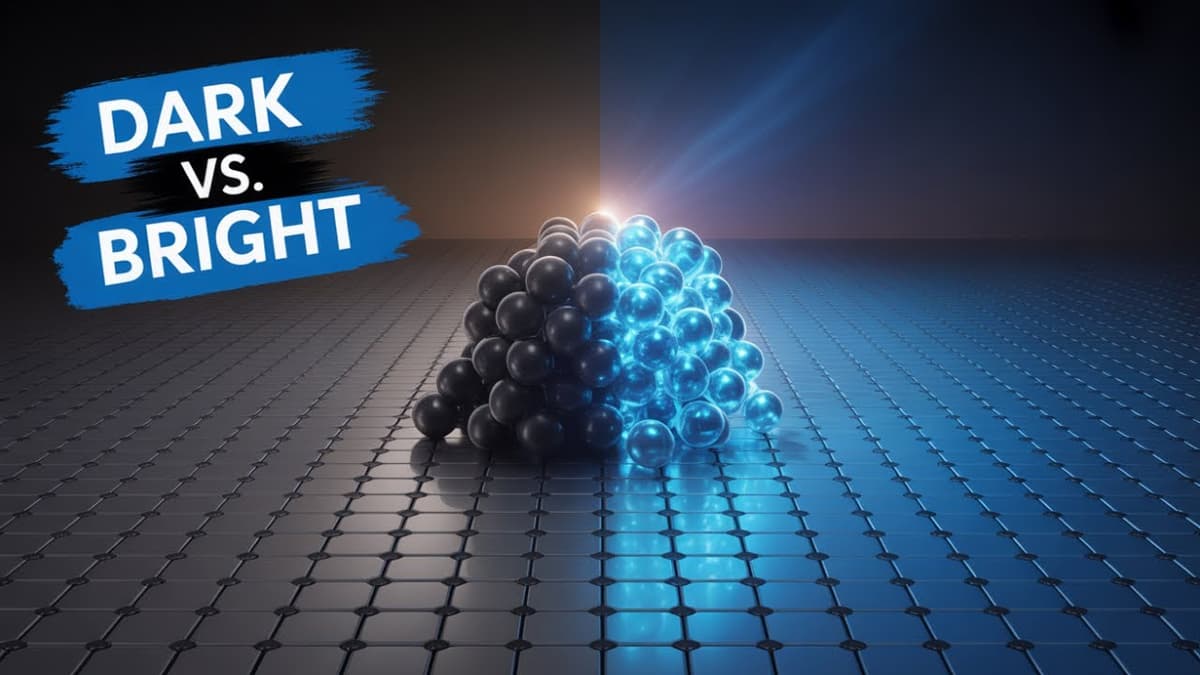
Amplifying the Undetectable: Inside Quantum Materials
The lecture explains how quantum‑optical engineering can turn invisible dark excitons in two‑dimensional semiconductors into bright, detectable emitters. Dark excitons arise when electron‑hole pairs have parallel spins or mismatched crystal momentum, making their oscillator strength six orders of magnitude weaker than...
By AI Labs: Nanotechnology