
The Pyramid Has Already Broken
A fast‑growing U.S. law firm, Pierson Ferdinand, now runs with more than 270 partners and no junior associates, relying on AI to perform tasks traditionally done by entry‑level lawyers. The firm’s model proves that capable AI can undercut the economic function of the junior tier, which historically subsidized senior expertise and provided on‑the‑job training. This shift accelerates a looming capability gap as senior professionals retire without a pipeline of experienced successors. The article argues for a new Human + Machine architecture that cultivates practical wisdom—or phronesis—through dense, real‑stakes learning and a collective social contract to fund capability development.

CRE AI Is a Layer Cake
The article argues that commercial‑real‑estate (CRE) AI should be built as a five‑layer stack—data foundation, reasoning substrate, grounded retrieval, workflow automation, and bespoke analytical models—rather than starting with predictive analytics. Most firms waste time chasing Layer 4 forecasts while ignoring the...

The Smooth Market That Hides the Rupture
A new forecasting paper co‑authored by the Federal Reserve Bank of Chicago, Yale, Stanford and the University of Pennsylvania finds that 61.4% of economists expect meaningful AI progress by 2030, yet they predict only modest shifts in headline GDP and...

AI & Real Estate: Beyond Generative
The latest "Generative AI for Real Estate" module highlights that the pace of AI adoption, not its direction, will dictate whether commercial real‑estate assets appreciate or depreciate. Fast‑feedback domains such as HVAC optimisation and lease abstraction are already transforming, while...

Where’s the New Business?
The article introduces the H3 Provocation Framework, a five‑question tool designed to push AI initiatives in commercial real‑estate (CRE) beyond efficiency (H1) and capability (H2) into true transformation (H3). By applying the framework to workflows such as diligence, advisory, occupancy...
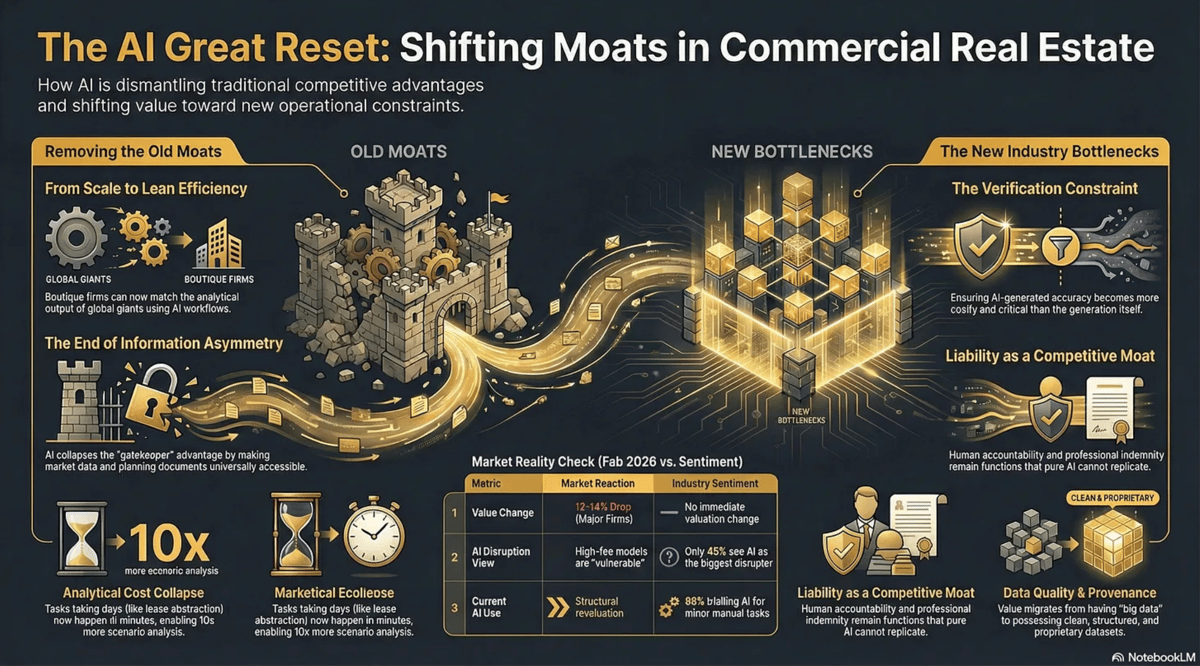
CRE: Constraints, Moats and Value
Wall Street wiped 12‑14% off the market caps of CBRE, JLL and Cushman & Wakefield after analysts warned that high‑fee, labor‑intensive CRE models are vulnerable to AI disruption. At the same time, Yardi’s research with AREF found only 45% of...

You're Probably Automating the Wrong Things
The commercial‑real‑estate (CRE) sector now has a structured tool called the CRE Automation Matrix, which classifies tasks by operational versus strategic nature and by verifiability. By mapping workflows onto four quadrants, the framework helps firms avoid low‑ROI automation and the...