
Recent Posts

News•Feb 27, 2026
Atmospheric Records as Infrastructure
Hospitals now host dense networks of temperature, humidity, CO₂, pressure and filtration sensors, delivering unprecedented operational visibility. While building management systems excel at real‑time control, they were never built to serve as immutable evidence. The industry faces a growing demand to produce continuous, tamper‑evident atmospheric records for legal, regulatory and insurance inquiries. A dedicated preservation layer beneath control systems is emerging as the solution to bridge operational data and defensible documentation.
By AutomatedBuildings.com

News•Feb 26, 2026
ThrowBack Thursday, a Brief History of Digital Twin Discourse (1999–2026)
The digital‑twin narrative in building automation has progressed from early virtual‑value concepts in 1999 to today’s composable, capability‑based models. Foundational work on data interoperability (XML/Web Services, Project Haystack) and the 2005 Honeywell‑Tridium acquisition set the stage for formal definitions in...
By AutomatedBuildings.com
News•Feb 25, 2026
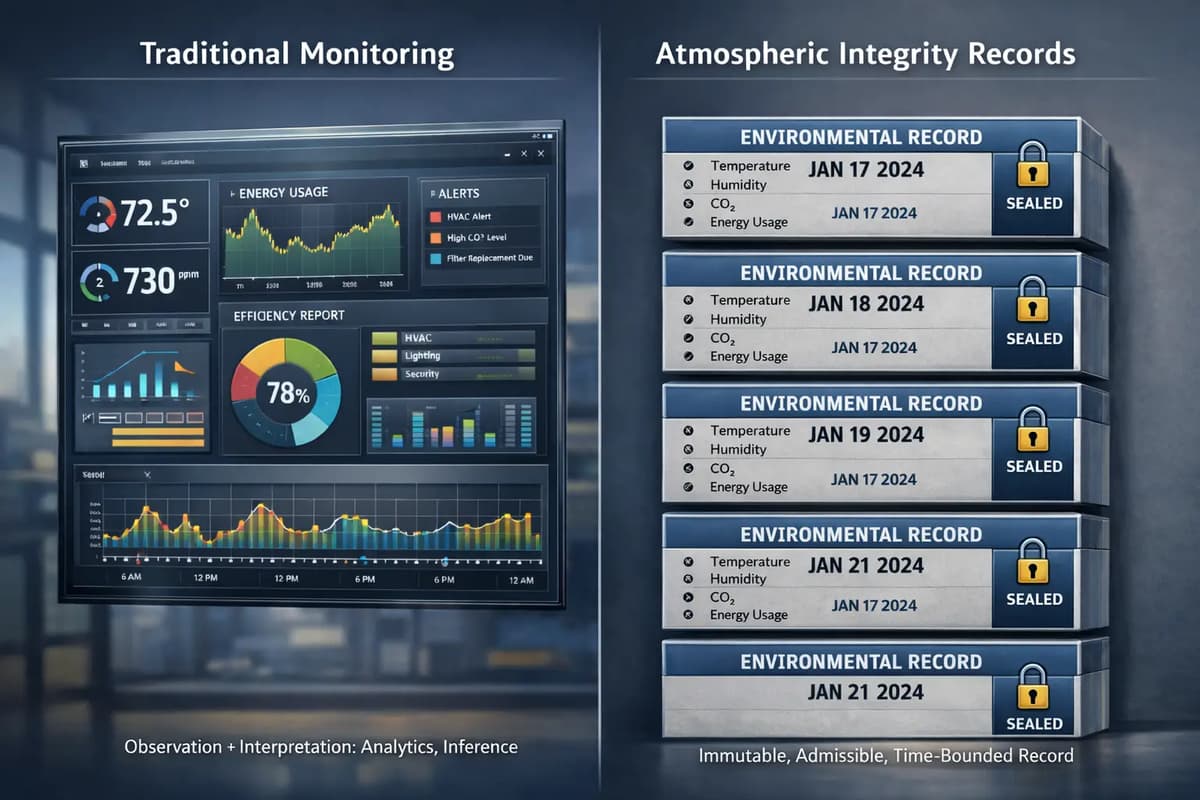
Atmospheric Integrity Records
The piece introduces Atmospheric Integrity Records (AIR), an append‑only, time‑bounded ledger that captures building atmospheric data separate from control and analytics layers, making it admissible evidence for regulators, insurers, utilities, and investors. It argues that current dashboards and optimization tools...
By AutomatedBuildings.com

News•Feb 22, 2026
Beyond Capacity: Why AI Is Forcing a Building-Level Performance Reckoning
AI‑driven workloads have accelerated U.S. electricity demand, with data centers responsible for roughly 60 % of last year’s load increase and a 150 % rise over five years. This non‑linear growth exposes a hidden vulnerability at the building level, where inefficiencies in...
By AutomatedBuildings.com

News•Feb 20, 2026
We Tried Using AI for Real Building Work. Here Is What Actually Happened.
At AHR Expo 2026, SES Consulting’s Brad White and Cochrane Supply’s Jacob Fenley tested generative AI on real building data. ChatGPT matched 80% of recommissioning measures but hallucinated equipment specs, while Gemini accurately extracted data from photos, PDFs, and handwritten...
By AutomatedBuildings.com

News•Feb 20, 2026
AHR Expo 2026: Connections, Innovation, and the Evolving Role of Platforms
The AHR Expo 2026 in Las Vegas underscored a rapid shift in the HVAC and building‑automation sector toward fully connected, AI‑enhanced ecosystems. Thousands of manufacturers and tech startups showcased solutions that move beyond simple automation to cloud‑native, data‑driven intelligence. A...
By AutomatedBuildings.com
News•Feb 19, 2026
Enduring ERU Control Logic: A Cross-Platform Architecture for Building Automation Excellence
Building automation professionals face recurring failures when Energy Recovery Unit (ERU) control logic is tied to proprietary tools, especially during platform migrations or retro‑commissioning. The article proposes a commissioning‑centric, cross‑platform architecture that abstracts control intent into five distinct layers, from...
By AutomatedBuildings.com

News•Feb 18, 2026
Our Free Education Session From AHR Vegas Online
AutomatedBuildings.com hosted 16 free education sessions during the AHR Expo 2026 online, drawing more than 2,000 attendees. The sessions spanned HVAC automation, controls, and sustainability topics, and each was recorded for on‑demand viewing. A YouTube playlist now provides access to...
By AutomatedBuildings.com

News•Feb 18, 2026
AHR Expo Reflections: Elevating the BAS Visual Layer for Real World Operators
At AHR Expo, industry leaders highlighted a persistent gap between building automation system (BAS) visual design and the needs of everyday operators. While user experience is a buzzword, many graphics are still engineered for technicians rather than the people who...
By AutomatedBuildings.com

News•Feb 15, 2026
From Time-Based HVAC to Evidence-Based Reality
The article argues that traditional building automation systems (BAS) conflate measurement, control, and reporting, making performance data inferential rather than verifiable. It proposes adding an independent, time‑bounded evidence layer that records environmental conditions without influence from optimization logic. This governed...
By AutomatedBuildings.com

News•Feb 12, 2026
Real Results: 3 Enterprise Projects Powered by Reliable Controls Solutions
Reliable Controls showcases three enterprise building‑automation projects that demonstrate scalability, sustainability, and long‑term compatibility. In Washington, D.C., the Constitution Square portfolio leveraged backward‑compatible controls across an 11‑year build without replacing legacy devices. In Australia’s Gold Coast, integration of a 312 kW...
By AutomatedBuildings.com