Video•Feb 27, 2026
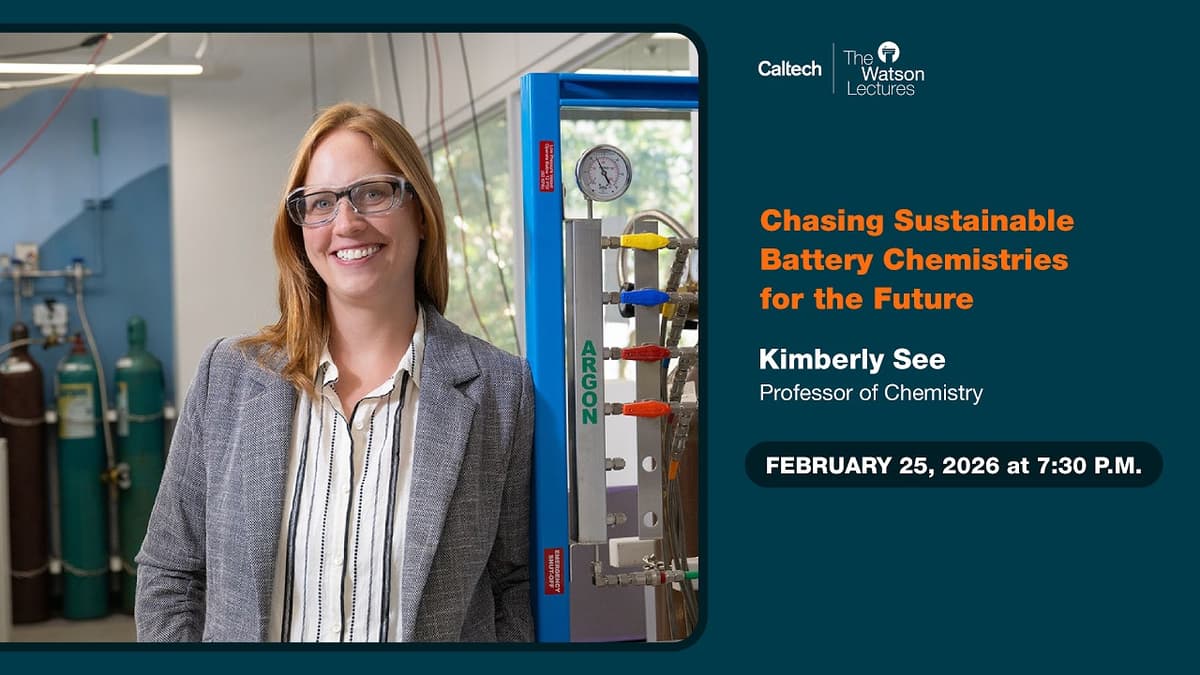
Chasing Sustainable Battery Chemistries for the Future - Kimberly See
The Watson Lecture featured Professor Kimberly C. discussing the next generation of sustainable battery chemistries at Caltech. After a lively introduction that highlighted Caltech’s unique undergraduate culture—tiny class sizes, a 3:1 student‑to‑faculty ratio, and a tradition of hands‑on research—the talk turned to the urgent need for battery technologies that go beyond conventional lithium‑ion systems.
Kimberly outlined three research pillars: replacing scarce, expensive lithium with earth‑abundant elements such as iron, sulfur, and aluminum; developing solid‑state electrolytes that improve safety and energy density; and integrating solid‑state chemistry with electrochemical engineering to create high‑performance, low‑cost storage. She emphasized that understanding the fundamental thermodynamics and transport properties of these materials is essential before they can be commercialized.
The lecture interwove historical anecdotes—like the 1968 electric‑vehicle race between Caltech and MIT—and personal stories about Kimberly’s upbringing in Colorado, her work at NREL, and her award‑winning research. Her students’ enthusiasm, demonstrated through live experiments on the lawn, underscored the collaborative, interdisciplinary environment that fuels breakthroughs in the lab.
If successful, these new chemistries could dramatically reduce reliance on geopolitically sensitive minerals, lower battery costs, and enable longer‑range electric vehicles and grid‑scale storage. The work positions Caltech at the forefront of a transition toward more sustainable, resilient energy infrastructure.