
Recent Posts

News•Feb 27, 2026
Pentagon Shifts to Data-Centric Security to Boost Resilience
The Pentagon is moving from network‑centric to data‑centric security, embedding zero‑trust principles across the Navy and Marine Corps. Initiatives such as Project Dynamis and the Operation Cattle Drive effort aim to accelerate secure data sharing, reduce technical debt, and modernize legacy systems. Mesh networking and commercial cellular infrastructure are being leveraged to ensure data moves quickly and resiliently across contested environments. Acquisition reforms are opening the door to non‑traditional contractors, fostering a more competitive ecosystem for defense data solutions.
By GovernmentCIO Media & Research

News•Feb 27, 2026
Navy CTO: Innovation Adoption Kit Breaks the ‘Valley of Death’
The Navy’s Innovation Adoption Kit (IAK) is a new framework that fast‑tracks emerging technologies by using measurable metrics and structured pilot programs. Launched in October, the kit provides a standardized vendor template and a clear path from pilot to production,...
By GovernmentCIO Media & Research

News•Feb 24, 2026
Accelerating Federal Cloud Modernization
Federal agencies are accelerating cloud modernization, but must first close gaps in data readiness, cybersecurity, and legacy infrastructure. Officials from the Centers for Medicare & Medicaid Services, the Department of Energy, and NinjaOne discussed prerequisites for hybrid and multi‑cloud success....
By GovernmentCIO Media & Research

News•Feb 24, 2026
Navy Pushes AI From Experiments to Everyday Warfighting Functions
The U.S. Navy is moving artificial intelligence from experimental pilots into routine warfighting functions, aiming to embed trustworthy AI across all mission areas. Deputy Director Christopher Page emphasized the need for a common taxonomy and lexicon to ensure data quality...
By GovernmentCIO Media & Research

News•Feb 23, 2026
VA Launches Tech Pilot Portfolio to Accelerate Modernization
The Department of Veterans Affairs has launched a portfolio of technology pilots to fast‑track modernization across its digital services. Led by the Office of Information and Technology, the pilots evaluate Google Workspace, Oracle Cloud, Google Cloud, and a cybersecurity rationalization...
By GovernmentCIO Media & Research

News•Feb 23, 2026
Officials Build Digital Backbone for Federal Health Care Reform
The Trump administration is constructing a federal digital backbone to support the Great Healthcare Plan, focusing on interoperability, patient identity verification, and transparent prescription pricing. The Centers for Medicare and Medicaid Services are advancing a Health Technology Ecosystem that will...
By GovernmentCIO Media & Research

News•Feb 23, 2026
Submit Your Nominations for the 2026 Federal IT Efficiency Flywheel Awards
GovCIO Media & Research announced that nominations are now open for the 2026 Federal IT Efficiency Flywheel Awards, to be presented at the Federal IT Efficiency Summit on May 20 in Reston, Virginia. The awards honor federal employees whose recent programs...
By GovernmentCIO Media & Research

News•Feb 19, 2026
Federal AI Series: Security Priorities
Federal agencies are rapidly integrating artificial intelligence, prompting heightened focus on securing the underlying data and systems. Zscaler’s Federal Field CTO Chad Tetreault outlined the evolving AI threat landscape, highlighting supply‑chain vulnerabilities, data‑poisoning, prompt‑injection, and emerging agentic AI risks. He...
By GovernmentCIO Media & Research

News•Feb 18, 2026
War CIO Seeks Private Partners to Help Modernize Acquisition
The Pentagon launched the Business Operators for National Defense (BOND) program, recruiting up to 250 senior industry executives to work directly with acquisition, engineering, and sustainment teams. The initiative aims to cut bureaucratic delays, speed weapon fielding, and strengthen supply‑chain...
By GovernmentCIO Media & Research

News•Feb 18, 2026
White House CTO Outlines Federal AI Agenda
White House CTO Ethan Klein outlined a federal AI agenda that links government, industry, academia, and philanthropy around three pillars: U.S. leadership in emerging tech, revitalizing the science enterprise, and broad societal benefit. The plan calls for a national AI...
By GovernmentCIO Media & Research

News•Feb 13, 2026
NOAA Nears Rollout of Its Modernized National Spatial Reference System
NOAA's National Geodetic Survey is nearing completion of the modernized National Spatial Reference System, which integrates GPS and GNSS to replace the legacy NAD83 and NAVD88 datums. The new system will deliver centimeter‑level accuracy, streamline surveying, and cut costs for...
By GovernmentCIO Media & Research

News•Feb 13, 2026
Who’s in Charge of AI at Every Federal Agency
Federal agencies are rapidly appointing chief artificial intelligence officers (CAIOs) to comply with President Biden’s 2023 AI executive order and a 2025 Trump administration memo that mandates AI leadership. The Office of Management and Budget (OMB) has also launched a...
By GovernmentCIO Media & Research

News•Feb 13, 2026
Navy Installations Shift to Continuous Cybersecurity Model
The U.S. Navy is moving to a continuous cybersecurity model that relies on artificial intelligence to detect and mitigate threats in real time. Navy Installations Command (CNIC) is replacing its legacy risk‑management framework with the Cybersecurity Risk Management Construct, emphasizing...
By GovernmentCIO Media & Research
News•Feb 12, 2026
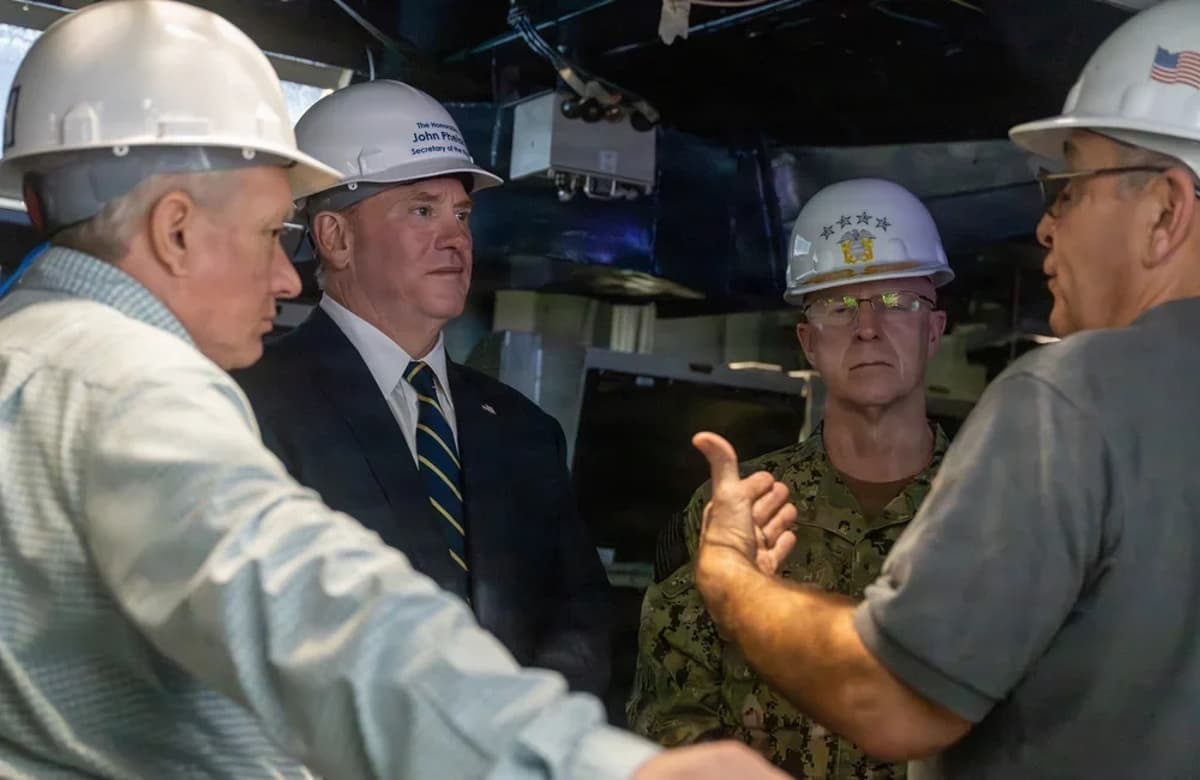
Navy Secretary Outlines AI, Unmanned Tech to Advance Golden Fleet Initiative
U.S. Navy Secretary John Phelan detailed the Golden Fleet initiative, which pairs AI, autonomous systems and distributed shipbuilding to accelerate fleet growth and modernize the maritime industrial base. Central to the plan is ShipOS, an AI‑driven connective platform that integrates...
By GovernmentCIO Media & Research

News•Feb 12, 2026
New NPS Challenge Aims to Rewrite How the Military Builds Missiles
The Department of Defense has long struggled with the high cost and long timelines of traditional missile programs, where a single system can exceed millions of dollars. To counter this, the Naval Postgraduate School introduced the Tactical Missile Innovation Challenge,...
By GovernmentCIO Media & Research