
Recent Posts
News•Mar 2, 2026
Best Practices for Applying HDX-MS to FBLD
A recent open‑access study demonstrates that hydrogen‑deuterium exchange mass spectrometry (HDX‑MS) can reliably map binding sites of extremely weak fragment hits (up to 7 mM KD) against Cyclophilin D. By optimizing protein concentration at 10 µM and testing fragments at 2.5‑10 mM, the authors observed measurable deuterium protection even with 5‑18% occupancy, confirmed through statistical validation. The method correctly identified aniline and pyrazolo pocket binders, uncovered a pH‑dependent proline‑pocket interaction, and reproduced known binding modes for a FAK fragment. The work provides a practical roadmap for applying HDX‑MS in fragment‑based lead discovery.
By Practical Fragments

News•Feb 16, 2026
3D Fragments vs the Histamine H1 Receptor
Researchers at Vrije Universiteit Amsterdam built an 80‑compound, three‑dimensional fragment library and screened it against the histamine H1 receptor. Only one fragment (1a) showed activity, but iterative optimization yielded the low‑nanomolar antagonist VUF26691 with picomolar cellular potency. The campaign required...
By Practical Fragments

News•Feb 9, 2026
Multivalent Fragments in the Clinic: Muvalaplin
Researchers at Eli Lilly and Monash University have advanced a multivalent fragment, muvalaplin (LY3473329), to target the Kringle IV‑8 domain of apolipoprotein(a). The trimeric molecule binds three copies of KIV8, achieving picomolar inhibition of Lp(a) assembly in vitro and lowering...
By Practical Fragments

News•Feb 2, 2026
XSAR: Crystallographic SAR From Crude Reactions
Researchers at Diamond Light Source and the University of Oxford introduced xSAR, a quantitative crystallographic SAR approach that converts fragments into Morgan fingerprint bits to calculate Positive and Negative Binding Scores (PBS/NBS). Applying PBS to 957 crude‑reaction fragments recovered 23...
By Practical Fragments
News•Jan 26, 2026
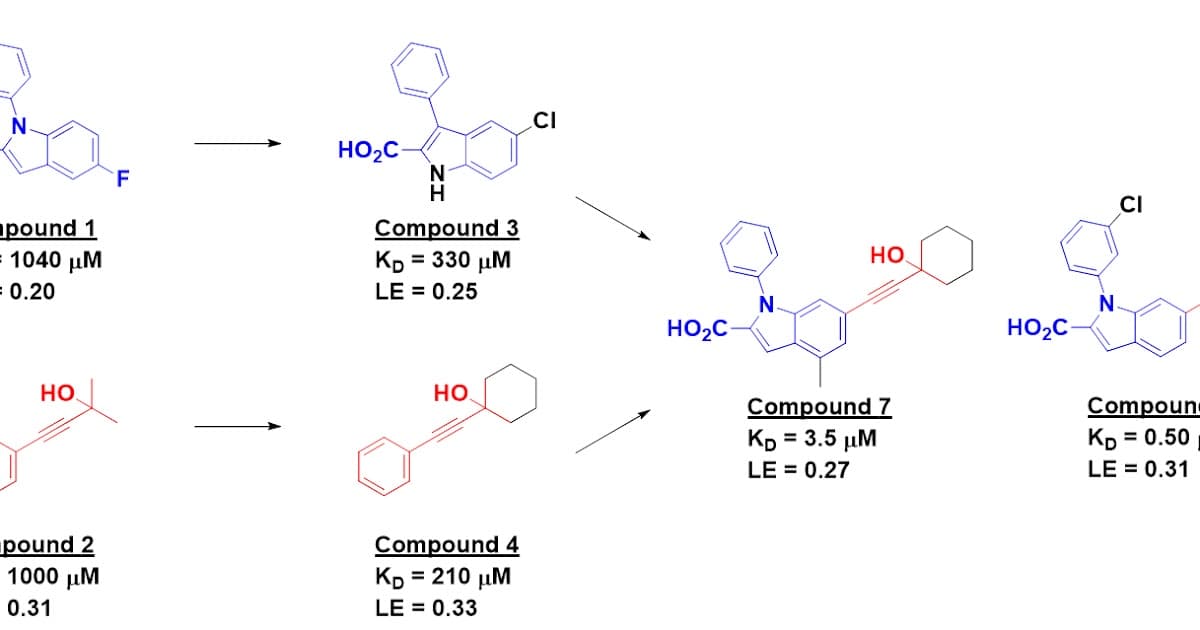
Fragment Merging – and Flipping – on the Leucine Zipper of MITF
Researchers at Novartis used 19F NMR to screen the DNA‑binding domain of the microphthalmia‑associated transcription factor (MITF), a leucine‑zipper protein implicated in melanoma. Only nine fragments emerged from the LEF4000 library, reflecting the target’s difficulty. Two series were merged, yielding...
By Practical Fragments

News•Jan 19, 2026
How Best to Assess Molecular Shapeliness?
The recent open‑access Drug Discovery Today paper evaluates three common metrics for quantifying molecular three‑dimensionality: fraction of sp3‑hybridized carbons (FCsp3), plane of best fit (PBF), and principal moments of inertia (PMI) expressed as ΣNPR. An analysis of half a million...
By Practical Fragments
News•Dec 29, 2025
Review of 2025 Reviews
The Practical Fragments blog celebrated its thousandth post in 2025, highlighting a decade of fragment‑based drug discovery (FBDD) milestones. Key reviews covered fragment‑to‑lead successes, the rise of covalent fragments, AI‑driven cryptic pocket discovery, and extensive bibliometric analysis showing steady global...
By Practical Fragments

News•Dec 15, 2025
GAS41 Revisited: A Chemical Probe
Researchers at the University of Michigan have refined a fragment‑based series into DLG‑41, a monomeric chemical probe targeting the YEATS domain of GAS41. The probe exhibits ~1 µM affinity by ITC and nanomolar potency in a NanoBRET cellular assay, confirming both...
By Practical Fragments