
News•Mar 10, 2026
Here’s Why Early F/A-18 Pilots Routinely Lost 1v1 Dogfight Against an F-14
The F/A‑18 Hornet proved its strike capability in Desert Storm, shooting down MiG‑21s and surviving surface‑to‑air hits, yet early Navy pilots struggled in air‑to‑air combat. Most of those pilots transitioned from A‑7 attack aircraft and were taught to view the Hornet as a bomber rather than a fighter. This doctrinal mismatch led to routine 1v1 losses against the superior F‑14 Tomcat in the late 1980s and early 1990s. Marine Hornet squadrons, inheriting a fighter mindset from the F‑4, performed better in dual‑role missions.
By The Aviation Geek Club

News•Mar 9, 2026
Sikorsky Ramps Up Production of S-92A+, Latest Variant of Its Flagship Helicopter
Sikorsky announced the start of its first production batch of the S‑92A+ helicopter, the newest iteration of its heavy‑lift platform. The company will assemble five aircraft – two for a newly‑added head‑of‑state customer and three additional units – while maintaining...
By The Aviation Geek Club

News•Mar 8, 2026
More than 5 Hours Above Mach 3.0: SR-71 Pilot Recalls 11.13 Hours Mission During the Yom Kippur War
On October 13, 1973, SR‑71 pilots Jim Shelton and Gary Coleman completed an 11.13‑hour sortie from Griffiss AFB, flying over five hours above Mach 3.0 and refueling six times to gather critical photo intelligence over the Yom Kippur War theater. The...
By The Aviation Geek Club

News•Mar 7, 2026
Rare Boeing 747 (Operated by IRIAF) Cargo Aircraft Targeted and Destroyed at Mehrabad Airport
A U.S. and Israeli strike on March 7 destroyed the Islamic Republic of Iran Air Force's rare Boeing 747 cargo aircraft at Tehran's Mehrabad Airport. The aircraft, a modified 747‑100 used for long‑range logistics and previously spotted delivering military supplies...
By The Aviation Geek Club
News•Mar 5, 2026
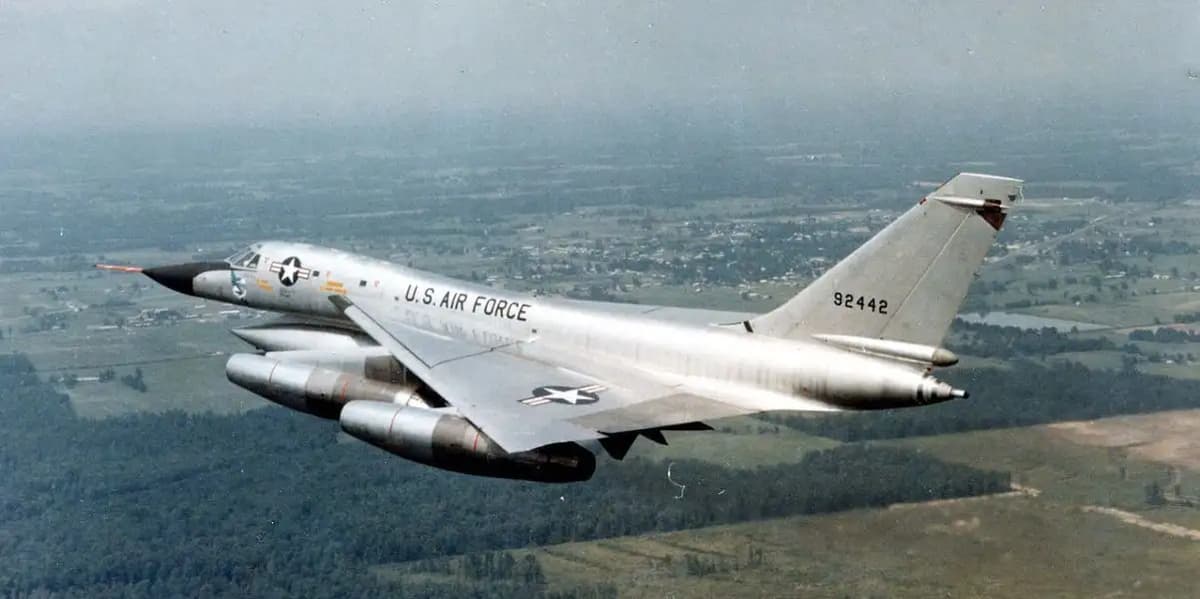
B-58 Navigator Recalls Dropping Mark-53 Nuclear Bomb (without Plutonium Pit) While Flying at 500 Feet and at 628 Knots, Dinner...
Colonel Richard “Butch” Sheffield recounts his B‑58 Hustler service, highlighting ultra‑low‑level, supersonic training at 500 feet and 628 knots and a secret reconnaissance role kept from adversaries. He describes the Dual Exhaust program where his crew dropped a Mark‑53 nuclear bomb without...
By The Aviation Geek Club

News•Mar 2, 2026
The Man Who Bought All the Spare B-2 Windshields and Used Them in His Daughter’s Tree House. USAF Had to...
The U.S. Air Force discovered that its only spare B‑2 Spirit stealth bomber windshields had been sold as surplus to a private individual. After a goose strike caused a hairline crack, the squadron had to locate the owner and buy...
By The Aviation Geek Club

News•Mar 1, 2026
The RF-4C Crew Chief Who Stole Parts From an F-4 to Get His Aircraft Airborne After It Developed a Fuel...
The RF‑4C tactical reconnaissance aircraft entered service in 1964, with 499 units built for the USAF. During the 1965 deployment to Vietnam, crew chief SSgt Edgar M. Mays faced a fuel‑system failure that would have grounded the aircraft for weeks....
By The Aviation Geek Club

News•Mar 1, 2026
NASA F-15 Completes First Flight of Laminar Flow Scaled Wing Design
NASA successfully completed the first flight of its 40‑inch Crossflow Attenuated Natural Laminar Flow (CATNLF) wing model mounted on an F‑15B research jet at Armstrong Flight Research Center. The 75‑minute sortie demonstrated safe maneuverability with the wing attached and captured...
By The Aviation Geek Club

News•Feb 23, 2026
The F-14 Pilot Grounded After Leaving an EA-6B Unescorted to Strafe an Iraqi Ground Target During Desert Storm
During Operation Desert Storm, F‑14 Tomcats struggled to engage Iraqi aircraft because older A/B models lacked modern IFF and relied heavily on AWACS. Frustrated pilots turned to ground‑attack missions, and one VF‑14 crew abandoned an EA‑6B Prowler escort to strafe...
By The Aviation Geek Club

News•Feb 20, 2026
A-4 Pilot Recalls when His Skyhawk Cabin Pressurization Failed at 40000 + Feet During a Test Flight
A Navy A‑4 Skyhawk maintenance test pilot climbed above 40,000 feet to verify the aircraft’s pressure‑breathing cabin system. During the test the pressurization failed, causing a sudden influx of pure liquid oxygen, cockpit flooding and even a watch explosion. The pilot...
By The Aviation Geek Club

News•Feb 20, 2026
Navy Declares IOC for SDB II on Super Hornet
The U.S. Navy has declared initial operational capability for the GBU‑53/B Small Diameter Bomb II on its F/A‑18E/F Super Hornet, completing a transition that began with limited use in 2025. The StormBreaker’s tri‑mode seeker—infrared, millimeter‑wave radar and semi‑active laser—enables all‑weather,...
By The Aviation Geek Club

News•Feb 18, 2026
The F-117 Test Pilot Who Successfully Landed His Nighthawk After Its Nose Wheel Fell Off upon Take Off
In January 1982, Lockheed test pilot Tom Morgenfeld experienced a nose‑wheel loss moments after taking off the third YF‑117A prototype from Area 51. Rather than eject, he continued the flight, burned off fuel, and used the aircraft’s drag chute to execute...
By The Aviation Geek Club

News•Feb 17, 2026
The F-15E Crew that Pulled 10.5g to Evade Iraqi SAMs and Other Operation Desert Storm Eagle’s Tales
During Operation Desert Storm, F‑15E Strike Eagle crews faced intense Iraqi SAM fire, with some missions encountering up to 17 SA‑2 and SA‑3 missiles. To survive, pilots jettisoned fuel tanks, expelled most of their chaff, and performed extreme evasive maneuvers...
By The Aviation Geek Club

News•Feb 15, 2026
B-58 Navigator Recalls Nose-High Stall During Night Training Mach 2 Bomb Run over Dallas. His Hustler Pilot Turned in His...
Richard “Butch” Sheffield, a B‑58 Hustler navigator, recounts a night Mach‑2 training run over Dallas that ended in a nose‑high stall when the altitude‑hold was left on. The stall caused a loss of power, autopilot lock‑out, and a rapid descent,...
By The Aviation Geek Club

News•Feb 13, 2026
The Bristol Beaufighter TF.X: The Definitive WWII Torpedo-Fighter Variant of the British “Torbeau”
In 1941 RAF Coastal Command introduced the Bristol Beaufighter TF.X, the definitive torpedo‑fighter derived from the Beaufort bomber’s wing and tail assemblies. The TF.X replaced the interim Mk VIC “Torbeau” with 60 conversions and featured the low‑level Hercules XVII engines, a torpedo...
By The Aviation Geek Club