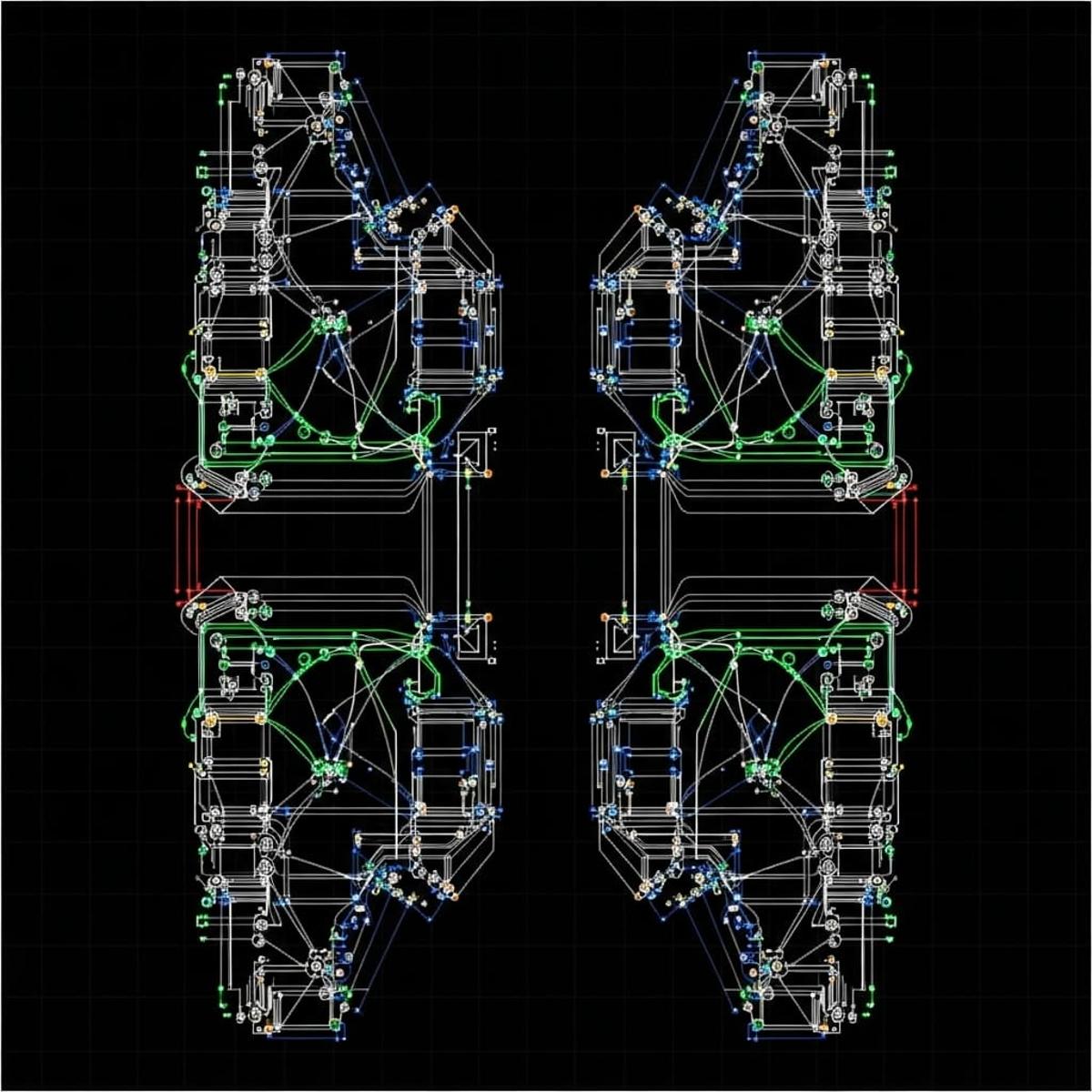
Achieves Four-State Fault-Tolerant Preparation for Steane-Type Quantum Circuits
•January 22, 2026
0
Why It Matters
Reducing ancilla overhead and automating circuit synthesis accelerates practical fault‑tolerant quantum computing, lowering hardware demands for near‑term devices.
Key Takeaways
- •Automated synthesis works for arbitrary CSS codes.
- •Constant ancilla overhead achievable, as low as four states.
- •Simulations up to distance‑seven show strict fault tolerance.
- •Parallel CNOT copying reduces depth and error propagation.
- •Open‑source toolkit released for circuit generation.
Pulse Analysis
Fault‑tolerant state preparation has long been a bottleneck for scalable quantum error correction, especially in Steane‑type protocols that rely on high‑fidelity ancilla qubits. Traditional techniques depend on exploiting extensive symmetry in codes such as the Golay code, which limits applicability and inflates resource requirements. By decoupling circuit design from code symmetry, the new methodology broadens the range of usable CSS codes and paves the way for more flexible quantum architectures, addressing a critical gap between theoretical error‑correction thresholds and experimental capabilities.
The core of the breakthrough lies in an automated synthesis engine that constructs multiple CNOT‑based encoding circuits with distinct fault‑propagation profiles. These circuits are executed in parallel, copying potential errors onto auxiliary ancillae via transversal CNOT gates, then detecting them through measurement. This strategy enables a repeat‑until‑success protocol that can operate with a constant number of ancilla states—four in the optimal case—dramatically reducing both depth and qubit overhead. Flag qubits are integrated directly into the encoding stage, further curbing error amplification without the need for high‑weight stabiliser checks.
Beyond the immediate performance gains, the authors released an open‑source toolkit that automates circuit generation, fault‑set analysis, and simulation under realistic noise models. This resource lowers the entry barrier for experimental groups working with trapped‑ion or neutral‑atom platforms, where gate parallelism can be exploited. While constructing large fault sets for higher‑distance codes remains a scalability challenge, the demonstrated constant‑overhead approach signals a viable path toward near‑term demonstrations of fault‑tolerant quantum computation and informs future compiler designs for quantum programming languages.
Achieves Four-State Fault-Tolerant Preparation for Steane-type Quantum Circuits
0
Comments
Want to join the conversation?
Loading comments...